Math Problems That Went Viral Online
Social media turns everything into an argument. Political debates, sports opinions, and apparently simple arithmetic.
Math problems that should have one clear answer somehow generate thousands of comments with people insisting different solutions are correct. These viral problems spread because they look simple but contain ambiguities, rely on rules people half-remember from school, or trigger debates about mathematical conventions.
The 8 ÷ 2(2+2) Debate

This problem broke the internet multiple times. People argued whether the answer was 1 or 16.
Both sides were absolutely certain they were right and everyone else was an idiot. The problem comes down to how you interpret implied multiplication.
If you follow the strict order of operations, you solve the parentheses first to get 8 ÷ 2(4), then divide 8 by 2 to get 4, then multiply by 4 to get 16. But some people treat the 2(4) as a single term that should be resolved before division, which gives you 8 ÷ 8 equals 1.
Different calculators give different answers depending on how they’re programmed. The problem is intentionally ambiguous, designed to generate arguments.
How Many Triangles Are in This Image

Someone draws a complex geometric pattern and asks how many triangles you can find. The images typically have overlapping shapes that create dozens of triangles of different sizes.
People start counting and get different totals. The problem is harder than it looks because you need to count small triangles, medium triangles formed by combining smaller ones, and large triangles that encompass the whole design.
Missing even one combination throws off your count. Comment sections fill with people insisting the answer is 18, or 24, or 37. Nobody agrees, and the original poster usually never confirms which answer is correct.
The Horse Math Problem

A viral problem asked: You buy a horse for $10, sell it for $20, buy it back for $30, then sell it again for $40. How much profit did you make? The problem seems straightforward but it generated a massive debate.
The correct answer is $20 profit. You spent $40 total and made $60 total.
But people got confused by the back-and-forth transactions and convinced themselves the answer was $0, $10, or some other number. The problem tests whether you can track multiple transactions or get distracted by the intermediate steps.
Missing Dollar Riddle

Three people split a hotel room that costs $30, paying $10 each. The clerk realizes the room should cost $25 and sends a bellhop with $5 to return.
The bellhop keeps $2 and gives each person $1 back. Now each person paid $9, totaling $27. The bellhop has $2. That’s $29. Where’s the missing dollar?
This problem went viral because it seemed like money vanished. The trick is that you shouldn’t add the $27 and $2.
Each person paid $9 times three equals $27. The hotel has $25, and the bellhop has $2. No dollar is missing.
The problem deliberately misdirects you into adding numbers that shouldn’t be added.
The Birthday Probability Problem

How many people do you need in a room before there’s a 50 percent chance two share a birthday? Most people guess way too high.
The answer is just 23 people, which feels impossibly low. The math works because you’re not looking for a specific birthday match.
You’re looking for any two people to match. With 23 people, there are 253 possible pairs. Each pair has a chance of matching.
When you calculate all the probabilities, you hit 50 percent around 23 people. The counterintuitive result made this problem go viral, with people refusing to believe the math even after seeing the explanation.
The Monty Hall Problem
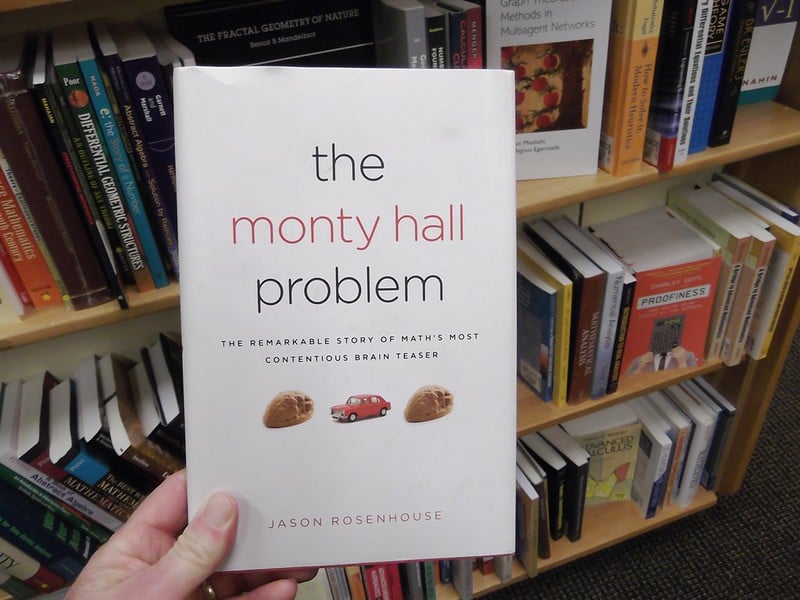
You’re on a game show with three doors. Behind one is a car, behind the others are goats. You pick a door.
The host, who knows where the car is, opens a different door revealing a goat. He offers you a chance to switch your choice. Should you switch?
The correct answer is yes, switching doubles your chances of winning. Your initial choice had a one-third chance of being right.
The host’s action gives you information that makes switching a two-thirds probability. This problem famously caused arguments even among mathematicians.
When it went viral online, thousands of people insisted that switching made no difference, even after seeing multiple explanations of why it does.
The Lily Pad Problem

Lily pads double every day in a pond. If the pond is fully covered on day 48, on what day was it half covered? People confidently answer day 24. Wrong again.
The answer is day 47. If the pond doubles from half full to completely full in one day, it must have been half full the day before it was completely full.
The problem catches people because they assume linear growth when the problem explicitly states exponential doubling. Viral posts featuring this problem collected thousands of incorrect answers from people who didn’t read carefully.
The Squares Counting Problem

Similar to the triangle problem, someone posts a grid and asks how many squares you can find. A 4×4 grid might seem to have 16 squares. Actually, it has 30.
You need to count all the different sized squares, including the one large square encompassing the whole grid. People systematically miss the larger squares or double-count.
Comment sections become competitions to see who can find the highest total. Different people arrive at different numbers, all convinced they’re right.
The problem works because it’s tedious to count carefully and easy to make mistakes.
The Rope Around Earth Problem

Imagine a rope wrapped tightly around Earth’s equator. You add 10 feet to the rope’s length. How much higher off the ground would the rope now sit if you distributed the extra length evenly? People guess fractions of an inch.
The actual answer is about 1.6 feet. The math is the same regardless of the circle’s size.
Add 10 feet to the circumference of any circle, and the radius increases by about 1.6 feet. People’s intuition fails because Earth is huge and 10 feet seems insignificant in comparison.
When this problem went viral, the correct answer shocked people who couldn’t believe the size of the original circle didn’t matter.
The Handshake Problem

At a party with 10 people, everyone shakes hands with everyone else exactly once. How many handshakes happen? People start calculating and get confused.
The answer is 45 handshakes. The formula is n(n-1)/2 where n is the number of people.
The first person shakes 9 hands, the second person shakes 8 new hands since they already shook with the first person, and so on. Adding 9+8+7+6+5+4+3+2+1 gives you 45.
The problem trips people up when they try to track who shook whose hand instead of using the formula.
The Two Trains Problem

Two trains are 100 miles apart traveling toward each other at 50 mph each. A bird flies back and forth between them at 75 mph. How far does the bird fly before the trains meet? The problem seems complicated.
The answer is simple. The trains meet in one hour since they’re each traveling 50 mph toward each other. The bird flies at 75 mph for one hour.
The bird flies 75 miles. People get distracted calculating how far the bird flies on each leg of the trip, but that’s unnecessary. The problem went viral because the simple solution feels like cheating.
The Hundred Prisoners Problem

This problem is too complex to fully explain, but it involves 100 prisoners and 100 boxes. Each prisoner needs to find their number by opening 50 boxes.
If all prisoners find their numbers, everyone goes free. If one fails, everyone dies. The prisoners can strategize before starting but can’t communicate once it begins.
The intuitive answer is that their chances are essentially zero. Actually, there’s a strategy that gives them about a 31 percent chance of success.
The solution involves cycle theory and probability that most people don’t understand. When explained, it seems like magic. The problem went viral among math enthusiasts who enjoyed watching others struggle with the counterintuitive answer.
The Cheryl’s Birthday Problem

This problem from a Singapore math test went viral worldwide. Albert and Bernard just met Cheryl, who gave them a list of 10 possible birthdays.
Cheryl tells Albert only the month and Bernard only the day. Through a series of logical statements, you’re supposed to figure out Cheryl’s birthday.
The problem requires careful logical deduction. Both Albert and Bernard make statements about what they know and what the other person knows.
Most people can’t follow the chain of reasoning without writing it out step by step. The problem became famous because it seemed impossibly hard for a middle school test, though it was actually from a math competition for advanced students.
Why Simple Math Breaks the Internet

People stick with these puzzles online since solving gives a confidence boost, while being corrected sparks pushback. What makes certain math challenges spread fast often comes down to three traits.
Simple appearance invites everyone in – no expertise needed upfront. A hidden twist catches solvers off guard, despite first impressions. Clear outcomes settle debates, leaving little room for compromise once revealed.
Screens light up fast when someone says they know the truth. It spreads quickly, not quietly.
A single post claims certainty – loud, bold, no pause. Others jump in, eyes locked on pixels, ready to fight for their number.
Solving turns into showdowns, played out where anyone can watch. Mistakes get magnified, guesses treated like gospel.
One voice sparks dozens, each louder than the last. Thinking slows down but typing never does. Numbers become battles. Quiet doubt stands no chance.
What matters shifts from numbers to who wins the argument online. Solving it quietly fades once people start caring more about proving a point. Being correct in public now outweighs working through the idea itself. Attention sticks to reputation, not reasoning. The original puzzle gets lost under layers of debate. Winning feels heavier than understanding ever did.
More from Go2Tutors!

- The Romanov Crown Jewels and Their Tragic Fate
- 13 Historical Mysteries That Science Still Can’t Solve
- Famous Hoaxes That Fooled the World for Years
- 15 Child Stars with Tragic Adult Lives
- 16 Famous Jewelry Pieces in History
Like Go2Tutors’s content? Follow us on MSN.



