Math Symbols And What They Mean
Math uses its own language of symbols. Some you learned so young you forgot there was ever a time you didn’t know them.
Others show up in advanced classes and make you wonder who decided a backwards 3 should represent anything. Understanding these symbols means understanding the shorthand mathematicians developed over centuries to express ideas clearly.
Plus Sign (+)

The plus sign means addition, combining things together. Three apples plus two apples gives you five apples.
The symbol appeared in print around 1489, though people had been adding things long before that. The same symbol also indicates positive numbers in algebra.
When you see +5, that’s positive five, five units above zero. The plus sign has become so universal that it shows up everywhere from medical symbols to video game controllers.
Minus Sign (−)

Subtraction takes away. Seven minus three leaves four.
The minus sign looks like a small horizontal line, and it also doubles as the negative number indicator. Negative five (−5) sits five units below zero on the number line.
The symbol represents more than just taking away physical objects. It indicates direction, debt, temperature below freezing.
Mathematicians treat negative numbers as real quantities now, but that took centuries. Ancient Greeks rejected the idea of numbers less than zero.
Multiplication Sign (× or ·)
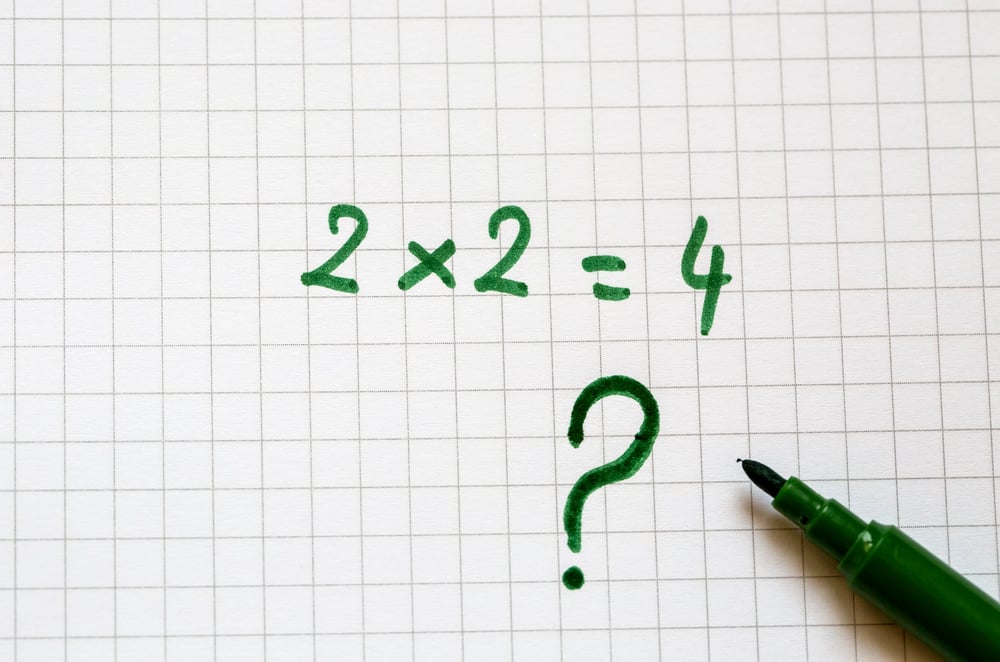
Multiplication means repeated addition. Three times four equals adding three to itself four times: 3 + 3 + 3 + 3 = 12.
The × symbol works fine in elementary school, but causes confusion in algebra where x represents a variable. That’s why mathematicians use alternatives.
A centered dot (·) works: 3 · 4 = 12. Sometimes numbers just sit next to each other: 3(4) or 3x means three times four or three times x.
The parentheses or the variable tells you multiplication is happening.
Division Sign (÷ or /)

Division splits things into equal groups. Twelve divided by three equals four.
The ÷ symbol appeared in the 1600s, but the forward slash (/) has largely replaced it. You’ll see 12/3 more often than 12÷3, especially as math gets more advanced.
Division also shows up as fractions. The fraction 12/3 and the division problem 12÷3 mean exactly the same thing.
The horizontal fraction bar is just another way to show division, one that makes more sense when you’re working with complex expressions.
Equals Sign (=)

Robert Recorde invented this symbol in 1557, choosing two parallel lines because “no two things can be more equal.” The equals sign shows that both sides have the same value. If 2 + 2 = 4, then you can swap those expressions freely.
Wherever you see 4, you could write 2 + 2 instead. The equals sign anchors algebra.
Equations are statements of equality. Solving an equation means finding what value makes both sides equal.
That simple pair of lines represents one of the most powerful concepts in mathematics: equivalence.
Less Than and Greater Than (< and >)

These symbols compare values. The small end points to the smaller number. 3 < 7 reads as “three is less than seven.”
Flip it around and 7 > 3 means “seven is greater than three.” You can remember which is which by thinking of the symbols as hungry alligator mouths.
The mouth always opens toward the bigger number because it wants to eat the larger meal. Adding a line underneath creates “less than or equal to” (≤) and “greater than or equal to” (≥).
Square Root (√)

The square root symbol asks what number multiplied by itself gives you the number under the symbol. The square root of 16 is 4 because 4 × 4 = 16. The symbol looks like a check mark with a horizontal bar extending right.
Mathematicians in medieval times wrote out “radix” (Latin for root) before they started using symbols. The √ symbol evolved from a stylized letter r.
Square roots connect to geometry—the square root of a square’s area gives you the length of its sides.
Pi (π)

This Greek letter represents the ratio of a circle’s circumference to its diameter. No matter how big or small the circle, divide the distance around it by the distance across it and you get approximately 3.14159.
The digits continue forever without repeating. William Jones introduced π as a symbol for this ratio in 1706.
Leonhard Euler popularized it. Before calculators and computers, people memorized dozens of digits.
Some still do. The current record exceeds 70,000 digits, which serves no practical purpose but shows what human memory can achieve.
Infinity (∞)

John Wallis introduced this symbol in 1655 to represent something without end. Infinity isn’t a number you can reach by counting. It’s a concept describing endlessness.
The set of positive integers goes on forever—there’s no largest integer because you can always add one more. The symbol looks like a sideways figure eight. Some interpret it as a closed loop with no beginning or end.
In calculus, limits approach infinity. In set theory, different sizes of infinity exist, which sounds contradictory but follows from the logic of infinite sets.
Factorial (!)

The exclamation mark in math means something different than in English. The factorial of a number is that number multiplied by every positive integer below it. So 5! = 5 × 4 × 3 × 2 × 1 = 120.
Factorials grow absurdly fast. 10! equals 3,628,800. By 20!, you’re dealing with numbers in the quintillions.
Factorials show up in probability calculations, especially when figuring out how many ways you can arrange things. The number of ways to arrange five books on a shelf equals 5!.
Summation (∑)

This capital Greek letter sigma tells you to add up a series of numbers. The notation includes start and end points plus a formula.
It’s shorthand for “add these things up according to this pattern.” Instead of writing 1 + 2 + 3 + 4 + 5 + 6 + 7 + 8 + 9 + 10, you can use summation notation to express it compactly.
The symbol saves space and makes patterns clearer when you’re adding hundreds or thousands of terms.
Integral (∫)

The integral symbol, a stretched-out S, comes from calculus. It represents adding up infinite tiny pieces. When you integrate a function, you’re finding the area under its curve.
Gottfried Leibniz developed this notation in the 1670s. The elongated S stands for “sum” because integration is a sophisticated addition.
Instead of adding discrete numbers like 1 + 2 + 3, integration adds continuous quantities. The concept powers physics, engineering, and economics by letting you calculate totals when dealing with constantly changing rates.
Delta (Δ)

This Greek letter indicates change. In physics, Δt means “change in time.” In math, Δx represents how much x changes.
The symbol appears in equations showing relationships between changing quantities. Uppercase delta (Δ) shows finite change—the difference between two specific values.
Lowercase delta (δ) sometimes indicates very small changes. Scientists and engineers use delta constantly because most real-world problems involve things that change rather than stay fixed.
Approximately Equal (≈)

Two wavy lines stacked horizontally mean “approximately equal to.” Use this when values are close but not exactly the same.
Pi approximately equals 3.14 (π ≈ 3.14), though the real value continues with infinite decimals. This symbol acknowledges that perfect precision isn’t always possible or necessary.
Engineers use approximations constantly. Your calculator might show 2.5, but the actual value could be 2.50000000001.
The approximately equal symbol indicates you’re working with rounded numbers or estimates.
Absolute Value (| |)
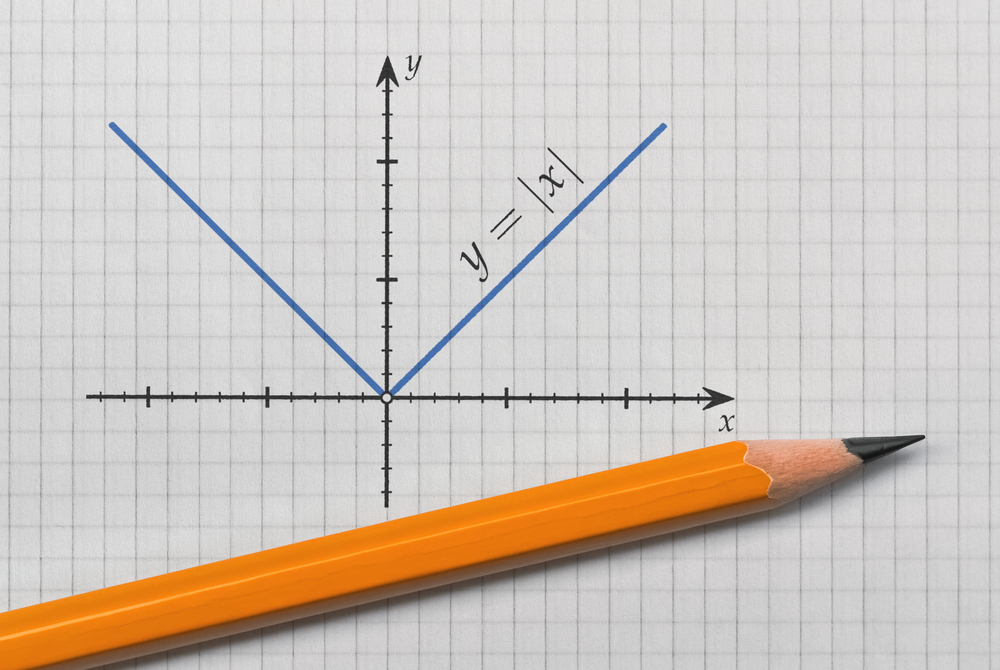
A vertical bar on each side of a number shows its absolute value – how far it is from zero, no matter which way. Even if the number’s negative, like −5, it still sits five units away.
Take away the minus, keep the size – that’s what the bars do. So |5| is just 5, same as |−5|.
Size counts if direction doesn’t matter. Whether it is warmed up or cooled down, going from 70° to 65° means a gap of 5°.
No such thing as negative distance – it’s never less than zero. Math uses absolute value to show this kind of measure.
The Alphabet of Numbers

These signs make up a way of talking clearer than speech. Every mark stands for a thought people spent centuries grasping.
Things like minus values, endlessness, rough estimates – ideas we take for granted today used to stir big arguments among the sharpest minds around. Learning math signs can seem like recalling meaningless scribbles.
Yet every mark came about when thinkers hit a wall. Because they had to record ideas on shapes, links, or amounts.
These aren’t picked by chance. Over time, trial and error shaped them – slowly sharpened into precise forms.
That messy cluster of notation? It’s compressed insight from minds across history.
A shared code functioning identically whether you’re in Tokyo, Lisbon, or Nairobi.
More from Go2Tutors!

- The Romanov Crown Jewels and Their Tragic Fate
- 13 Historical Mysteries That Science Still Can’t Solve
- Famous Hoaxes That Fooled the World for Years
- 15 Child Stars with Tragic Adult Lives
- 16 Famous Jewelry Pieces in History
Like Go2Tutors’s content? Follow us on MSN.



