Most Complex Mathematical Equations Ever Solved
Mathematics has always pushed the boundaries of human understanding, but some equations stand as monuments to intellectual achievement. These aren’t just problems that kept mathematicians busy for a few months—these are the equations that consumed centuries, launched entire fields of study, and fundamentally changed how we see reality itself.
Each represents a moment when pure thought conquered what seemed impossible.
Fermat’s Last Theorem
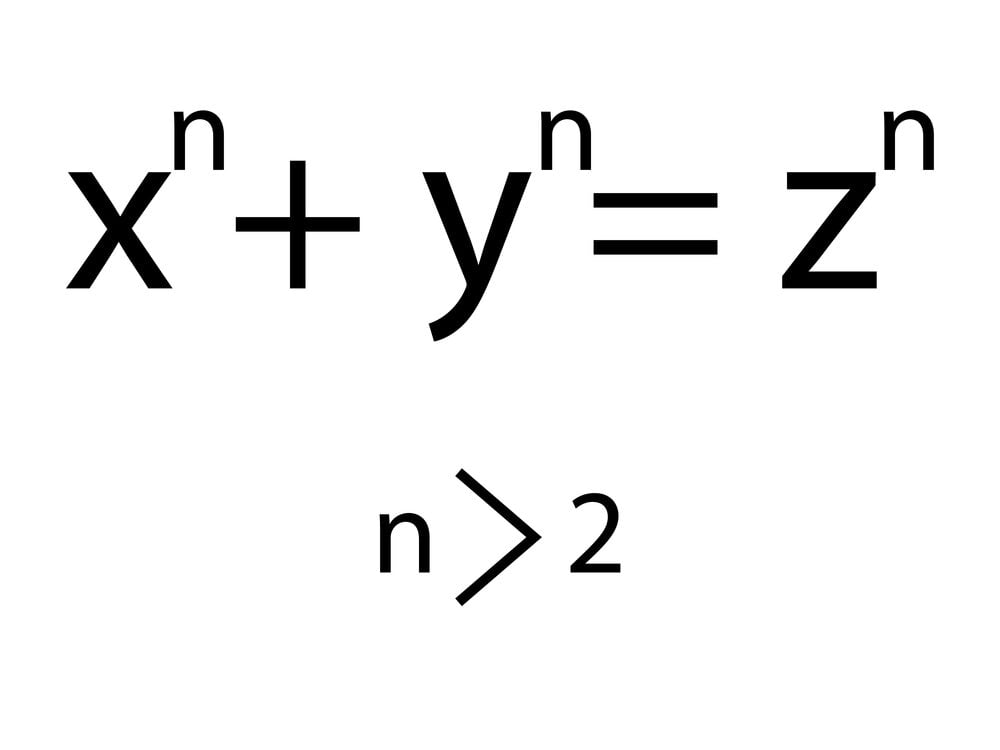
No solution exists. That’s what Pierre de Fermat claimed in 1637 about the equation x^n + y^n = z^n for integer values greater than 2.
He scribbled a note in his copy of an ancient Greek text, saying he had a proof but the margin was too narrow to contain it.
For 358 years, mathematicians tried to prove him right. The equation became mathematical legend—simple enough for a high school student to understand, impossible enough to defeat the greatest minds in history.
Andrew Wiles finally cracked it in 1995 using techniques that didn’t exist in Fermat’s time. Whatever proof Fermat thought he had, it wasn’t this one.
The Navier-Stokes Equations
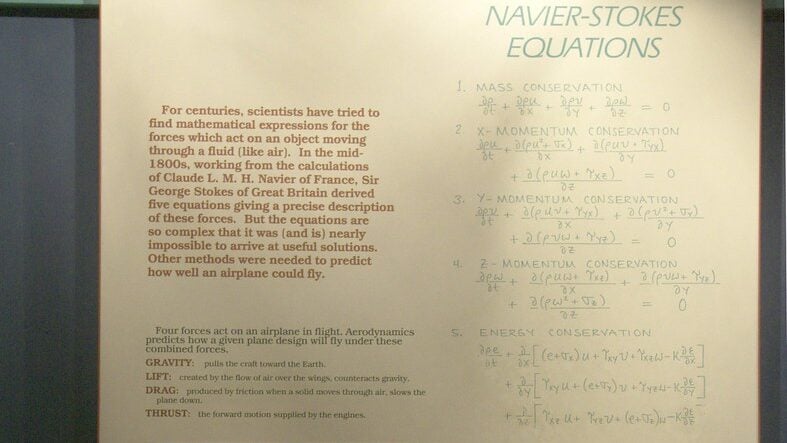
Water flowing through a pipe sounds simple until you try to describe it mathematically. The Navier-Stokes equations govern fluid motion, and they’re so complex that proving whether smooth solutions always exist is worth a million dollars from the Clay Mathematics Institute.
These partial differential equations capture something fundamental about how liquids and gases behave. Weather prediction, airplane design, blood flow through arteries—all depend on solutions to these equations.
The mathematics behind your morning coffee is still partially unsolved.
Schrödinger’s Equation
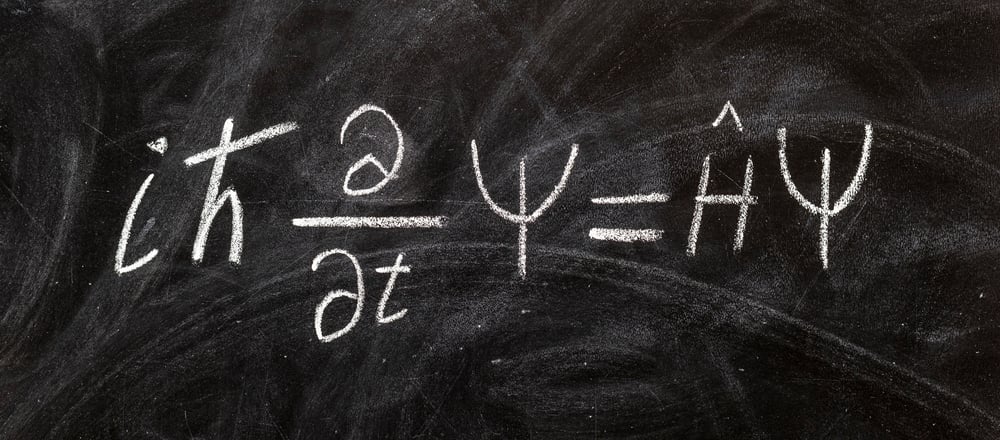
Quantum mechanics demanded a new kind of mathematics, and Erwin Schrödinger delivered it in 1926 with an equation that describes how quantum systems evolve over time (though the word “time” itself gets complicated when particles exist in multiple states simultaneously, which is precisely the kind of conceptual knot that makes quantum mechanics feel more like philosophy than physics until you sit down with the actual mathematical machinery). The equation looks deceptively straightforward: iℏ∂ψ/∂t = Ĥψ.
Clean, almost elegant.
But that ψ (psi) represents the wave function—a mathematical object that contains all possible information about a quantum system, and when you start working with systems that have multiple particles, the mathematics explodes into dimensions that have no physical analogue. So the equation that governs everything from electron behavior to the fundamental forces becomes this sprawling, multidimensional beast that requires mathematical techniques most people never encounter: Hilbert spaces, operator theory, functional analysis.
And here’s where it gets strange—the equation is perfectly deterministic, yet it describes a fundamentally probabilistic reality. The mathematics tells you exactly how the wave function evolves, but the wave function itself only gives you probabilities about what you might measure.
The equation works flawlessly; understanding what it means about the nature of reality is another problem entirely.
Einstein’s Field Equations

Gravity isn’t a force—it’s geometry. That insight led Einstein to field equations that describe how mass and energy warp spacetime itself.
The mathematics reads like poetry if you speak tensor calculus: Gμν + Λgμν = 8πTμν.
Each symbol represents layers of complexity that took Einstein years to work through. The left side describes the curvature of spacetime, the right side describes matter and energy.
The equation says they’re equal, which means massive objects literally bend the fabric of reality. The great abyss, GPS satellites, and the expansion of the universe all emerge from solutions to these equations.
The mathematics of curved space predicted phenomena that weren’t observed until decades later.
The Yang-Mills Equations
Particle physics needed mathematics that could handle symmetries—the idea that certain transformations leave physical laws unchanged. Yang-Mills theory provided that framework in 1954, describing how gauge fields interact with matter particles.
The equations themselves involve non-Abelian gauge theory, fiber bundles, and differential geometry that makes most advanced mathematics look elementary. These aren’t just equations; they’re the mathematical foundation of the Standard Model of particle physics.
Every fundamental interaction except gravity gets described through Yang-Mills theory. The Strong Nuclear Force, the Weak Nuclear Force, electromagnetic interactions—all emerge from solutions to these equations.
The Riemann Hypothesis
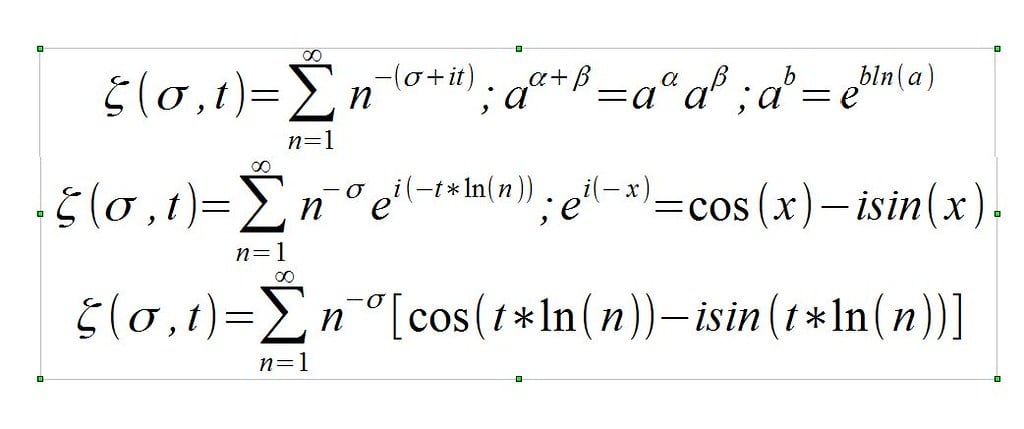
The distribution of prime numbers follows a pattern that Bernhard Riemann described in 1859 through the Riemann zeta function: ζ(s) = Σ(1/n^s). His hypothesis claims that all non-trivial zeros of this function have real part equal to 1/2.
This conjecture connects number theory to complex analysis in ways that still surprise mathematicians. The hypothesis has been verified for the first 10 trillion zeros, but a general proof remains elusive.
Prime number distribution, cryptography, and dozens of other mathematical results depend on the Riemann Hypothesis being true. It’s mathematics built on faith in a pattern that seems too elegant to be false.
The Millennium Prize Problems
Seven problems define the frontiers of mathematical knowledge (though the Poincaré conjecture has been solved, leaving six that continue to resist solution, each representing a fundamental gap in mathematical understanding that has persisted for decades or centuries). The Clay Mathematics Institute attached million-dollar prizes to each one, which sounds like a publicity stunt until you realize these problems have genuine implications for everything from computer science to theoretical physics.
The P versus NP problem asks whether every problem whose solution can be quickly verified can also be quickly solved—a question that would revolutionize computer science and cryptography if answered definitively. The Hodge conjecture deals with algebraic topology and complex geometry in ways that bridge pure mathematics and theoretical physics.
So these aren’t just abstract mathematical curiosities; they’re questions about the fundamental nature of computation, space, and mathematical truth itself. The prize money is almost irrelevant—solving any of these problems would reshape entire fields of study.
The Birch and Swinnerton-Dyer Conjecture

Elliptic curves over rational numbers connect algebraic geometry to number theory in ways that reveal deep patterns about rational solutions to polynomial equations. The BSD conjecture, formulated in the 1960s, relates the rank of an elliptic curve to the behavior of its L-function at a specific point.
The mathematics involves modular forms, complex analysis, and algebraic number theory. Proving this conjecture would unlock new understanding about Diophantine equations—problems about finding integer or rational solutions to polynomial equations.
The conjecture represents one of the most sophisticated attempts to connect different areas of mathematics through a single unifying principle.
The Hodge Conjecture

Algebraic geometry and topology intersect in complex ways when dealing with projective algebraic varieties. The Hodge conjecture proposes that certain topological cycles can be represented as algebraic cycles, bridging the gap between geometric intuition and algebraic rigor.
The mathematics requires knowledge of sheaf theory, cohomology, and complex manifolds. This isn’t just abstract theory—the conjecture addresses fundamental questions about how algebraic and topological properties relate to each other.
Solutions would impact everything from mirror symmetry in theoretical physics to practical applications in algebraic geometry.
Bessel Functions and Differential Equations
Solutions to Bessel’s differential equation appear throughout physics and engineering, describing phenomena from heat conduction to electromagnetic wave propagation. The equation x²y” + xy’ + (x² – n²)y = 0 generates functions that seem abstract but govern real-world behavior.
These functions emerge naturally when solving problems in cylindrical coordinates. Vibrating drumheads, planetary motion, signal processing—all involve Bessel functions as fundamental components.
The mathematics connects pure analysis to physical applications in ways that demonstrate the unexpected unity between abstract theory and practical problems.
The Monster Group
Group theory reaches its extreme in the Monster—a finite simple group with approximately 8 × 10^53 elements. The Monster’s existence was predicted before it was constructed, representing the largest of the sporadic groups in the classification of finite simple groups.
Understanding the Monster requires knowledge of character theory, representation theory, and connections to modular functions that surprised mathematicians. The group appears in string theory and algebraic geometry, suggesting deep connections between discrete mathematics and continuous structures.
Its construction and analysis required computational techniques that pushed the boundaries of both theoretical and computational mathematics.
The Atiyah-Singer Index Theorem
Differential geometry meets algebraic topology in the Index Theorem, which relates analytical properties of elliptic differential operators to topological properties of manifolds. The theorem connects the dimension of solution spaces to topological invariants in precise, calculable ways.
This result unified several areas of mathematics that had developed independently. K-theory, differential geometry, and algebraic topology converge in the theorem’s proof and applications.
The mathematics has implications for theoretical physics, particularly in understanding anomalies in quantum field theory and the geometric foundations of gauge theories.
The Langlands Program
Number theory and representation theory connect through a vast network of conjectures known as the Langlands Program. These conjectures propose deep relationships between Galois groups, automorphic forms, and L-functions that would unify large areas of mathematics.
The program involves harmonic analysis, algebraic number theory, and representation theory of p-adic groups. Proving the Langlands conjectures would establish connections between number theory and geometry that many consider the most ambitious unification project in modern mathematics.
Parts of the program have been proven, but the full scope remains an open challenge.
Where Mathematics Meets Mystery
These equations represent more than mathematical achievement—they’re humanity’s attempt to find order in complexity that seems beyond comprehension. Each solution opened new territories of understanding while revealing even deeper mysteries.
The mathematics that seemed impossibly abstract often becomes the foundation for technologies that reshape daily life.
The pattern continues: today’s unsolvable equation becomes tomorrow’s breakthrough, launching new fields and revealing connections that no one anticipated. Mathematics doesn’t just describe reality; it uncovers relationships between ideas that seem to exist independent of human thought, waiting to be discovered rather than invented.
More from Go2Tutors!

- The Romanov Crown Jewels and Their Tragic Fate
- 13 Historical Mysteries That Science Still Can’t Solve
- Famous Hoaxes That Fooled the World for Years
- 15 Child Stars with Tragic Adult Lives
- 16 Famous Jewelry Pieces in History
Like Go2Tutors’s content? Follow us on MSN.



