Most Expensive Guitars Played by Rock Legends
A guitar isn’t just held – it lives alongside the person playing, soaked through with long nights and unplanned riffs. Years pass.
The instrument shows up again, worn but speaking louder than its parts suggest. Not merely aged timber and wire, it carries weight from when it helped shift culture sideways.
Timing gives it presence. A single take in a studio, one live moment – these build stories people repeat like they were there.
What matters is how sound once moved through it. A few guitars pass a point when they’re no longer tools for playing, just pieces of the past.
Value rises not from richer tones, instead it comes from stages stood on, hands that gripped them tight. Guitars tied to famous players show how moments in music get saved, bought, passed along.
These objects hold stories far beyond notes struck long ago. Fresh strings hum on instruments where cost speaks just as loudly as the songs they shaped.
Jimi Hendrix

Jimi Hendrix’s guitars sit at the very top of rock history, and the instruments tied to his most iconic performances are among the most valuable ever sold. His white Fender Stratocaster, played during his legendary late-night performance at Woodstock in 1969, became permanently linked to a moment that redefined what electric guitar could do.
That instrument later sold for several million dollars, driven not by rarity alone, but by symbolism. Hendrix turned feedback, distortion, and controlled chaos into a language of its own on that stage.
The guitar became a visual shorthand for creative freedom and rebellion. Its value reflects how completely one performance can fuse an artist and an instrument into a single cultural memory.
Eric Clapton

Eric Clapton’s ‘Blackie’ Stratocaster holds a different kind of significance. Rather than a single showpiece, Blackie was assembled from parts of several vintage guitars and became Clapton’s primary instrument throughout the 1970s.
It was played on countless recordings and tours, quietly shaping the sound of an era. When Blackie went to auction, it sold for several million dollars, with proceeds directed toward charity.
Its value came from longevity rather than spectacle. Fans recognised it as a working guitar, worn down through years of use rather than preserved for display.
That authenticity elevated its status, turning visible wear into proof of history rather than damage.
David Gilmour

David Gilmour’s ‘Black Strat’ represents one of the most documented guitars in rock history. Used extensively throughout Pink Floyd’s most influential years, it featured on recordings that defined progressive rock’s emotional and sonic range.
Subtle modifications over time made it uniquely his. When Gilmour auctioned the Black Strat, it achieved one of the highest prices ever paid for a guitar.
The instrument’s value rested on its association with carefully crafted soundscapes rather than raw aggression. Every adjustment and repair added to its narrative, making it a physical record of creative evolution. Collectors saw it not as memorabilia, but as a living archive of music-making.
Kurt Cobain

Kurt Cobain’s guitars occupy a unique space where cultural impact outweighs technical detail. His Fender Mustang, played during the filming of the ‘Smells Like Teen Spirit’ video, sold for a record-breaking sum that surprised even seasoned collectors.
The guitar itself was modest by design, reflecting Cobain’s preference for unpretentious instruments. That modesty is precisely what drove its value.
The Mustang symbolised a rejection of excess and polish, aligning perfectly with the music that reshaped alternative rock in the early 1990s. Its price reflects how a simple instrument can become priceless when tied to a generational shift in sound and attitude.
John Lennon
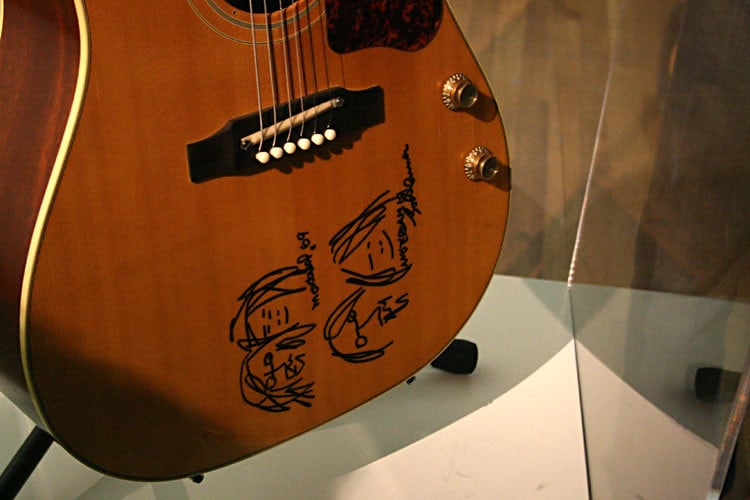
John Lennon’s Gibson J-160E acoustic-electric guitar stands as one of the most historically important instruments in popular music. Used extensively during the early years of The Beatles, it appeared on recordings that helped define modern songwriting and studio experimentation.
The guitar was lost for decades before resurfacing, a backstory that only increased its value when it eventually sold for millions. Its importance lies not in virtuosic playing, but in composition.
Lennon used it to write songs that became cultural landmarks, giving the instrument an enduring relevance that transcends performance alone.
George Harrison

George Harrison’s 1964 Gibson SG, used extensively during the mid-Beatles period, became one of the most expensive guitars linked to the band. It appeared during a transitional phase when studio experimentation began to reshape how rock albums were made.
That said, Harrison’s instrument gained value through subtlety rather than dominance. His playing style emphasized texture and melodic restraint, qualities that influenced generations of guitarists.
The guitar’s price reflects appreciation for nuance, rewarding an approach that valued atmosphere over spectacle.
Bob Dylan

Bob Dylan’s 1964 Fender Stratocaster, played at the Newport Folk Festival when he controversially went electric, represents a turning point in music history. That single performance altered expectations around genre boundaries and artistic autonomy.
When the Stratocaster went to auction, its value soared into the millions. Buyers were not purchasing tone or craftsmanship alone.
They were buying the physical symbol of a moment when an artist chose progress over approval. Few guitars are tied so clearly to a shift in cultural direction.
Jimmy Page

Jimmy Page’s guitars are closely associated with Led Zeppelin’s mythic status. His ‘Number One’ Les Paul, used on numerous recordings and tours, became synonymous with heavy, layered guitar sounds that influenced hard rock and metal.
The value of Page’s instruments reflects both rarity and influence. They represent a bridge between blues tradition and stadium-scale rock.
When such guitars surface in private sales or exhibitions, their worth reflects decades of reverence rather than short-term demand.
Why these guitars command such prices

The value of these instruments comes from a convergence of factors. Provenance matters, as documented use during key moments elevates even common models.
Condition plays a role, but visible wear often enhances rather than diminishes appeal when it tells a clear story. Still, the most important element is cultural memory.
These guitars were present when music shifted direction, when audiences heard something new for the first time. Their prices reflect how deeply those moments remain embedded in collective experience.
They function as physical links to events that shaped popular culture.
What their value says about music history
Priced skyward, these guitars show one way music’s past sticks around – inside wooden frames strung tight. Held by hands that sparked change, they hum with defiance even when silent.
Meaning outlasts sound, lingering like smoke after a fire dies down. Value hides where money can’t reach, buried in moments others felt something shift.
Later on, many of these instruments vanish, yet their histories grow deeper. Music isn’t simply listened to – fingers mold it, play after play slowly carving change.
Expensive ones? Not mere objects tucked away. Instead, they carry traces of touch, moments pressed into wood, proof that meaning can gain value over years.
More from Go2Tutors!

- The Romanov Crown Jewels and Their Tragic Fate
- 13 Historical Mysteries That Science Still Can’t Solve
- Famous Hoaxes That Fooled the World for Years
- 15 Child Stars with Tragic Adult Lives
- 16 Famous Jewelry Pieces in History
Like Go2Tutors’s content? Follow us on MSN.



