Oldest World Records in Sport That Nobody Has Broken Yet
Some records get broken every few years. Athletes get faster, stronger, better-coached, and the old marks fall. But then there are records that sit on the books decade after decade, quietly defying every attempt to erase them. Some date back to the 1940s. Others were set during an era when sports science barely existed. And yet, here they still are.
These are the records that make analysts scratch their heads and fans debate endlessly about whether they’ll ever fall.
Joe DiMaggio’s 56-Game Hitting Streak (1941)

Baseball has produced plenty of long-standing records, but this one stands apart. In the summer of 1941, Joe DiMaggio hit safely in 56 consecutive games for the New York Yankees — a run that stretched from May into July and captivated the entire country.
Nobody has come close since. The closest modern challenge came from Pete Rose, who reached 44 games in 1978.
That’s still 12 games short. In a sport where getting a hit in any single game is far from guaranteed, stringing together 56 in a row requires a combination of talent, timing, and fortune that simply hasn’t lined up for anyone in over 80 years.
Wilt Chamberlain’s 100-Point Game (1962)

On March 2, 1962, Wilt Chamberlain scored 100 points in a single NBA game for the Philadelphia Warriors against the New York Knicks. No photographer was in the arena.
No video footage exists. The only proof is a grainy image of Chamberlain holding a piece of paper with “100” written on it.
And yet no one has seriously threatened it since. Kobe Bryant’s 81-point game in 2006 is the second-highest total in NBA history — still 19 points behind.
The modern game, with its emphasis on pace and efficiency, has actually made a 100-point performance feel even more remote. Teams share the orb more.
Single players dominate possessions less. This record may be the most untouchable in all of professional basketball.
Secretariat’s Belmont Stakes Time (1973)

Horse racing records are unusual because they depend on the animal, not just the athlete. And Secretariat was unlike any animal that had come before.
In the 1973 Belmont Stakes, he won by 31 lengths in a time of 2:24 flat — a world record that still stands over 50 years later. What made it stranger was that Secretariat ran each successive quarter-mile faster than the last.
Horses typically slow down as a race progresses. Secretariat sped up.
Trainers, jockeys, and racing scientists have studied the tape for decades and still struggle to fully explain it.
Don Bradman’s Test Cricket Average (1948)

Sir Donald Bradman retired from Test cricket with a batting average of 99.94. The next highest in history belongs to Steve Smith at around 60.
That gap — nearly 40 runs per innings — is extraordinary in any sport, but in cricket, where an average of 50 marks a truly elite player, it’s almost incomprehensible. Bradman needed just four runs in his final innings to finish with a clean average of 100.
He was bowled second for a duck, leaving the number at 99.94 forever. It’s been called the greatest statistical outlier in all of sport.
Generations of batters have come and gone, and none have come within striking distance.
Nadia Comaneci’s Perfect 10 (1976)

This one requires a little context. At the 1976 Montreal Olympics, 14-year-old Nadia Comaneci became the first gymnast in Olympic history to be awarded a perfect score of 10.0. She did it seven times across the Games, and the scoreboard wasn’t even designed to display a “10” — it showed “1.00” because a perfect score was considered impossible.
The record is unbreakable in the most literal sense. The international gymnastics federation abolished the 10.0 scoring system entirely in 2006, replacing it with an open-ended code that rewards difficulty.
No one can score a 10.0 anymore because the number no longer exists in the sport. Comaneci’s mark sits alone, frozen in time.
Yuriy Sedykh’s Hammer Throw (1986)

Yuriy Sedykh threw the hammer 86.74 metres at the 1986 European Athletics Championships in Stuttgart. That record has now stood for nearly four decades.
The current world-class athletes in the event regularly throw in the low 80s, and only a small handful have ever exceeded 84 metres. What makes this record particularly remarkable is that Sedykh set it during the final throw of his career at a major championship — a send-off that no one in the sport has been able to match since.
Hammer throwing technique and training have advanced significantly, and yet the number remains untouched.
Jürgen Schult’s Discus Throw (1986)

Set in the same year as Sedykh’s hammer record, Jürgen Schult’s discus throw of 74.08 metres in Neubrandenburg has stood since June 6, 1986. Schult, an East German athlete at the height of the country’s controversial state-sponsored sports programme, produced a throw that even modern discus specialists — with superior equipment, coaching, and sports science — haven’t been able to match.
The current men’s discus world record chase has stalled well below that mark for years. It’s a reminder that some performances from that era were exceptional regardless of the circumstances surrounding them.
Jarmila Kratochvílová’s 800m Women’s World Record (1983)

This is arguably the most scrutinised record in all of athletics. Jarmila Kratochvílová of Czechoslovakia ran 1:53.28 at the 1983 World Championships in Munich — a time that has stood for over 40 years and is widely considered the oldest standing world record in track and field.
The record has attracted sustained controversy, with critics pointing to the era in which it was set and the broader doping culture across Eastern Bloc athletics during that period. It has survived multiple calls to be reviewed or struck from the books.
Caster Semenya came closest to threatening it before being suspended from competition due to testosterone regulations. Whether the record falls to a clean athlete or eventually gets annulled is a debate that resurfaces every few years.
Marita Koch’s 400m Women’s World Record (1985)

Like Kratochvílová’s 800m, Marita Koch’s 400m world record carries the weight of its era. She ran 47.60 seconds in Canberra in 1985, representing East Germany.
It remains the fastest 400m ever run by a woman. Sanya Richards-Ross, Allyson Felix, and Shaunae Miller-Uibo — three of the finest 400m runners in modern history — never came close to threatening it in their prime years.
The record sits over a second ahead of most contemporary performances, which in a sprint race is a canyon. Its longevity raises questions that athletics has never fully resolved.
Florence Griffith-Joyner’s Sprint Records (1988)
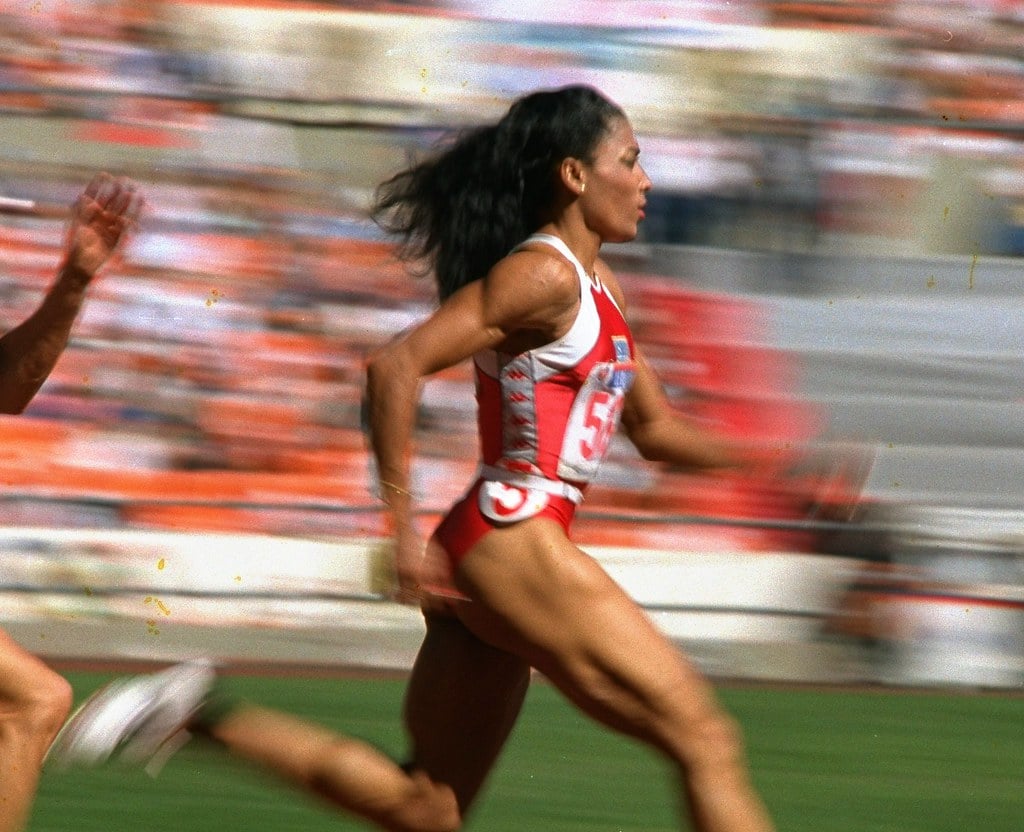
Florence Griffith-Joyner — known as Flo-Jo — rewrote the record books at the 1988 US Olympic Trials and Seoul Olympics. She ran 10.49 seconds in the 100m and 21.34 seconds in the 200m.
Both records still stand today, over 35 years later. No woman has run within a quarter of a second of her 100m time in any officially ratified race.
Her 200m record has been approached more closely, but not broken. Flo-Jo died in 1998 at 38, and the sport has spent the time since trying — and failing — to produce performances like hers again.
Stefka Kostadinova’s High Jump (1987)

Bulgaria’s Stefka Kostadinova cleared 2.09 metres at the 1987 World Championships in Rome, setting a women’s high jump world record that has now lasted nearly four decades. What makes her record unusual is that it was set at a major championship, not in a low-key meet — the pressure was real, and the jump was enormous.
Several athletes in the years since have come within a centimetre or two, but none have matched or beaten it. At a height where fractions of a centimetre determine whether you clear or knock the bar, 2.09 metres remains an elusive ceiling for the event.
Galina Chistyakova’s Women’s Long Jump (1988)

Back in 1988, yet another athlete emerged from the East – Galina Chistyakova. That summer in Leningrad, she launched herself across seven point five two meters.
Her leap became the new benchmark for women’s long jump. Since then, seasons have turned, training evolved, records elsewhere shattered – hers stands untouched.
Nearly four decades later, no one has managed to go farther. Still, Brittney Reese and Malaika Mihambo built standout careers without touching that number.
That leap stands like a peak from which the sport has slowly stepped back. Though both excelled, neither reached it.
Randy Barnes Throws World Record Shot Put 1990

Twenty-three twelve meters flew the shot in L.A., back when clocks still ticked on analog hands. That throw by Randy Barnes never got beaten since.
A suspension followed him years after, rules bent where shadows grew thick. Doubt sticks to that number now like old tape on a worn-out shoe.
It was Ryan Crouser who carried shot put dominance across the 2010s and into the next decade. Close he got, nearly reaching that mark until his throw stretched to 23.37 meters in 2021 – Barnes’ number now behind him. Thirty-one long years passed before this line shifted at last.
Not every name listed here has seen their wait end quite so happily.
Wayne Gretzky NHL Points Record

Fifty-seven points shy of three thousand, Wayne Gretzky stepped away from the NHL in 1999. His tally included a massive number of helpers – 1,963, to be exact.
That count by itself beats every other player’s entire career output. Second place doesn’t come close when you add up someone else’s goals and assists together.
Even without counting a single goal by Gretzky, just his helpers would top the overall scoring list. Right now, nobody playing comes near that mark.
Jagr ended his run well over a thousand points short – the nearest any person got. Perhaps no athlete in North America’s major leagues has so far outpaced peers in raw numbers.
Time Ends

Each of these marks lives in a flash so total, never to return, where the game quietly left them behind. Not every one sits clean – doubt shadows some.
A few dangle in questions we still can’t answer. Others rose during times when sports now pretended didn’t happen.
The marks stay. Fixed.
Unmoving. Yet each year they remain unbroken, the silence around them grows heavier.
What would it really demand – pulling off what no one managed since four decades ago? Truth is, certain documents have mysteries even experts can’t crack.
Some gaps just sit there, unanswered, decades deep. A few files? Their origins vanished long before anyone thought to ask.
Nobody now holds the full picture on every single one. Factual loops remain – plain as day, stubborn as stone.
More from Go2Tutors!

- The Romanov Crown Jewels and Their Tragic Fate
- 13 Historical Mysteries That Science Still Can’t Solve
- Famous Hoaxes That Fooled the World for Years
- 15 Child Stars with Tragic Adult Lives
- 16 Famous Jewelry Pieces in History
Like Go2Tutors’s content? Follow us on MSN.



