People Who Hold The Most World Records
Breaking a single world record takes dedication, talent, and often years of training. But some people don’t stop at one.
They chase records like collectors hunting rare treasures, pushing past what seems humanly possible time after time. These aren’t always Olympic champions or household names.
Sometimes they’re ordinary people who discovered an extraordinary drive to keep breaking barriers.
The Man With Over 600 Records

Ashrita Furman from Brooklyn never considered himself athletic as a kid. He’d flip through the Guinness Book of World Records each year, amazed by the feats inside but certain he’d never join their ranks.
That changed when he discovered meditation and a philosophy that taught him limits exist mostly in our minds. In 1979, he attempted 27,000 jumping jacks in just under seven hours.
The record was his. That first success sparked something.
He didn’t just celebrate and move on. He started training for the next record immediately.
By 2017, Furman had set more than 600 official Guinness Records and held over 200 simultaneously. He literally holds the record for holding the most records.
His achievements span every category you can imagine. He balanced pool cues at the Egyptian pyramids, hopped on a kangaroo orb along the Great Wall of China, and completed sit-ups at the Eiffel Tower.
He’s done records on all seven continents and at famous landmarks worldwide. Mount Fuji by pogo stick.
Milk bottle balanced on his head for a mile at Borobudur. Some records sound whimsical, like underwater juggling (which he pioneered and called “gluggling”).
Others demand serious endurance.
When Records Become Your Job

Furman manages a health food store in Queens, but record-breaking is clearly his life’s work. He created entirely new categories. Landrowing, for instance, involved converting an indoor rower with wheels and brakes, then rowing 1,500 miles across Bali in 16 days.
Distance sack racing against a yak in Mongolia. These aren’t activities that existed before he invented them.
He also built a 76-foot pencil weighing 22,000 pounds as a birthday gift for his spiritual teacher. The pencil traveled from Queens to a museum in St. Louis.
Guinness recognized it officially. That kind of dedication separates casual record attempts from true obsession.
What drives someone to do this? Furman credits his meditation practice and spiritual beliefs.
He sees each record as part of a larger journey of self-transcendence. The activities themselves matter less than proving you can push beyond perceived limitations.
Many of his records involve childlike pursuits—juggling, hopscotch, unicycling, yodeling. He finds joy in the practice itself, not just the achievement.
The Rush Behind Record Breaker Rush

David Rush earned his nickname honestly. Since 2015, he’s been on a mission to claim as many records as possible, and he currently holds over 100 titles.
His first record was juggling three objects blindfolded for 6 minutes and 34 seconds. He still holds that record, though he’s extended it to over an hour.
Rush takes a different approach than Furman. He often breaks multiple records in a single day.
When he visited Guinness World Records headquarters in London during 2024, he broke 15 records in just one day. One of them was the fastest time to fold and throw a paper aircraft—5.12 seconds.
That’s the kind of precision and speed that defines his style. His records range from practical to absurd.
Some require genuine skill and athleticism. Others test creativity and patience.
But consistency matters more than any single achievement. Breaking records becomes a routine, a practice you refine over time.
Rush demonstrates that you don’t need decades of preparation—sometimes you just need to show up repeatedly and keep pushing.
Italy’s Master of Balance

Silvio Sabba started his record-breaking journey in 2011. As a personal trainer, he brings an understanding of human physiology to his attempts.
His specialty involves balancing objects in ways that defy common sense. He once balanced nine 500ml plastic bottles on one finger.
Then he broke his own record. And again.
And again. The current record stands at 25 bottles.
Balance requires more than physical strength. Your mind has to quiet completely.
Any distraction, any slight tremor, and everything collapses. Sabba has mastered that mental discipline.
He’s also involved his son Cristian in record-breaking, setting team records together. They hold the fastest time to stack a set of dominoes as a duo—10.31 seconds set in 2021.
Germany’s All-Rounder

Andre Ortolf doesn’t specialize. He holds records across wildly different categories—food challenges, memory tests, musical instruments, even fancy dress competitions.
He once held 27 eggs in one hand. That record stood from 2013 for years before anyone challenged it.
This shotgun approach proves you don’t need to find one niche and dominate it. You can bounce between completely unrelated skills and still accumulate an impressive collection.
Ortolf’s range shows that record-breaking rewards versatility as much as mastery.
The Sprinter Who Redefined Speed
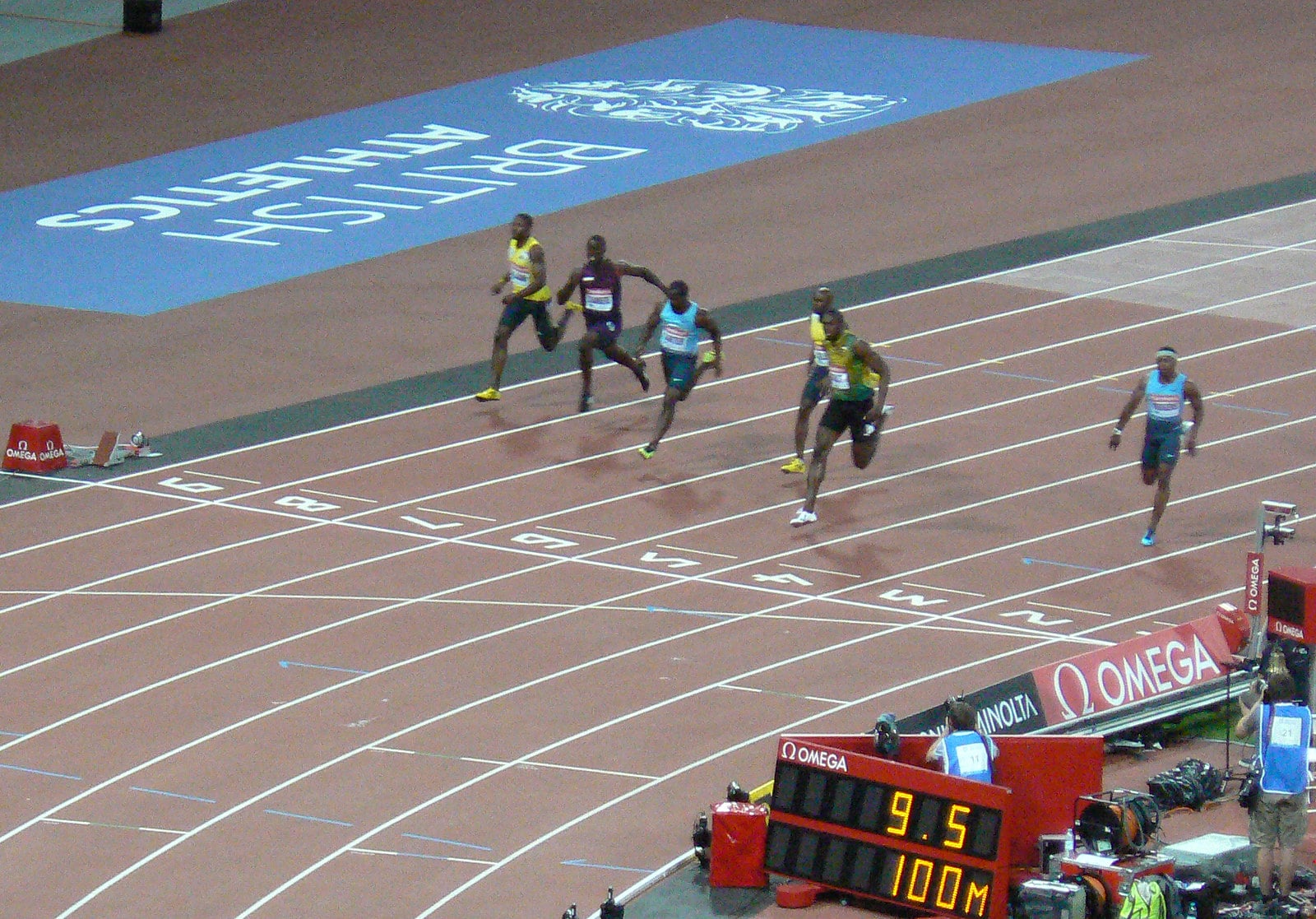
Usain Bolt holds a different kind of record monopoly. He owns both the 100-meter and 200-meter world records, set at the 2009 World Championships in Berlin.
His 100-meter time of 9.58 seconds remains untouched. So does his 200-meter time of 19.19 seconds.
What makes these records remarkable isn’t just the times themselves. It’s that Bolt lowered both records by significant margins in the same competition.
He also holds three Olympic gold medals in the 100 meters, more than any other athlete in history. His Olympic record of 9.63 seconds from the 2012 London Games stands as another barrier that seems impossible to break.
Bolt didn’t just beat his competition. He competed in a different category entirely.
Other sprinters train their whole lives to run under 10 seconds in the 100 meters. Bolt did it routinely and made it look effortless.
The Pole Vaulter’s Three-Decade Reign

Sergei Bubka set 35 world records in the pole vault between 1984 and 1994. Nobody else held the world record during that entire decade.
He was the first to clear six meters, a psychological barrier as significant as the four-minute mile. His outdoor record of 6.14 meters, set in 1994, lasted 20 years before anyone surpassed it.
Bubka’s dominance came from technical mastery and mental strength. Pole vaulting combines speed, strength, timing, and courage.
You’re sprinting with a pole, planting it at precisely the right moment, and launching yourself into the air trusting that your body will clear the bar. Any hesitation, any miscalculation, and you fail or get hurt.
Bubka made it look routine.
Swimming’s Record Machine

Michael Phelps holds 28 Olympic medals, 23 of them gold. That alone makes him the most decorated Olympian ever.
But his individual records go deeper. At the 2008 Beijing Olympics, he won gold in all eight events he entered.
He set seven world records in the process. Phelps competed for over two decades at the highest level.
His body was built for swimming—long torso, short legs, wingspan longer than his height. But genetics alone don’t create champions.
He trained relentlessly, often swimming 80,000 meters per week. His work ethic matched his physical advantages.
The question isn’t whether anyone will break Phelps’ medal count. The question is whether the sport of swimming will ever see another athlete who dominates across so many different stroke styles and distances simultaneously.
Phelps mastered everything from the 100-meter butterfly to the 400-meter individual medley. That kind of versatility might be his most unbreakable record.
When Musicians Break Records

Taylor Swift holds multiple records, including highest annual earnings for a music artist. Madonna is recognized as the best-selling female artist in music history with over 335 million albums sold.
Eminem holds 11 different Guinness World Records related to rap, lyrics, and chart performance. These aren’t people collecting records for the sake of collection.
Their records follow naturally from their dominance in music. But the numbers still matter.
They represent measurable proof of impact and reach. When Ariana Grande becomes the female musician with the most YouTube subscribers, that reflects not just talent but cultural influence.
The Psychology of Record Chasing

What separates someone who attempts one record from someone who pursues hundreds? The initial achievement often feels like validation—proof that you can do something remarkable.
But then what? Most people celebrate and return to normal life.
Serial record breakers find something different in that first success. They discover that limits are negotiable.
Furman talks about this openly. Each record represents a test of whether his philosophy works in practice.
If mental discipline and spiritual focus can help you do 27,000 jumping jacks, what else becomes possible? The records themselves become less important than what they symbolize—evidence that human potential extends further than most people believe.
Rush seems motivated by the challenge itself. He likes testing variables, finding new categories, and pushing efficiency.
It’s almost scientific in approach. How fast can you really fold and throw a paper plane?
What’s the absolute limit? The only way to find out is to attempt it with complete focus.
The Athletic Records That Stand Alone

Florence Griffith-Joyner’s records in the 100 meters (10.49 seconds) and 200 meters (21.34 seconds) have stood since 1988. That’s over three decades.
Her times were so far ahead of the competition that suspicions of enhancement still linger. But the records remain official.
Jackie Joyner-Kersee’s heptathlon world record of 7,291 points, set at the 1988 Seoul Olympics, still stands. The heptathlon combines seven different track and field events.
You need to excel at sprinting, jumping, and throwing. Joyner-Kersee was the first woman to surpass 7,000 points, and she pushed the record even higher.
Nobody has seriously threatened it in over 35 years. These records differ from serial record breakers in one key way.
They weren’t trying to accumulate quantity. They achieved peaks of human performance in their chosen disciplines.
The records stand not because others aren’t trying, but because what they accomplished remains at the edge of what’s humanly possible.
Why Some Records Matter More

Not all records carry equal weight. Breaking the record for most jumping jacks in six hours is impressive, but it doesn’t change athletics.
Usain Bolt’s 100-meter record changed how people think about human speed. Phelps’ Olympic medal count changed expectations for what an athlete can achieve across a career.
Serial record breakers like Furman understand this distinction. Many of his records are deliberately quirky or new categories.
The value isn’t in the record itself but in the accumulation. He’s not trying to be the greatest at any one thing.
He’s trying to prove consistency, versatility, and determination across hundreds of attempts. Athletic records in major sports carry more prestige because the competition is fiercer.
Millions of people run the 100 meters. Only a tiny fraction ever break 10 seconds.
When someone sets a world record in that environment, they’ve beaten everyone who ever tried. That’s different from creating a new category where you’re the first and possibly only serious competitor.
Both approaches have value. Elite athletic records push the limits of human capability in established disciplines.
Serial record breaking shows that with enough creativity and dedication, you can carve out your own space in the record books.
Where the Lines Blur

Sometimes the distinction between types breaks down completely. Sergei Bubka set 35 pole vault records.
That’s both elite athletic achievement and serial record breaking. He dominated his sport and kept pushing his own limits repeatedly.
The same applies to Phelps. His 28 Olympic medals represent the highest level of achievement in swimming.
But the sheer number of medals also makes him a serial champion. He didn’t just win once or twice.
He kept winning across multiple Olympics and numerous events. You could argue that anyone who holds multiple world records in different categories is a serial record breaker regardless of the sport.
The distinction might be artificial. What matters is the drive to keep attempting new challenges rather than resting on past success.
Beyond the Numbers

Record breaking serves different purposes for different people. For some, it’s about proving something to themselves.
For others, it’s about inspiring people or showing what’s possible. Furman explicitly connects his record breaking to spiritual practice and teaching.
Rush seems driven by curiosity and the challenge itself. Olympic athletes chase records because that’s the ultimate measure of success in their sports.
The records that last longest tend to share certain characteristics. They were set by people at peak performance in their discipline.
They represent something beyond normal human achievement—not just better than most people, but so far beyond the average that reaching it requires extraordinary circumstances. Weather conditions, mental state, physical conditioning, competition level, equipment quality—all these factors align rarely.
When they do, records fall. When they don’t, records stand for decades.
Part of what makes record breaking fascinating is that unpredictability. You can train perfectly and still miss the mark.
Or you can have an unexpected day where everything clicks and you achieve something that seemed impossible.
The Chase Continues

Furman adds another mark to his name while old benchmarks still hold firm. Records drop like leaves in autumn, yet some refuse to break.
Rush discovers fresh territory where few have tried before. While others watch and learn, young competitors shape their routines around proven paths.
Techniques get studied, copied, then pushed further by those just starting out. Out here, tools shift what people can do.
Newer running footwear has lifted race outcomes beyond old benchmarks. Vaulting gear evolved, letting Bubka soar past earlier assumptions.
Coaches now know more about building strength. Meals fuel bodies better than before.
Limits once taken seriously often turn into average marks later on. Still, a few marks remain unbroken even with today’s edge.
Only then does it sink in – something extraordinary took place. Decades of upgrades in gear, workouts, and methods fail to touch what once was done long before.
Then the name stops being just a number. It becomes part of the story everyone tells.
Most top record holders have something in common. Never pausing defines them more than anything else.
Each success flows into another effort without delay. When things go wrong, they pay attention instead of quitting.
What matters is doing it again, using what happened last time. Chasing records isn’t about reaching an end point.
It’s a habit kept alive through repetition. Meaning lives inside the trying, not just the result.
The Measure Of What We Can Become

Something stands when nobody thought it could. That mark shows where we’ve been, hinting at where we might go.
What once seemed impossible began as an empty space. One individual stepped in. Another moved it further.
Forward rolls like that. Names like Furman do more than fill pages.
The record books grow because of them. New kinds show up when people try odder things.
Sticking to usual sports marks would make it dull fast. Decades-old sports records aren’t just numbers on a page.
Peaks appear when conditions line up exactly right. Seeing what extreme performance looks like sticks in your mind.
Young competitors might chase them, even knowing they may fall short. One matters just as much as the other.
Pushing what people can do happens in more than one form. Yet each shows how boundaries tend to stretch beyond first guesses.
Breaking six hundred records isn’t likely. Matching Bolt’s speed probably won’t happen either.
Maybe not everywhere, yet deep inside one small task lies a trace you might follow – should you ever choose to look. It’s that chance, fragile as it seems, holding everything together.
More from Go2Tutors!

- The Romanov Crown Jewels and Their Tragic Fate
- 13 Historical Mysteries That Science Still Can’t Solve
- Famous Hoaxes That Fooled the World for Years
- 15 Child Stars with Tragic Adult Lives
- 16 Famous Jewelry Pieces in History
Like Go2Tutors’s content? Follow us on MSN.



