Simple Physics Behind Complex Everyday Objects
Physics isn’t just something that happens in laboratories or textbooks. It’s woven into nearly everything we touch, use, and depend on throughout our day.
From the moment you silence your alarm clock to the second you zip up your jacket, you’re interacting with clever applications of fundamental physical principles that make modern life remarkably convenient. Here is a list of everyday objects whose seemingly simple operations are powered by fascinating physics.
Microwave Ovens

Your microwave uses a device called a magnetron that generates electromagnetic waves at about 2.45 gigahertz frequency. These waves cause water molecules in food to rotate rapidly because water is polar—one side is slightly positive and the other slightly negative—and the alternating electric field makes them spin.
That spinning creates friction between molecules, which generates the heat that warms your leftovers in minutes instead of the half hour an oven would take.
Ballpoint Pens

The tiny point at the tip of your pen sits in a socket with just enough room to roll freely, and as you write, gravity pulls ink down from the reservoir onto the point, which then transfers it to paper. Capillary action also plays a role, drawing ink through the narrow space between the point and its housing even against gravity’s pull.
This combination of gravity and surface tension is why most regular ballpoint pens won’t write upside down—the ink can’t reach the point when you flip them over.
Bicycles

A bicycle stays upright through a front-loaded steering geometry where the front of the bike falls faster than the back when tilting, causing the front wheel to turn into the direction of the fall, which creates centrifugal force that snaps the bike back upright. While gyroscopic effects from spinning wheels contribute slightly, the trail—the distance between where the steering axis hits the ground and where the front wheel touches the pavement—is actually more important for stability.
This is why a properly designed bike can balance itself even without a rider, coasting along like a ghost is pedaling it.
Zippers

A zipper works through reversible deformation of interlocking teeth that are shaped so the forces acting on a worn garment can’t unlock them. The slider contains a series of wedges that guide the two tracks together at an angle when you zip up, forcing each tooth into its corresponding hollow on the opposite side, and pushes them apart when you zip down.
The whole mechanism is basically a moving inclined plane that converts your pulling force into the sideways force needed to join or separate hundreds of tiny hooks in sequence.
Refrigerators

Refrigerators rely on thermodynamics to transfer thermal energy from inside the unit to the outside environment through compression and expansion of gases. When the refrigerant gas is compressed, it heats up and releases that heat outside the fridge, then when it expands inside the cooling chamber, it absorbs heat from your food and drinks.
This phase change cycle runs continuously, which is why the back of your fridge feels warm while the inside stays cold enough to keep your milk fresh.
Smartphones

Your phone relies on electromagnetism for wireless communication, with Wi-Fi and Bluetooth transmitting electromagnetic waves through the air to let devices talk without wires. The touchscreen uses electrostatics to register your finger’s input, detecting the way your conductive fingertip disrupts the electrical field across the glass.
All those sensors, processors, and radios packed into something thinner than a pencil represent decades of miniaturization made possible by understanding how electrons behave in semiconductor materials.
Alarm Clocks

The buzzing sound that jolts you awake involves the physics of sound waves, which your alarm generates through vibrations that travel through the air to your eardrums. The study of sound includes understanding its origin, how it propagates through different materials, and its various properties like frequency and amplitude.
Digital displays on modern alarm clocks also involve quantum mechanics at the level of light-emitting diodes or liquid crystals that control which pixels light up to show you it’s already 7:30.
Car Seat Belts

Your seat belt works on the principle of inertia, which is the tendency of your body to resist changes in its state of motion. When your car suddenly stops in a collision, your body wants to keep moving forward at the same speed the car was traveling, and the belt applies force to change that motion and keep you in your seat.
The locking mechanism in the retractor uses a pendulum or centrifugal clutch that engages during sudden deceleration, turning a simple strap into a life-saving device.
Airplanes

Airplanes achieve flight by manipulating physics through wing shape and angle, both of which alter airflow to create lift using principles like Bernoulli’s theorem. The wings are designed to create differences in air pressure above and below them, with faster-moving air on top creating lower pressure that essentially sucks the plane upward.
Newton’s laws of motion govern everything else about flight, from the thrust that propels the plane forward to the drag that resists its movement through the air.
Elevators

Elevators use the principles of mechanics with pulleys and counterweights to lift the car efficiently, taking advantage of mechanical advantage to reduce the force needed. The motor applies force to overcome gravity and move the elevator smoothly and safely between floors.
The counterweight typically equals the weight of the car plus about 40 percent of its maximum load, which means the motor only needs to work hard when the elevator is more or less than half full.
Speakers and Headphones

Small speakers in your headphones use electricity and moving magnets to create sound waves that bounce off your eardrums. When electrical signals flow through a coil of wire near a permanent magnet, the coil moves back and forth, which moves a cone or diaphragm that pushes air molecules to create pressure waves we perceive as sound.
The frequency of these vibrations determines the pitch you hear, while the amplitude controls the volume.
Washing Machines

Washing machines rely on rotational motion and centripetal force to clean your clothes. During the spin cycle, the drum rotates rapidly, and centripetal force keeps the clothes moving in a circle while water is flung outward through the pits in the drum, using the same principle that keeps you pressed against the wall in a spinning carnival ride.
The agitation during the wash cycle uses mechanical energy to force detergent and water through fabric fibers, dislodging dirt particles.
Steam Irons

A steam iron applies the principle of heat transfer from thermodynamics, where thermal energy moves from the hot metal base plate to the cooler fabric. The steam function adds another layer by turning water into vapor, which penetrates fabric fibers more effectively than dry heat alone and helps relax wrinkles.
The weight of the iron combined with heat and moisture creates enough force to temporarily break and reform the hydrogen bonds in fabric fibers, leaving them smooth and flat.
Automobile Engines
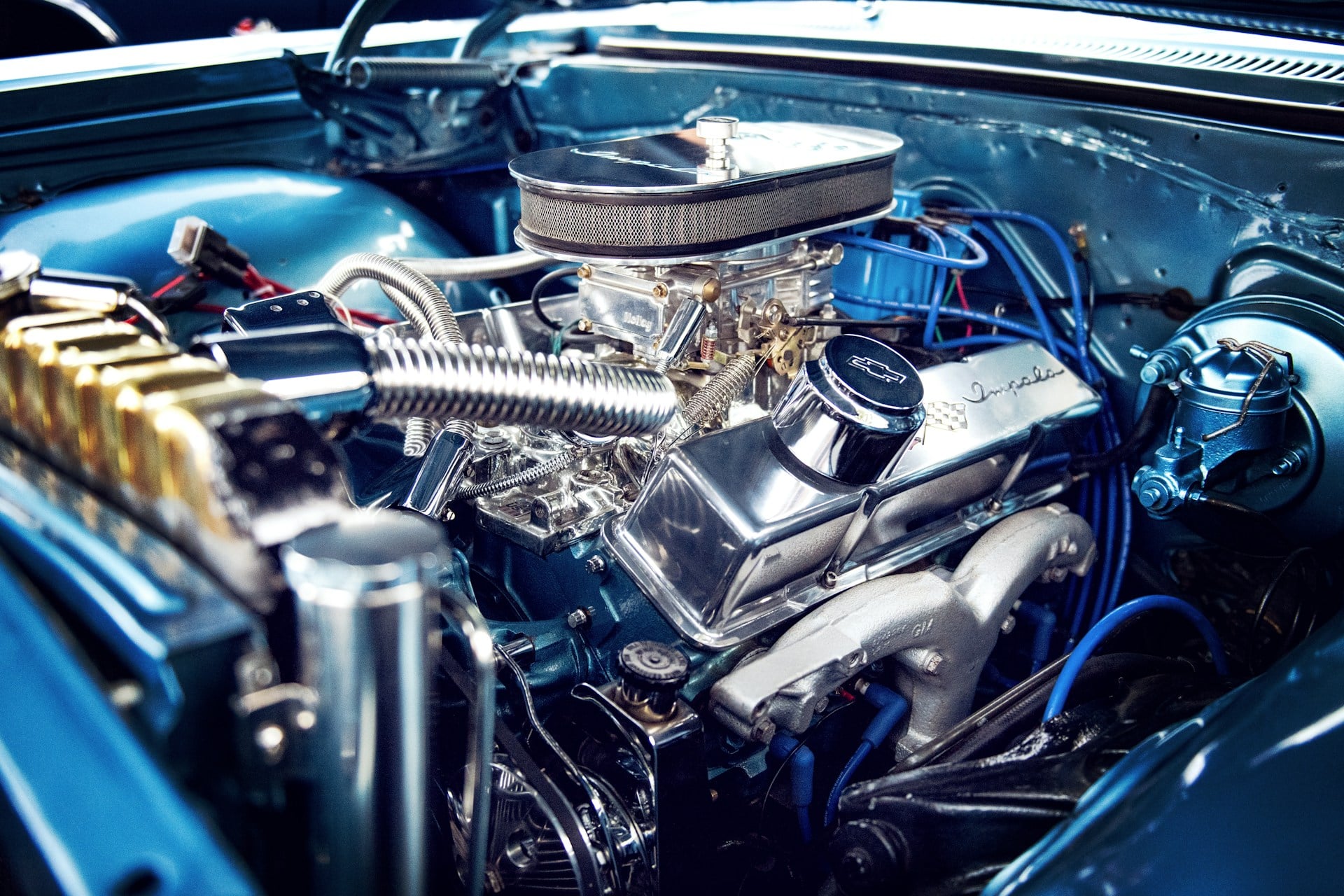
Car engines operate on thermodynamic principles, using combustion to convert the chemical energy stored in gasoline into mechanical energy that powers the vehicle. The four-stroke cycle—intake, compression, combustion, and exhaust—repeats thousands of times per minute, with each controlled explosion pushing pistons that turn the crankshaft.
Forces like friction between tires and road, inertia resisting changes in speed, and aerodynamic drag all affect how the car moves.
Light Bulbs

Light bulbs transform electrical energy into light through different mechanisms depending on the type. Traditional incandescent bulbs heat a tungsten filament until it glows, while more efficient LED bulbs use semiconductors where electrons release photons when they jump between different energy levels.
Fluorescent bulbs take yet another approach, exciting mercury vapor with electricity to produce ultraviolet light that then strikes a phosphor coating to create visible light.
Batteries

Batteries store electrical energy and create it through chemical reactions that produce a flow of electrons from one terminal to another. Inside a battery, chemical reactions at the negative electrode release electrons that travel through your device to the positive electrode, creating the electrical current that powers everything from remote controls to electric cars.
The principles of electromagnetism and electrochemistry determine how batteries work, how long they last, and how much power they can deliver.
The Physics All Around Us

The objects we use every day aren’t magic—they’re evidence of how well humans have learned to harness fundamental forces and physical laws. What started as abstract theories about motion, energy, and matter has been refined into practical tools that save us time and effort at every turn.
Understanding the physics behind these devices doesn’t just satisfy curiosity; it reminds us that science isn’t separate from daily life but deeply embedded in it, making the ordinary quietly extraordinary.
More from Go2Tutors!

- The Romanov Crown Jewels and Their Tragic Fate
- 17 Halloween Costumes Once Considered Taboo
- Famous Hoaxes That Fooled the World for Years
- 15 Child Stars with Tragic Adult Lives
- 16 Famous Jewelry Pieces in History
Like Go2Tutors’s content? Follow us on MSN.