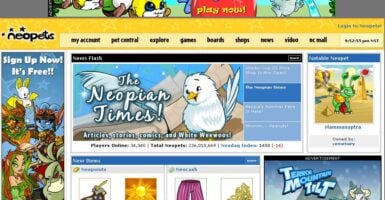
The Rise and Fall of Neopets Explained
Before social media dominated our screens and smartphones ruled our pockets, a colorful virtual world called Neopets captured the hearts of millions. This browser-based game about caring for digital pets became one of the internet’s most beloved destinations, only to struggle through years of decline before finding new hope in 2023.
The story of Neopets is more than just another dot-com tale. It’s about how a simple idea from two British students grew into a global phenomenon, survived corporate takeovers, and managed to endure through technological shifts that killed countless other websites. Here’s the complete story of Neopets’ remarkable journey from internet darling to digital survivor.
The Humble Beginning

— Photo by SandraFoyt
Neopets was conceived in 1997 by Adam Powell, a British student at the University of Nottingham at the time. He shared this idea with Donna Williams and the two started work on the site in September 1999, with Powell responsible for the programming and the database and Williams the web design and art. Their original setup was refreshingly modest—just a small office in Guildford and a big dream.
With the help of two friends, the site launched on 15 November 1999. Powell stated that the original goal was to “keep university students entertained, and possibly make some cash from banner advertising”. The early site had a quirky personality, featuring Neopets that were simply pictures of celebrities like Bruce Forsyth and cartoon versions of singers like Macy Gray.
Explosive Early Growth

The timing couldn’t have been better. The user base grew by word of mouth and by Christmas 1999, Neopets was logging 600,000 page views daily and sought investors to cover the high cost of running the site. This wasn’t just casual browsing either—people were genuinely hooked on the virtual pet experience.
What made Neopets special was its stickiness factor. A press release from Neopets in 2001 stated that Neopets.com led in site “stickiness” in May and June, with the average user spending 117 minutes a week. Neopets also led in the average number of hours spent per user per month in December 2003 with an average of 4 hours and 47 minutes. In an era when most websites got mere minutes of attention, Neopets was commanding hours of engagement weekly.
The Peak Years

By May 2005, a Neopets-affiliated video game producer cited about 35 million unique users, 11 million unique IP addresses per month, and 4 billion web page views per month. These weren’t just impressive numbers—they represented a cultural phenomenon. Kids and teenagers worldwide were spending their afternoons feeding virtual Kougras and playing Flash games for Neopoints.
The site’s appeal went beyond simple pet care. Players created elaborate backstories, participated in complex plots, and built communities around shared interests. It was like having an entire fictional universe at your fingertips, complete with its own economy, geography, and mythology.
The Viacom Era Begins

Success attracts attention, and Viacom, the American conglomerate that owns Nickelodeon, purchased Neopets, Inc. on 20 June 2005 for $160 million and announced plans to focus more on the use of banner ads over the site’s existing immersive advertising. On paper, this seemed like a perfect match—Viacom had the resources and reach to take Neopets to new heights.
However, the acquisition marked a fundamental shift in the site’s DNA. Founders Powell and Williams left Neopets, Inc. shortly after the purchase due to creative differences. The original vision of keeping things entertaining gradually gave way to maximizing revenue streams and corporate synergies.
The Slow Decline Begins
The Viacom era marked a shift from creative innovation to monetisation. The site became increasingly cluttered with advertisements, including branded tie-ins with fast food chains and movies. The heavy commercialisation alienated some of the original fanbase and began to dilute the magic that had made Neopets special. What once felt like a labor of love started feeling more like a marketing machine.
The problems went deeper than just advertising overload. While competitors evolved and embraced new technologies, Neopets remained largely static. The charming early-2000s aesthetic that once felt cutting-edge began looking dated as the internet moved forward.
The JumpStart Years

JumpStart Games acquired the Neopets property from Viacom in March 2014. Server migration began in September. JumpStart-owned Neopets was immediately characterized by glitches and site lag. Instead of breathing new life into the platform, this ownership change brought fresh problems.
On 6 March 2015, much of the Neopets Team remaining from Viacom were laid off. The site that once employed teams of creative writers, artists, and developers was now operating with skeleton crews. Quality suffered, bugs multiplied, and new content became increasingly rare.
The Flash Problem

software platform used for production of animations.
— Photo by monticello
The site relied heavily on Adobe Flash, a once-dominant platform that fell out of favour as mobile usage exploded and HTML5 emerged. With Flash’s official end-of-life in 2020, much of Neopets’ content became inaccessible. This wasn’t just an inconvenience—it was an existential crisis for a site built around Flash-based games.
Imagine logging into your favorite website only to find that most of its core features simply don’t work anymore. That’s what happened to Neopets users as browsers stopped supporting Flash. Years of carefully crafted minigames became unplayable overnight.
Competition and Changing Times

As competitors emerged, ranging from social games on Facebook (such as Farmville) to mobile apps on iPhones and Android and MMOs such as World of Warcraft, Neopets struggled to keep up. The user interface remained outdated, mobile optimisation was poor, and attempts at redesigns were inconsistent. The internet had moved to smartphones, but Neopets was still designed for desktop computers from the early 2000s.
Gaming itself had evolved dramatically. Players now expected sophisticated graphics, seamless mobile experiences, and social features that went far beyond simple message boards. Neopets felt increasingly like a relic from a bygone era.
The Management Buyout

southeast China’s Fujian province, 23 April 2018
— Photo by ChinaImages
Just when it seemed like Neopets might fade into internet history, something unexpected happened. As many of you may have seen, Jumpstart was shut down on June 30th, 2023. Prior to this shutdown, Dom pushed NetDragon to save Neopets. A management buyout deal was struck, allowing the two Neopets teams to combine forces and become an independent company.
The buyout was led by Dominic Law, someone who understood Neopets from both a business and fan perspective. New CEO of Neopets is Dominic Law, who previously headed the Neopets Metaverse and brokered a “management buyout deal” This wasn’t just another corporate acquisition—it was a rescue mission by people who genuinely cared about the site’s future.
New Investment and Vision

New TNT has raised $4,000,000 from external investors to be used for rebuilding the brand/site The funding represented something Neopets hadn’t seen in years: actual investment in its core platform rather than just attempts to extract value from existing assets.
Until this point, Neopets has been running at a loss for over a decade, making it hard to enact any major overhaul; however, in early 2023 Neopets raised $4M in funding from various investors with plans to nurture a shared dream of an immersive, community-driven gaming experience. Finally, there was money and motivation to address the site’s long-standing problems.
The Flash Revival

One of the new team’s first priorities was tackling the Flash crisis. Plan to incorporate Ruffle to save Flash content. 50 games will be returning via Ruffle on July 25th By using modern emulation technology, they could bring back the games that had made Neopets special without requiring users to install outdated browser plugins.
Already, the new Neopets company has used Flash emulator Ruffle to bring back over 100 games, and its efforts are having an effect: The site just hit its highest monthly users figure in five years. It was proof that people still wanted what Neopets offered—they just needed it to actually work.
Looking Forward

Plan to launch new mobile app “World of Neopets”: “a social life-simulation game in which you live your ideal Neopian life from the perspective of a Neopet” in 2024 The new leadership team isn’t just fixing old problems—they’re building for the future with mobile-first experiences that could introduce Neopets to a new generation.
Neopets Metaverse has been cancelled. Some assets will be used for World of Neopets, but World of Neopets will have no crypto/NFT elements. By abandoning controversial blockchain initiatives, the team signaled their commitment to focusing on what actually matters to users: fun, engaging gameplay.
The Enduring Appeal

Many of those users are 30-to-40-year-olds driven by nostalgia for the old game, which is now in its 25th year of operation and still very much looks like it comes from the 2000s. But many are also kids being introduced to Neopets by their millennial parents, says Law, who describes the site as a “living relic” of the internet.
There’s something uniquely appealing about Neopets that transcends technological limitations. Unlike modern games that demand constant attention and rapid reflexes, Neopets operates at a more relaxed pace. You can check on your pets, play a few games, and return hours or days later without falling behind.
From Internet Pioneer to Digital Survivor

The story of Neopets reads like a microcosm of the entire internet’s evolution. It rose during the optimistic early days of the web, survived the dot-com crash, adapted to corporate ownership, struggled through technological transitions, and ultimately found new life through the passion of its community and dedicated leadership.
Following the transition, it was reported that the site achieved its highest revenue stream in 2023 since 2017 (which was the same year Netdragon acquired Jumpstart), and had tripled its monthly active userbase from 100, What seemed like a slow march toward irrelevance has transformed into something resembling a comeback. While Neopets may never again reach the cultural dominance it enjoyed in the mid-2000s, its persistence proves that some corners of the internet are worth preserving—not just as nostalgic curiosities, but as living, breathing communities that continue to bring joy to both longtime fans and curious newcomers discovering virtual pet ownership for the first time.
More from Go2Tutors!

- The Romanov Crown Jewels and Their Tragic Fate
- 13 Historical Mysteries That Science Still Can’t Solve
- Famous Hoaxes That Fooled the World for Years
- 15 Child Stars with Tragic Adult Lives
- 16 Famous Jewelry Pieces in History
Like Go2Tutors’s content? Follow us on MSN.