Unexpected Animal Friendships That Will Melt You
Sometimes the best friendships come from the most unlikely places. Animals have a way of teaching us that connection doesn’t depend on species, size, or natural instincts.
These bonds form without explanation and endure without effort. They remind us that friendship exists in its purest form when we stop overthinking it and simply show up for each other.
Owen the hippo and Mzee the tortoise
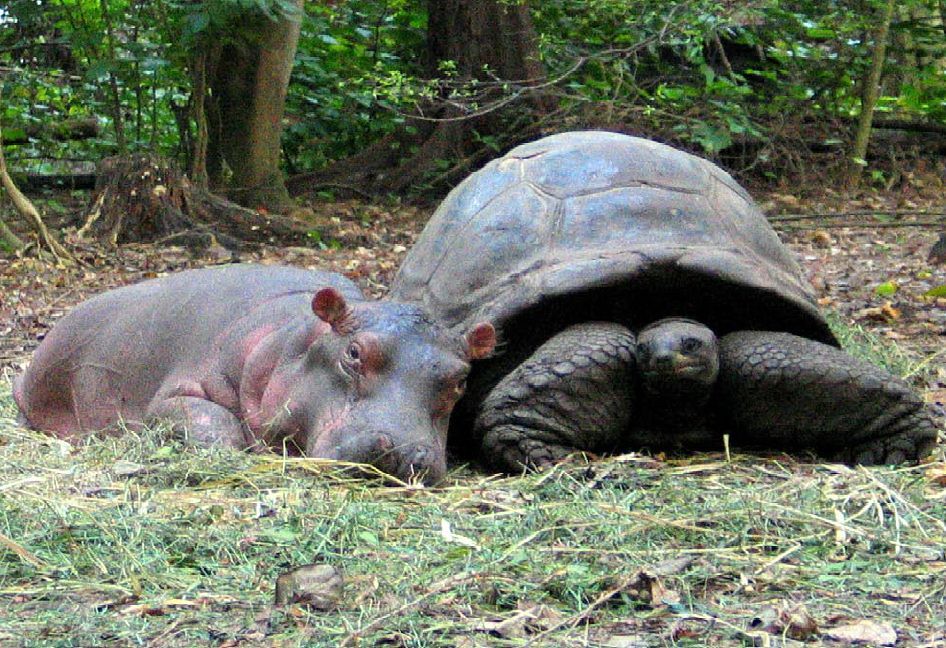
A tsunami changed everything for a baby hippo in Kenya. Owen lost his family and found himself alone, scared, and desperately seeking comfort.
He spotted Mzee, a 130-year-old giant tortoise, and decided this ancient creature would become his new family. Mzee had lived more than a century in peaceful solitude.
Suddenly he had a 600-pound hippo following him everywhere. The tortoise could have retreated into his shell and waited for the strange situation to end. Instead, he accepted his role as surrogate parent.
They sleep together. Owen rests his massive head on Mzee’s shell while the tortoise patiently endures the weight.
When Owen gets playful, Mzee moves slowly away — not rejecting the friendship, just setting boundaries the way good friends do.
Bubbles the elephant and Bella the black Lab
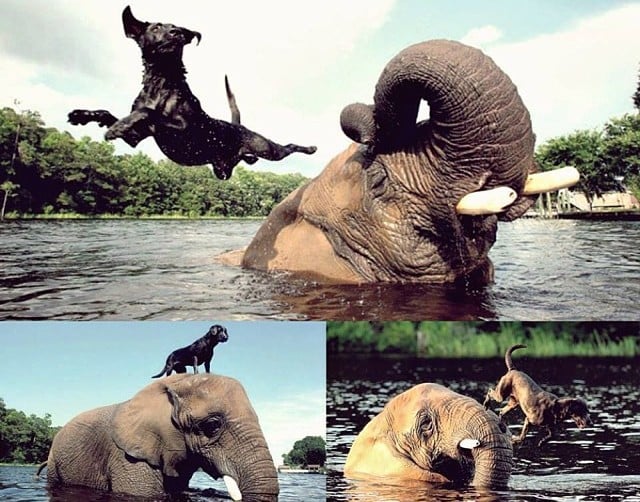
Bubbles weighs 9,000 pounds and spent her early years performing in circuses before finding sanctuary in South Carolina. Bella arrived as a contractor’s dog and never left.
The size difference should have made friendship impossible, but these two figured it out anyway. They swim together in the sanctuary’s pond, which sounds simple until you consider the logistics: Bubbles wades in slowly, creating waves that would knock most dogs off their feet, while Bella paddles circles around her massive friend (because Labs never just swim — they have to make it complicated).
And here’s the part that makes their friendship genuinely touching — Bella uses Bubbles as a diving platform, scrambling up the elephant’s back and launching herself into the water with complete trust that her friend will stay perfectly still until she’s safely airborne. Bubbles obliges every time.
So they’ve worked out a system that accommodates both species. The elephant gets companionship, the dog gets adventure, and visitors get to witness what happens when two animals decide practicalities matter less than friendship.
Koko the gorilla and her kittens
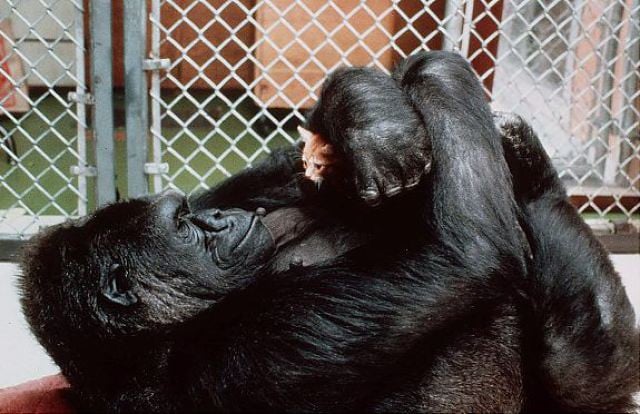
Koko spoke in sign language and asked specifically for a cat. Not just any companion — a cat.
Her caregivers thought she might lose interest or accidentally harm something so fragile. They were wrong on both counts.
The silverback gorilla who could bench press a small car held kittens like they were made of paper. She signed “soft” when she touched them.
She signed “love” when they purred. When her first kitten died, she signed “cry” and grieved like any pet owner would.
Koko had several cats throughout her life. Each one seemed to understand that this enormous, powerful being was gentle with small things.
The cats would climb on her, sleep against her, and treat her like an oversized heating pad with opposable thumbs.
Tarra the elephant and Bella the dog
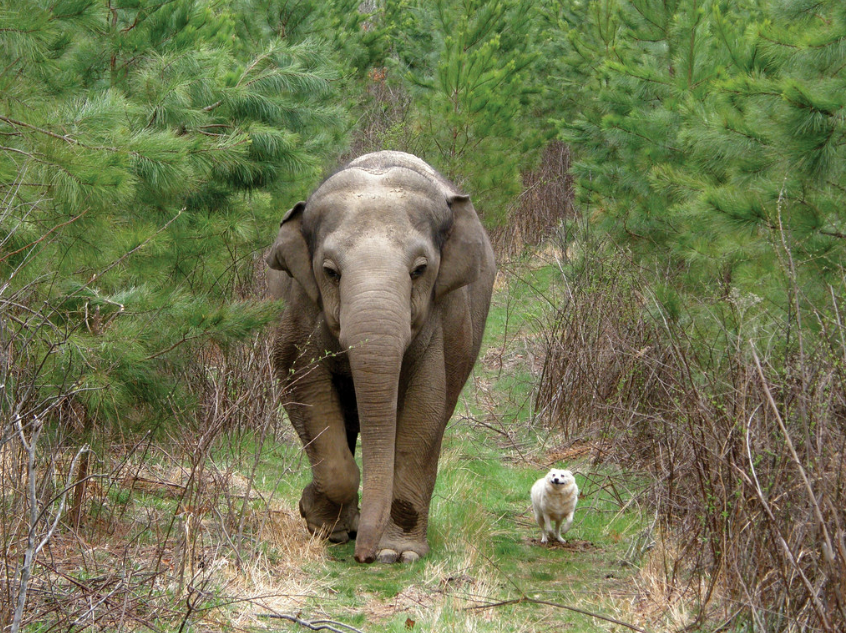
Friendship settles into routines that make sense only to the friends involved. Tarra and Bella developed their own strange rhythm at The Elephant Sanctuary in Tennessee — the elephant would wait patiently while the dog explored ahead, then Bella would circle back to walk beside legs thick as tree trunks, and when Bella got tired, she’d simply lie down wherever she happened to be, knowing Tarra would adjust her massive frame to accommodate one small dog’s need for rest.
Their daily walks looked like a nature documentary directed by someone with a sense of humor about scale and proportion. The sanctuary had other elephants, other dogs. These two chose each other and stuck with that choice for years.
When Bella was injured and couldn’t walk, Tarra stood at the fence of the veterinary building, waiting. She didn’t eat much. Didn’t interact with the other elephants.
Just waited for her friend to heal.
Suryia the orangutan and Roscoe the blue tick hound
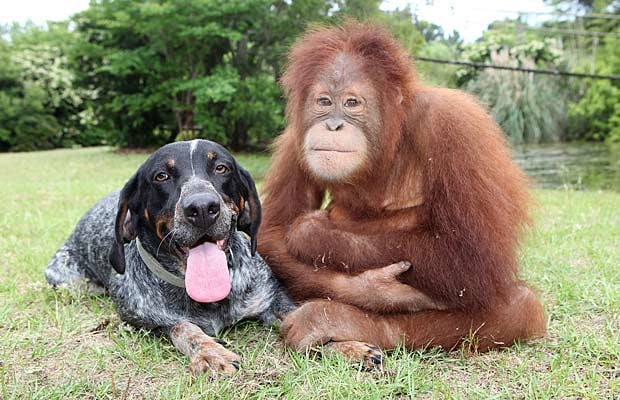
Suryia was meant to be released back into the wild. The plan fell apart when he became too comfortable with humans and refused to leave.
He ended up at a preserve in South Carolina, where socialization with his own species proved difficult. Then came Roscoe. A stray dog who wandered onto the preserve and decided to stay.
The orangutan and the hound hit it off immediately. They swim together, which is unusual since most dogs paddle frantically while orangutans move through water with deliberate, almost human-like strokes.
The best part is watching them share food. Suryia will carefully break treats in half, hand one piece to Roscoe, and eat the other.
The dog waits patiently for his share instead of just grabbing everything in sight. That kind of patience has to be learned, and only real friends bother teaching it.
Torque the dog and Shrek the owl
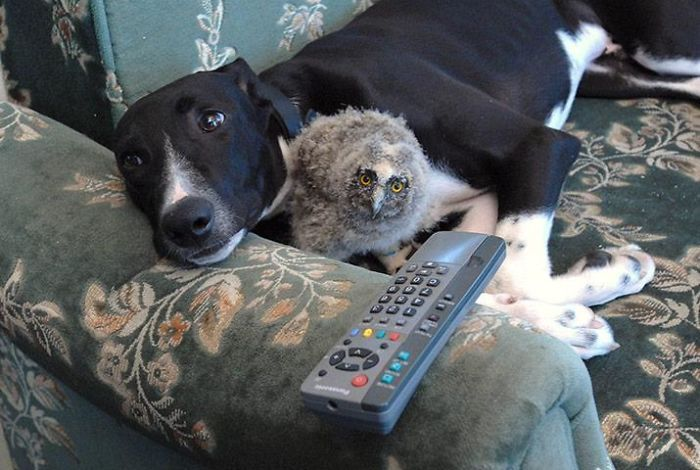
Night hunters and day walkers don’t usually overlap. But Torque, a rescue dog, and Shrek, a great horned owl with an injured wing, found common ground in their shared status as animals who needed second chances.
Both lived at a wildlife rehabilitation center in England (because apparently the British excel at pairing unlikely friends and giving them perfectly ordinary names like Torque and Shrek). The owl couldn’t fly well enough to survive in the wild, and the dog had been abandoned by owners who didn’t want to deal with his energy level.
So they dealt with each other instead. They play together in ways that make no evolutionary sense.
The owl will hop around on the ground while the dog bounces nearby, careful not to step on his friend. When Shrek gets tired, he perches on Torque’s back for rides around the facility. The dog doesn’t seem to mind carrying a bird of prey around like a feathered backpack.
Fred the Labrador and Dennis the duckling
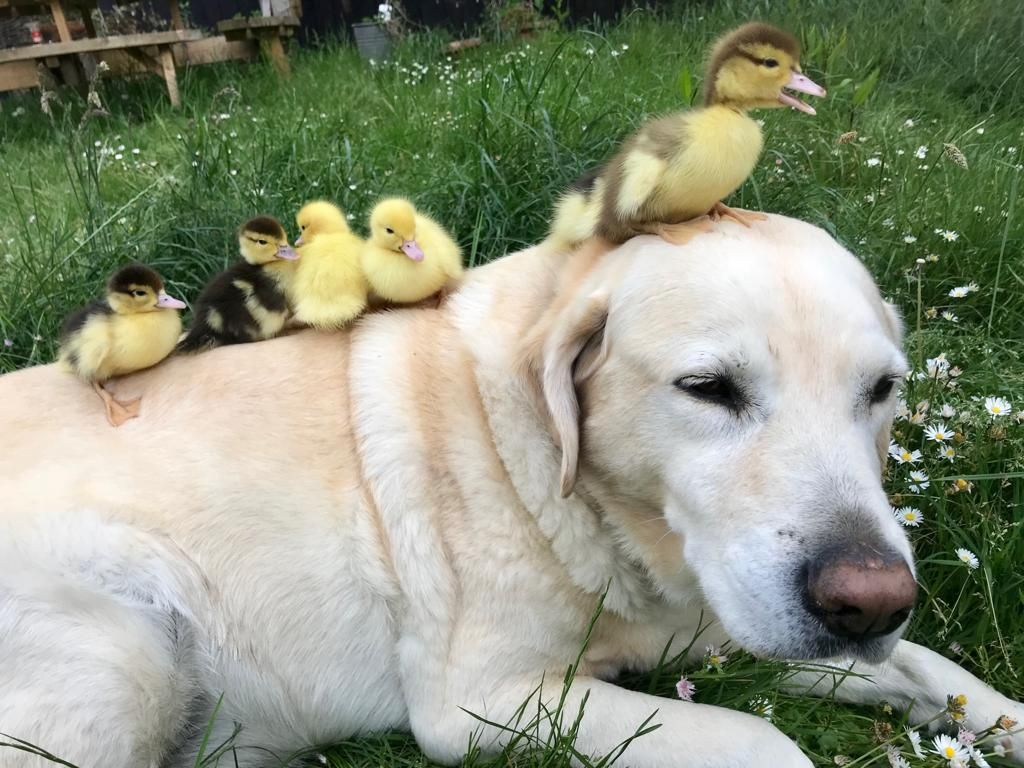
Dennis imprinted on the wrong species, which turned out to be exactly the right mistake. The duckling’s mother rejected him, leaving the tiny bird to figure out survival on his own.
He spotted Fred, a gentle Labrador, and decided this large, patient creature would serve as his new family. Fred had no experience raising waterfowl but proved surprisingly adaptable.
The dog would lie perfectly still while Dennis climbed all over him, using his fur as both playground and nesting material. When Dennis needed warmth, he’d burrow between Fred’s front paws and settle in for long naps.
The duckling grew into a full-sized duck but never lost his attachment to the dog. Dennis would waddle after Fred around the yard, quacking complaints whenever the dog moved too fast.
Fred learned to adjust his pace, the way good friends do when one of them has shorter legs.
Anjana the chimpanzee and tiger cubs
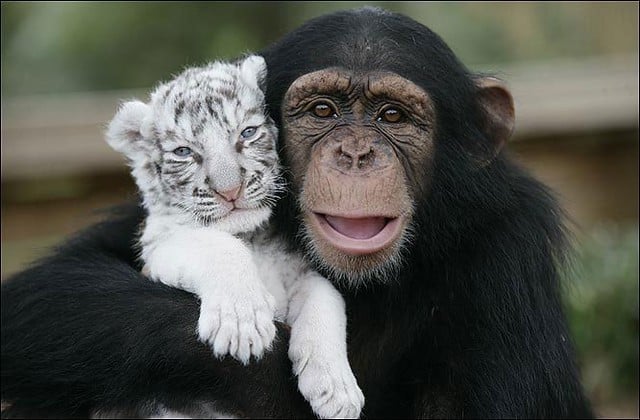
Motherhood doesn’t always follow species lines. Anjana, a chimpanzee at a wildlife preserve in South Carolina, became a surrogate mother to white tiger cubs whose own mother couldn’t care for them.
The arrangement sounds impossible until you watch it happen. Chimpanzees make excellent caregivers, as it turns out.
Anjana bottle-feeds the cubs, helps them with their baths, and sleeps curled around them for warmth. The tigers treat her like their mother because, functionally, that’s exactly what she is.
The cubs will eventually grow too large for this arrangement, but for now they follow Anjana everywhere. She’s patient with their play-fighting and their tendency to chew on everything.
When they get too rough with each other, she intervenes the way any good mother would. The tigers listen to her corrections and settle down.
Manni the wild boar and Candy the dog
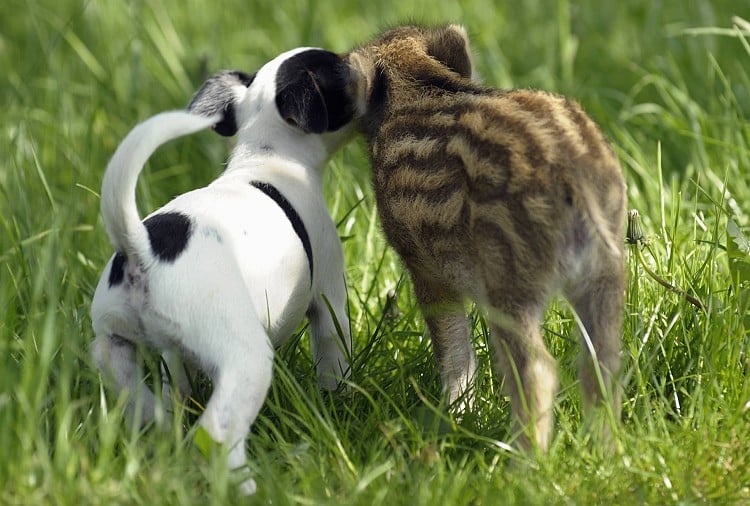
Some friendships begin with trespassing. Manni was a wild boar who started showing up in a German family’s backyard, helping himself to their vegetable garden and generally making himself at home.
Their dog Candy could have chased him off but chose diplomacy instead. The two animals worked out a peaceful coexistence that gradually became genuine friendship.
Manni would visit daily, not just for the vegetables but to spend time with Candy. They’d lie in the sun together, the boar’s bristly hide next to the dog’s smooth coat.
Wild boars are typically solitary and can be aggressive when threatened. Manni remained gentle around his adopted family, seeming to understand that this arrangement benefited everyone involved.
The family got an unusual garden companion, Candy got a friend who was roughly her size, and Manni got reliable meals plus social interaction.
Christian the lion and his human friends
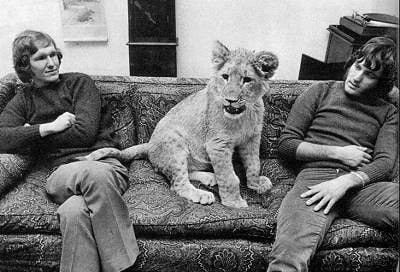
Christian started life in a London department store, which is already an unusual beginning for a lion. Two friends bought him and raised him in their apartment until he grew too large for city life.
They arranged for his release into the wild in Kenya, expecting never to see him again. A year later, they visited Kenya and found Christian living with pride in the wild.
The reunion was captured on film and became famous for good reason — the lion recognized his former caretakers immediately and greeted them with the kind of enthusiastic affection usually reserved for golden retrievers. Christian had successfully transitioned to wild life but hadn’t forgotten where he came from.
He spent hours with his human friends during their visit, relaxed and playful despite having grown into a 300-pound predator. The trust went both ways, which says something remarkable about bonds formed early and maintained through separation.
Kate the Great Dane and Pippin the deer
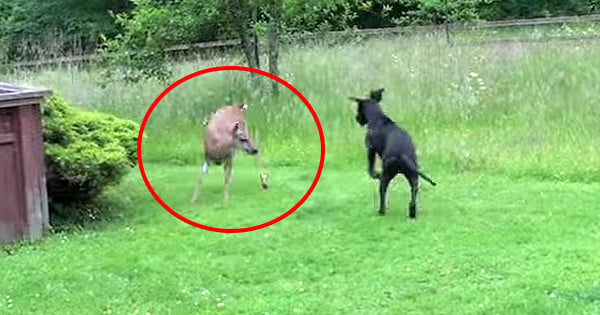
Pippin arrived at Isobel Springett’s animal sanctuary as an orphaned fawn, barely old enough to stand. Kate, a gentle Great Dane, immediately took on the role of foster mother.
The size difference was manageable at first — a fawn isn’t much larger than a big puppy. But deer grow faster than dogs, and Pippin soon towered over his adoptive mother.
The role reversal didn’t bother either of them. Kate continued to groom Pippin as if he were still a tiny fawn, standing on her hind legs to reach his head.
Pippin would lower himself down so Kate could more easily clean his ears. They developed a morning routine that lasted for years.
Kate would wait by the fence where Pippin slept, and the deer would bound over for their daily grooming session. Visitors expecting to see traditional farm animals instead found a Great Dane carefully tending to a full-grown deer who seemed to think this arrangement was perfectly normal.
Themba the elephant and Albert the sheep
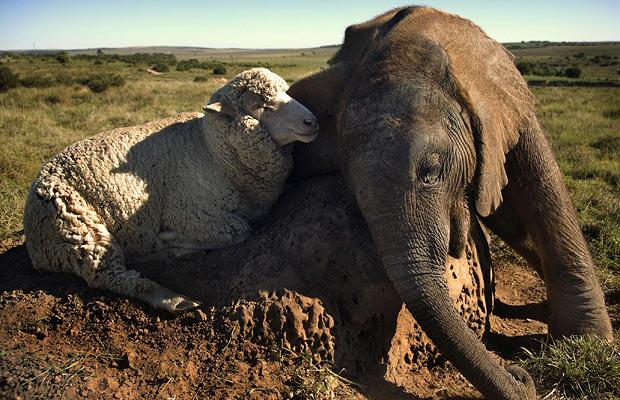
Orphaned elephants need constant companionship or they become depressed and fail to thrive. Themba lost his mother when he was only six months old and arrived at Shamwari Wildlife Rehabilitation Centre in South Africa deeply traumatized and alone.
The staff tried introducing him to other elephants, but Themba wasn’t interested. He wandered the facility listlessly until he encountered Albert, an elderly sheep who had also been orphaned and bottle-raised.
The two animals recognized something familiar in each other’s circumstances. Albert became Themba’s constant companion and unlikely role model.
The sheep would lead the young elephant around the facility, showing him where to find the best grass and shade. Themba followed Albert everywhere, his trunk often resting gently on the sheep’s back.
When Albert lay down to rest, Themba would curl his massive body around his small friend, careful not to crush him.
Jack the goat and Charlie the blind horse
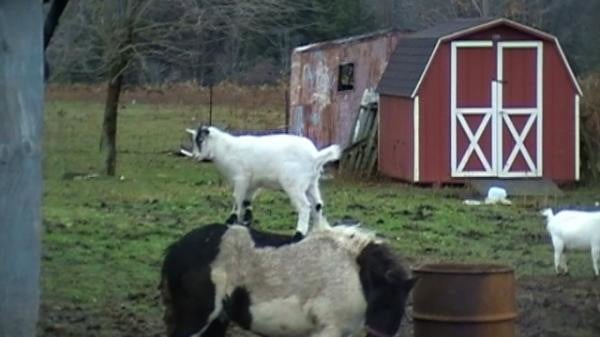
Charlie lost his sight to an illness but gained something unexpected — a seeing-eye goat named Jack. The two animals lived on a ranch in Texas where Charlie had struggled to navigate familiar terrain that suddenly became dangerous and confusing.
Jack appointed himself as Charlie’s guide without any training or encouragement from humans. The goat learned Charlie’s daily routine and began leading him to food, water, and shelter.
When Charlie hesitated at gates or obstacles, Jack would position himself to show the safe path forward. Their partnership developed its own communication system. Jack would make specific sounds to alert Charlie to different situations — one sound for “stop,” another for “safe to move forward.”
Charlie learned to trust these signals completely, following Jack’s guidance with the confidence of a horse who could see perfectly well.
A different kind of love story
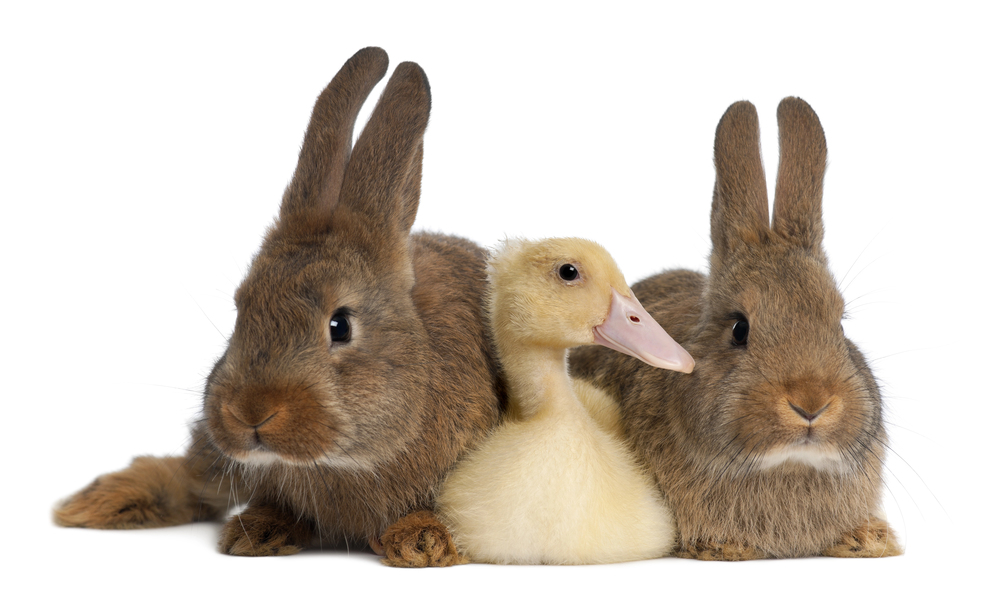
These friendships exist without explanation or evolutionary advantage. They simply are, in the way the best relationships often are — chosen rather than logical, maintained through small daily kindnesses rather than grand gestures.
Animals don’t overthink compatibility or worry about what others might think of their unusual partnerships. They find connection where it exists and nurture it through presence, patience, and the kind of loyalty that makes cynics reconsider what they know about love.
More from Go2Tutors!

- The Romanov Crown Jewels and Their Tragic Fate
- 13 Historical Mysteries That Science Still Can’t Solve
- Famous Hoaxes That Fooled the World for Years
- 15 Child Stars with Tragic Adult Lives
- 16 Famous Jewelry Pieces in History
Like Go2Tutors’s content? Follow us on MSN.