15 Times a Fake Product Was Created Just to Get Media Attention
In today’s attention-driven economy, companies often push creative boundaries to capture headlines and social media buzz. Sometimes, the most effective marketing doesn’t involve actual products at all, but rather elaborate hoaxes designed to generate publicity, start conversations, or highlight social issues.
Here is a list of 15 memorable instances when companies and individuals unveiled fake products that successfully hijacked the media cycle. These examples prove that sometimes the best way to sell something is not to sell anything at all.
Left-Handed Whopper

Burger King’s 1998 April Fools’ prank advertised a specially designed burger with ingredients rotated 180 degrees to better accommodate left-handed eaters. The fast-food chain took out full-page newspaper ads announcing this “innovation,” leading thousands of customers to request the specialized sandwich.
Burger King revealed the hoax the following day, having successfully generated massive free publicity.
Tauntaun Sleeping Bag

ThinkGeek’s 2009 April Fools’ joke featured a sleeping bag designed to look like the creature Luke Skywalker crawled inside for warmth in ‘The Empire Strikes Back.’ After being flooded with customer requests to purchase the non-existent product, ThinkGeek actually went on to manufacture it.
This fake-turned-real product demonstrated the incredible power of fan enthusiasm and remains a classic example of accidental product testing through a publicity stunt.
Google Nose

Google announced this imaginary product in 2013, claiming their new search feature could transmit scents through users’ devices. The elaborate hoax included an “Aromabase” of over 15 million “scentibytes” and detailed technical explanations of how the technology supposedly worked.
Google’s annual April Fools’ pranks consistently generate tremendous media coverage, with this aromatic invention being one of their most creative fabrications.
Potato Milk

Swedish food brand Vegavärt created the concept of potato milk in 2017 as a thought experiment about sustainable plant-based alternatives. Despite having no intention to create the product initially, media attention and consumer interest grew so significant that the company eventually developed and launched real potato milk.
What began as a conceptual marketing exercise transformed into an actual pioneering food product.
Forever 21 Neck Extender

When fashion retailer Forever 21 advertised a “neck elongation device” promising to help users achieve the “elegant, swan-like neck” of high-fashion models, it generated immediate buzz. The bizarre beauty gadget, promoted through official-looking product photos and descriptions, was revealed as a fake intended to spark conversation about unrealistic beauty standards.
Fashion and beauty blogs widely covered the hoax.
Sony Power Food

Sony once unveiled “nutritional food” that would power electronic devices through the energy generated by consumer digestion. Complete with fake packaging and scientific explanations, the product announcement claimed the technology would revolutionize battery life issues.
Tech journalists quickly recognized the impossibility of the product, but not before Sony had captured widespread media attention for their clever marketing stunt.
iArm
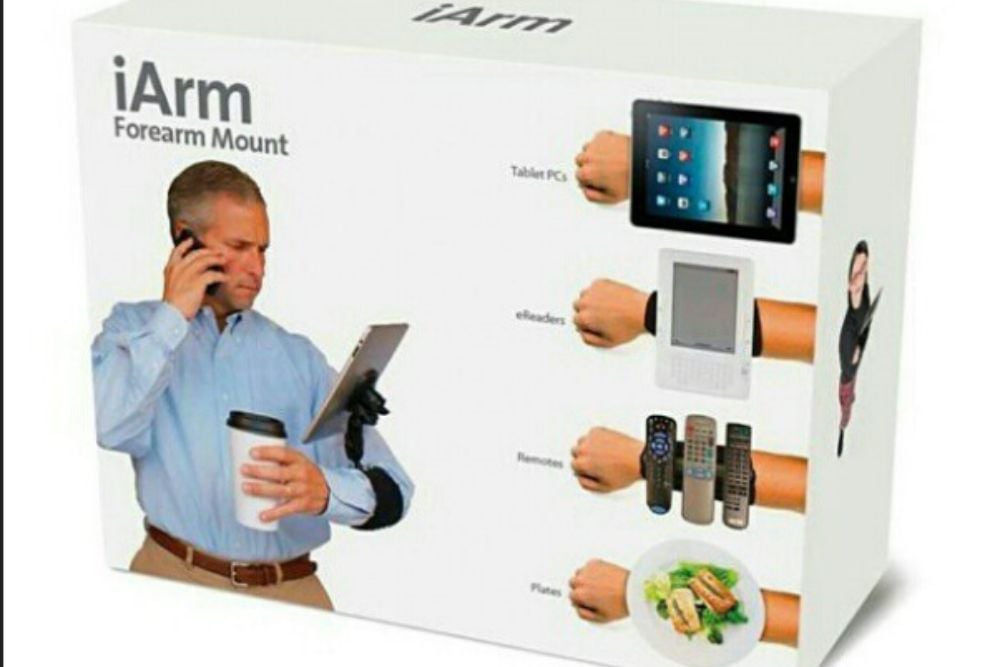
This fake wearable device promised to solve the problem of holding your smartphone while multitasking. The product—essentially an extendable arm attachment—was created by marketing agency Thinkmodo to demonstrate viral advertising techniques.
Despite being physically impossible and obviously satirical, news outlets reported on the innovation, generating millions of views for the promotional video.
Bacon Mouthwash

Scope announced minty fresh bacon-flavored mouthwash in 2013, promising consumers could “indulge” while maintaining oral hygiene. The company created professional packaging mock-ups and promotional materials for their non-existent product.
The absurd combination sparked discussions across morning shows and digital media, demonstrating how outlandish concepts often generate more coverage than practical innovations.
Grilled Stuft Nacho Bot
Taco Bell introduced a supposed autonomous robot designed to deliver their Grilled Stuft Nacho directly to customers wherever they might be. The company’s elaborate social media campaign included detailed technical specifications and “in-development” footage.
The fake technology generated excitement among fast-food enthusiasts who momentarily believed their nacho cravings would soon be satisfied by friendly delivery robots.
Guardian Goggles

The Guardian newspaper announced augmented reality glasses that would overlay their journalistic perspective onto the real world, filtering out opinions their readers might find objectionable. This satirical product announcement cleverly poked fun at both filter bubbles and The Guardian’s own left-leaning reputation.
Media analysts and competing publications extensively discussed the social commentary embedded in this fabricated product.
Cheetos Perfume

With sophisticated commercials showcasing Chester Cheetah, Frito-Lay unveiled ‘Cheeteau,’ a sophisticated scent that perfectly embodies Cheetos snacks. Customers were perplexed by the ridiculous idea, which was first written off as blatantly fraudulent, when the business actually manufactured small amounts for marketing.
The stunt sparked a lot of social media activity and showed how blending the distinction between authentic and counterfeit goods may increase interaction.
Emoji Ordering App
Domino’s Pizza created buzz by announcing customers could place orders simply by texting a pizza emoji. Initially perceived as a joke, the concept generated so much positive feedback that Domino’s actually implemented the feature.
This example shows how companies sometimes float “fake” innovations as trial balloons, implementing them only after gauging public interest through media coverage.
Self-Driving Baby Stroller

Baby gear company Contours unveiled a video demonstrating an autonomous stroller that could follow parents’ hands-free using sensors and motors. The realistic production showcased the product navigating urban environments independently.
While eventually revealed as conceptual rather than available for purchase, the video sparked debates about parenting, technology, and safety across numerous parenting blogs and news outlets.
Currency-Mining Toaster
According to reports, Samsung created a toaster with unique heat-conducting parts that will mine cryptocurrency while preparing breakfast. Before recognizing it was satire about the ridiculousness of integrating blockchain technology into common appliances, tech blogs first reported on the announcement.
The phony product demonstrated how, despite its lack of usefulness, mixing popular tech buzzwords might attract media attention.
Microsoft Telepathic Interface

Microsoft Research published compelling demonstration films of a headgear letting individuals operate computers with their ideas. Technical details on the brain interface technology and claims from “early testers” rounded out the sophisticated deception.
Before Microsoft disclosed the conceptual character of the device, tech writers enthusiastically discussed this next-generation input tool.
The Power of Publicity Stunts

The line between entertainment and marketing remains blurred as corporations learn the merits of telling compelling stories through innovative advertising methods instead of outright advertisements. Such constructed items exhibit the force that publicity stunts carry to create more buzz than several real product introductions.
Whether as an observation on technological trends, social obsessions, or simply as wry entertainment, these fake products accomplished their true purpose: capturing the fleeting interest of consumers and media in an increasingly saturated market. The best ones even transcended from fiction to reality, proving that sometimes the greatest market research is simply to see how many take the bait on your joke.
More from Go2Tutors!

- The Romanov Crown Jewels and Their Tragic Fate
- 13 Historical Mysteries That Science Still Can’t Solve
- Famous Hoaxes That Fooled the World for Years
- 15 Child Stars with Tragic Adult Lives
- 16 Famous Jewelry Pieces in History
Like Go2Tutors’s content? Follow us on MSN.