26 Facts That Show How Differently Left-Handed People Were Treated Throughout History and What Finally Changed
About one in ten people is left-handed. The proportion has been stable for at least 5,000 years — there is archaeological evidence from tools and cave paintings that roughly 10% of people have consistently preferred their left hand across all of recorded human history, and likely long before it. This is not a recent development, not a modern aberration, and not a cultural product.
It is a persistent feature of human biology. And for most of that history, it was treated as a defect, a moral failing, or worse.
The story of how left-handedness went from something to be corrected, exorcised, or punished to something understood as a natural variation in brain lateralisation is a short one in historical terms — most of the change happened between the 1950s and the 1980s — and the forces that drove it are worth understanding. Here are 26 facts about the treatment of left-handed people across history, and what finally shifted.
The Word “Sinister” Is Latin for Left

The Latin word for left, sinistra, carried associations with ill omen, bad luck, and the malign from ancient Rome onward. Roman augurs — religious officials who interpreted the will of the gods through the flight of birds and other signs — associated the left side of the sky with misfortune.
This directional association between left and evil entered the classical Latin that shaped Western European languages, and from there moved into law, theology, art, and daily speech. The English word “sinister” has carried the shadow of its Latin origin ever since.
The Word “Dexterous” Means Right-Handed

The Latin dexter means right, and from it English derives “dexterous” — meaning skilful and coordinated. The bias is baked into the vocabulary: the right hand is the skilled one; the left hand is the ominous one. The French gauche — meaning clumsy, socially awkward, or artless — is the word for left.
The English “adroit” comes from the French droit, meaning right. The language encodes what centuries of stigma assumed: the right hand is competent; the left hand is not.
Biblical and Religious Texts Repeatedly Favoured the Right Hand

The right hand carries consistent positive symbolism across the Old and New Testaments. Jesus, in Christian theology, is seated at the right hand of the Father. The righteous are placed on the right in Matthew’s parable of the sheep and goats; those condemned stand on the left.
In Islamic tradition, the right hand is used for eating and greeting while the left is reserved for bodily hygiene — a practical convention that reinforced the symbolic hierarchy. The consistent privileging of the right in religious texts gave theological weight to what might otherwise have remained a cultural preference.
The Catholic Church Considered Left-Handedness a Mark of the Devil

Medieval European theology drew a direct line between the left hand and demonic association. The Devil was depicted as left-handed in church art.
Left-handed people were considered at best unlucky and at worst possessed. In Catholic educational settings, the left hand was specifically called the Devil’s hand, and this belief was maintained with enough institutional seriousness that it shaped classroom practice well into the 20th century.
Children Were Routinely Tied to Prevent Left-Hand Use

The most common physical intervention in Western schools from the late 19th century through the mid-20th century was binding or restraining the left hand during writing. Methods included tying the left hand to the desk, tying it to the child’s belt or clothing, placing it in a sling, or requiring the child to sit on it.
The practice was not confined to religious schools — it was standard in secular educational settings across Britain, the United States, France, Germany, and Australia. The 1995 account of a kindergartener walking home with his left wrist tied to his belt loop with twine is not an anomaly; it is a late instance of a practice that was once ordinary.
Australia Tied Children’s Hands to Chairs

In Australia, left-handed children were sometimes physically secured to chairs with the left hand tied in place so that they had no physical access to it during writing tasks. The practice was carried out by teachers who believed they were correcting a developmental problem, and it was common enough across multiple school systems to be documented in educational records.
The belief was not simply that left-handedness was inconvenient — it was that it was something that could and should be fixed.
Early 20th Century Psychologists Called Left-Handers “Abnormal”

In the early 1900s, prominent psychologists and criminologists categorised left-handed people as exhibiting signs of primitiveness or developmental regression. Some researchers described left-handers as “stubborn, rebellious, and rigid.”
Others, in a particularly extreme application of the era’s pseudoscience, suggested that left-handedness could indicate tendencies toward deviance or moral instability. These characterisations were published in academic and medical journals of the time, giving what was essentially folk prejudice a scientific veneer.
Samuel Orton’s Theory Prolonged Forced Conversion for Decades

American neurologist Samuel Orton, publishing in the 1920s, proposed that left-handedness and mixed-handedness were associated with “mixed cerebral dominance” — a condition he argued disrupted language development and contributed to reading difficulties. His theory was influential enough to be cited by educators as scientific justification for forcing left-handed children to switch hands.
The irony is that the forced switching itself caused the very problems Orton was trying to prevent: the stuttering, reading difficulties, and anxiety his theory predicted appeared at high rates in children who had been forcibly converted — caused by the stress and neurological disruption of the conversion process, not by left-handedness itself.
Forced Conversion Caused Stuttering in Children

Multiple studies across the mid-20th century documented elevated rates of stuttering in children who had been forced to switch from their natural left-hand dominance to right-hand writing. The connection between forced hand-switching and speech disruption was documented across different countries, languages, and school systems.
The neurological explanation is that in many naturally left-handed people, the right hemisphere of the brain manages language alongside motor control — a different lateralisation pattern from most right-handers.
Disrupting the motor dominance with forced switching created neurological interference that expressed itself in speech.
The Proportion of Reported Left-Handers Dropped During Periods of Suppression
When researchers examined historical data on self-reported left-handedness across the 20th century, they found a pattern: the reported rate was lower in older birth cohorts — people born in eras of active suppression — and higher in younger ones. The decline was not because fewer left-handed people existed; it was because social pressure had forced left-handed adults to adopt right-hand use for formal tasks.
As suppression eased from the 1950s onward, the reported rate of left-handedness rose back toward the biologically stable level of around 10 to 12 percent. The data effectively shows the suppression and release of a stable underlying trait.
Paul Broca’s 1861 Discovery Connected Handedness to Brain Lateralisation

French physician Paul Broca’s 1861 identification of the language centre in the left hemisphere of the brain — now called Broca’s area — was the first major neuroscientific finding to connect brain lateralisation to specific human functions. It drew immediate scientific attention to the relationship between handedness and brain organisation. Left-handers, whose motor dominance runs counter to the majority, became subjects of neurological interest rather than merely objects of suspicion.
The discovery did not immediately end prejudice, but it began the scientific reframing that would eventually displace it.
The Word “Gauche” Reveals French Attitudes

In French, gauche means left. It also means clumsy, awkward, and socially inept. French speakers use it as an insult for someone who mishandles a social situation: une gaucherie is a social blunder.
The word carries its physical meaning and its evaluative meaning simultaneously, and any French speaker using it is implicitly invoking the old equation of left with incompetence. The English borrowing “gauche” preserves exactly this double meaning, and its currency in educated English usage shows how deep the cultural association runs.
Marian Annett’s Research Began the Scientific Reframing

British psychologist Marian Annett, who began publishing in the 1960s and 1970s, was among the first researchers to build a rigorous statistical model of the genetics of handedness. Her Right Shift Theory proposed that a genetic factor pushes most people toward right-hand dominance, but that the absence of this factor — rather than a defect or disease — produces left-handedness. Her work reframed left-handedness not as an anomaly or an error but as one end of a naturally occurring distribution.
This was a significant conceptual shift: left-handedness was no longer a problem to be explained or corrected but a variant to be understood.
China Has Among the Lowest Rates of Reported Left-Handedness

China has historically reported some of the lowest rates of left-handedness in the world, with estimates suggesting fewer than 1% of the population identifies as left-handed. Researchers believe this is not a biological difference in the Chinese population — the genetic and developmental factors that produce left-handedness operate globally — but the result of sustained educational and cultural pressure to conform to right-hand use.
Chinese school children have continued to face pressure to write right-handed well beyond the point when most Western countries had abandoned the practice.
Left-Handedness Has Been Linked to a Genetic Variant

In recent years, researchers have identified specific genetic variants associated with increased probability of left-handedness. A study published in the journal Brain in 2019 identified variants in genes involved in the development of microtubules — structures that shape cells — that were associated with a 2.7-fold increase in the likelihood of left-handedness.
The finding confirmed that handedness has a biological basis in the development of the brain and body before birth, and that it is not a choice, a habit, or a cultural product. The genes involved in microtubule development also showed connections to specific patterns of brain structure in left-handers.
The Stress Harms Were Documented, Not Just Theorised

The documented consequences of forced right-hand conversion in children — beyond stuttering — included reduced fine motor skill with both hands, chronic anxiety related to writing tasks, social withdrawal, loss of confidence in academic settings, and in some cases lifelong discomfort with any formal writing activity. These were not speculative harms.
They appeared consistently in studies examining adults who had been converted, and they were distinct from the difficulties faced by children who had been allowed to write naturally with their left hands.
Left-Handedness Stigma Was Worse in Agricultural Societies

Research on the relationship between handedness and cultural stigma found that the most intense pressure against left-handedness historically occurred in highly organised agricultural societies — the same societies that also had strong religious institutions, formalised writing systems, and centralised educational structures. Hunter-gatherer communities showed less systematic stigma against left-handedness.
The connection is plausible: formalised instruction, standardised tools, and organised religious teaching all created institutional systems that pushed toward conformity of hand use.
Scotland and Japan Considered Left-Handedness Lucky

While most of Western Europe developed negative associations with left-handedness, some cultures maintained positive or neutral attitudes. In Scotland, some folk traditions considered left-handedness a sign of special ability. In Japan, left-handedness carries no particular stigma and has historically been treated as a neutral characteristic.
The cross-cultural inconsistency reveals that the negative association was cultural, not inevitable — there was nothing in the nature of left-handedness itself that required the stigma it accumulated in European and American contexts.
Left-Handed Writers Were Taught With Their Wrists Contorted

Even when left-handed children were not forced to switch hands, they were frequently taught to write in positions that mimicked right-hand penmanship. Writing with the hand above the line — the “hook” position — emerged partly because left-handed children writing with a left-to-right script naturally smear what they have just written.
No instruction was given on alternative approaches, such as tilting the page. The contorted hook position produced distinctive strain in the wrist and forearm that many left-handers still describe decades after learning to write.
The 1960s and 1970s Were the Turning Point

In the United States and most of Western Europe, the practice of forcing left-handed children to switch hands declined sharply between the 1960s and the 1970s. The shift coincided with several converging changes: the accumulation of evidence about harm from forced switching, the broader influence of child psychology emphasising individual development over conformity, the declining institutional power of religious schools in many Western countries, and a general cultural shift toward tolerance of individual difference.
By the 1980s, actively forcing hand-switching in American and British schools had largely ceased.
Australia and Britain Followed Slightly Later

In Australia, educational guidelines formally withdrew support for hand-switching practices in the 1970s. Britain followed a similar trajectory. The change was administrative as much as cultural — it was embedded in teacher training, in educational psychology guidance, and in school inspection standards.
The generation of teachers trained after the mid-1970s in most English-speaking countries had been taught not just to tolerate left-handedness but to provide left-handed children with appropriate support: differently angled pages, left-handed scissors, appropriate seating positions.
International Left-Handers Day Was Established in 1976
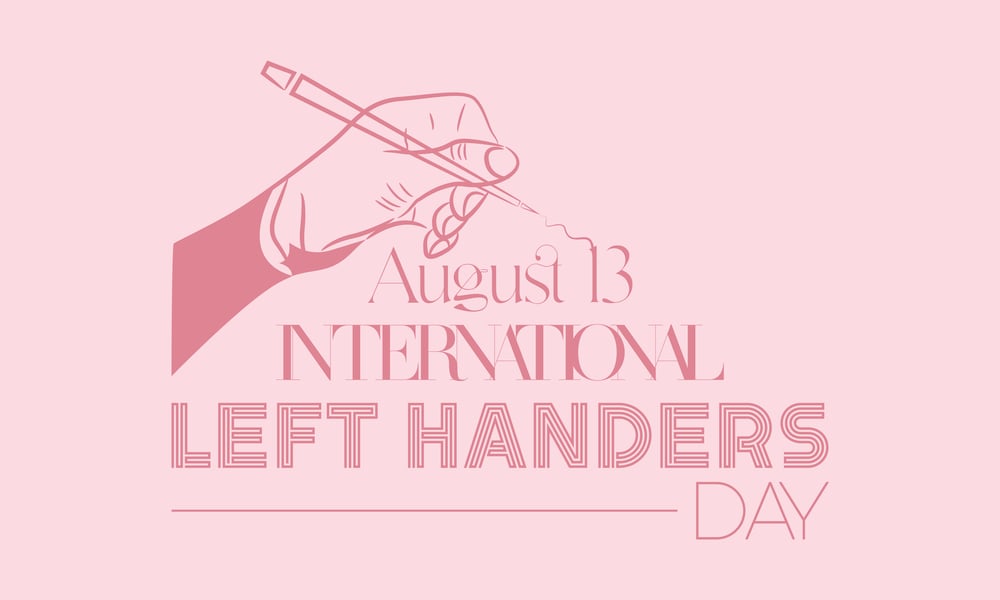
The Left-Handers Club established International Left-Handers Day on 13 August 1976. It was partly symbolic and partly practical: the date provided an annual occasion to raise awareness about the challenges left-handers face in a world designed for the right-handed majority, from scissors and can openers to guitar strings and writing desks.
The fact that such a day was necessary, and that it was received positively rather than as a provocation, is a marker of how far the cultural attitude had shifted in a relatively short time.
Left-Handed Tools Became a Commercial Category

The commercialisation of products specifically designed for left-handers — scissors, kitchen implements, notebooks with the spiral on the right, can openers, computer mice, guitar strings strung in reverse — is itself evidence of the shift from suppression to accommodation. These products did not exist at scale when left-handedness was being actively corrected away.
Their commercial success from the 1970s onward reflects both the public acknowledgment that left-handed people exist in significant numbers and the willingness of those people to spend money on tools that actually fit them.
Famous Left-Handers Were Used to Reframe the Perception

The public recalibration of left-handedness was helped by the prominent identification of celebrated left-handed historical figures. Leonardo da Vinci was left-handed or ambidextrous. Aristotle is believed to have been left-handed.
In music, Ludwig van Beethoven was left-handed. In politics, an unusually high proportion of US presidents have been left-handed, including Barack Obama, Bill Clinton, and George H.W. Bush. Whether this overrepresentation reflects any genuine cognitive or creative advantage remains debated, but its cultural function — reframing left-handedness as something geniuses and leaders do — was real and effective.
The Neuroscience Eventually Resolved the Question of Cause

By the end of the 20th century, the scientific consensus was clear: left-handedness is determined primarily during fetal development, shaped by a combination of genetic factors, hormonal environment in the womb, and developmental processes that establish brain lateralisation before birth. It is not caused by developmental delay, moral deficiency, cultural influence, or parental failure.
The brain of a left-handed person is not identical to that of a right-hander — there are measurable differences in how language, spatial processing, and motor control are distributed between hemispheres — but none of these differences constitute a disability or an abnormality. They constitute a variation.
What Actually Changed the Treatment of Left-Handers

The shift from suppression to acceptance was not driven by a single event or a single study but by the accumulation of evidence that the harm was real, the cause was biological, and the correction was making things worse. The children who stuttered after forced conversion.
The adults who never felt comfortable at a writing desk. The neuroscientific research that showed brain lateralisation was a physiological fact rather than a choice or a habit.
The child psychologists who argued that individual developmental differences should be accommodated rather than flattened. All of these converged in the same two decades — the 1960s and 1970s — to shift the institutional consensus.
The prejudice that had accumulated across centuries dissolved in about twenty years, once the evidence was clear and the institutions that enforced it lost the confidence that they had been right.
The Invisible Redesign That Never Happened

Left-handed people are today accepted without institutional pressure in most of the world. What has not changed is the design of most tools, spaces, and systems. Scissors, kitchen implements, measuring tapes, musical instruments, and the direction of writing in most of the world’s scripts are all optimized for right-handers.
The acceptance of left-handedness in the 20th century was acceptance of the person; it was not a redesign of the environment they have to navigate. Left-handers still adapt constantly, still purchase specialist equipment to do things that right-handers do automatically with standard tools, and still sit at writing desks designed for the other ten percent.
What changed was the labelling. What remained was the inconvenience.
The history of left-handedness is ultimately a history of how a culture can look at something that has been true forever, call it wrong for most of that time, and then — given sufficient evidence — quietly stop doing so. The stopping is worth noting. So is the fact that it took centuries.
More from Go2Tutors!

- The Romanov Crown Jewels and Their Tragic Fate
- 13 Historical Mysteries That Science Still Can’t Solve
- Famous Hoaxes That Fooled the World for Years
- 15 Child Stars with Tragic Adult Lives
- 16 Famous Jewelry Pieces in History
Like Go2Tutors’s content? Follow us on MSN.