Chat Rooms That Defined the Early Web
The internet used to be a much simpler place where people gathered in virtual rooms to type messages back and forth with complete strangers. Before social media profiles and video calls, these text-based chat rooms served as the main way people socialized online.
Millions logged in every day to find friends, share interests, or just kill time talking about whatever popped into their heads. These chat platforms shaped how an entire generation learned to communicate online and created communities that still influence internet culture today.
AOL Instant Messenger buddy lists

AIM launched in 1997 and quickly became the default way teenagers and young adults talked to each other online. The buddy list showed who was available to chat, and people obsessed over their away messages like mini status updates.
Custom profiles let users express themselves through favorite quotes, song lyrics, and carefully chosen fonts. The door opening and closing sounds became so iconic that hearing them today instantly triggers nostalgia.
Parents hated how much time kids spent on AIM, but those conversations taught a generation how to type fast and express emotions through text.
Yahoo Chat’s themed rooms

Yahoo Chat organized its spaces by interests, creating hundreds of rooms dedicated to specific topics from sports to music to regional locations. Users could create custom rooms for niche interests or private conversations with friends.
The platform peaked in the early 2000s with millions of simultaneous users. Voice chat capabilities set Yahoo apart from text-only competitors.
The service eventually shut down in 2012 after struggling with spam and inappropriate content that Yahoo couldn’t effectively moderate.
ICQ’s random number assignments

ICQ gave every user a random number instead of a username, which felt weird but created a sense of uniqueness. Lower numbers became status symbols because they meant someone had joined early.
The ‘uh-oh’ notification sound lives rent-free in the memories of anyone who used the service. ICQ introduced features like file sharing and group chats before they became standard.
The platform still technically exists but lost its cultural relevance once better alternatives emerged.
IRC channels for tech communities

Internet Relay Chat served as the serious, technical older sibling of consumer chat platforms. IRC required some actual computer knowledge to set up and use, which kept out casual users.
Developers, hackers, and early internet enthusiasts gathered in IRC channels to share knowledge and collaborate on projects. Each channel had operators who could kick out troublemakers, creating self-moderated communities.
Many open-source software projects still use IRC today, keeping the 1988 protocol alive decades after it launched.
MSN Messenger’s emotions and winks

Microsoft’s MSN Messenger competed directly with AIM and added animated emoticons that brought conversations to life. Users could send ‘winks’ and ‘nudges’ to get attention, which became either fun or incredibly annoying depending on who sent them.
The ability to see what music contacts were playing through Windows Media Player felt like a revolutionary feature. Display names could include colors and formatting that let people get creative.
Microsoft eventually merged MSN Messenger into Skype, ending an era for millions of users.
Habbo Hotel’s virtual world
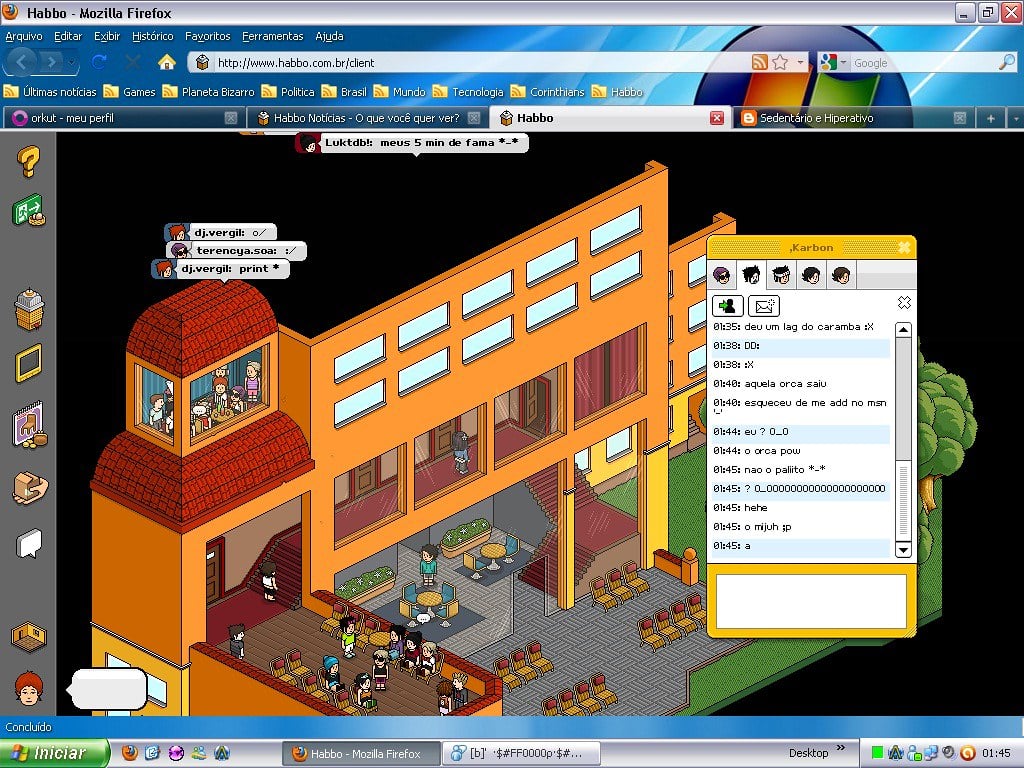
Habbo Hotel combined chat rooms with a visual game world where users controlled pixel art avatars. Players decorated virtual hotel rooms with furniture bought using credits.
The platform attracted mostly teenagers who treated it like a combination social network and interior design game. Habbo became infamous for various internet pranks and raids organized by outside communities.
Despite multiple controversies, the service still operates today with a smaller but dedicated user base.
The Palace’s graphical avatars

The Palace let users create custom graphical avatars that appeared in illustrated chat rooms. This visual element made conversations feel more personal than pure text.
Users could layer props and accessories on their avatars to create unique looks. The software required a download, which limited its reach compared to web-based alternatives.
The Palace represented an early attempt at visual online communities that predicted later platforms like Second Life.
Chatroulette’s video randomness

Chatroulette launched in 2009 and paired random strangers for video chats with a single click. The concept felt exciting and dangerous at the same time.
The platform gained massive attention but quickly developed a reputation for inappropriate content. Despite moderation efforts, Chatroulette never escaped its early reputation problems.
The service introduced the concept of random video matching that later apps like Omegle copied.
Discord’s gaming communities

Discord launched in 2015 specifically for gamers who needed voice and text chat while playing together. The server-based structure let communities create custom spaces with multiple channels for different topics.
Unlike older platforms, Discord offered modern features like screen sharing and high-quality voice chat from day one. The service grew beyond gaming to host communities for basically any interest imaginable.
Discord represents the evolution of chat rooms into sophisticated community platforms with features early internet users could only dream about.
Omegle’s stranger conversations

Omegle connected anonymous strangers for text or video chats without requiring registration or profiles. The tagline ‘Talk to strangers!’ captured both the appeal and the risk of the platform.
Users could add interests to get matched with people who shared similar hobbies. The complete anonymity led to unpredictable conversations ranging from profound to absolutely bizarre.
Privacy advocates praised the no-registration model while critics worried about safety issues.
Club Penguin’s kid-friendly approach

Disney’s Club Penguin created a safe chat environment for children using pre-approved phrases and heavy moderation. Kids controlled penguin avatars in a snowy virtual world with games and activities.
The chat restrictions frustrated some users but gave parents confidence their children were protected. Club Penguin proved that chat platforms could be both fun and safe for younger audiences.
Disney shut down the original in 2017, though fan-made versions keep the concept alive.
Slack’s workplace revolution

Slack launched in 2013 and brought chat room concepts into professional environments. Channels organized conversations by project or topic just like old IRC channels.
The platform made workplace communication less formal than email but more organized than group texts. Integrations with other work tools turned Slack into a productivity hub rather than just a messaging app.
Companies that adopted Slack saw how chat-based communication could replace countless emails and meetings.
Telegram’s encryption focus

Telegram positioned itself as the privacy-focused alternative to mainstream messaging apps. Secret chats offered end-to-end encryption that even Telegram couldn’t break.
The platform attracted users worried about government surveillance or corporate data collection. Groups could hold up to 200,000 members, creating massive communities around specific topics.
Telegram’s commitment to minimal content moderation made it popular with people who felt censored elsewhere.
Kik’s anonymous messaging

Starting out, Kik gave teens a way to message without handing over phone numbers – privacy won them over fast. Instead of real names, usernames made things feel less traceable compared to other apps.
Conversations stayed tidy in groups capped at fifty members. Officials raised concerns because hidden identities sometimes masked harmful behavior.
Despite several brushes with closing down, it kept running, now aiming mostly at younger adults.
Forums that felt like chat rooms

Back then, places such as Something Awful and NeoGAF ran live discussion threads – kind of like delayed messaging chats. Because users stayed around, unique group habits formed, complete with private humor and common memories.
Instead of instant updates, alerts kept folks tuned in, nearly matching the pace of regular chat tools. Since messages never vanished fast, talks unfolded across many days, sometimes even weeks.
These sites sat right between classic bulletin boards and the quick pulse of online chatting.
From simple text to complex communities

Back when computers were new, folks learned to bond without seeing faces. Inside plain windows full of words, connections sparked – some turned into love, others into tight-knit circles lasting ages.
Today’s tools flash with cameras, sound, endless buttons, yet still rely on the same idea: bringing unknowns together by talking. Wanting to reach someone far away stays constant; just the gadgets shift over time.
Hidden inside every busy online hub today lives a quiet echo of those first blank spaces where people dared to say hello.
More from Go2Tutors!

- The Romanov Crown Jewels and Their Tragic Fate
- 13 Historical Mysteries That Science Still Can’t Solve
- Famous Hoaxes That Fooled the World for Years
- 15 Child Stars with Tragic Adult Lives
- 16 Famous Jewelry Pieces in History
Like Go2Tutors’s content? Follow us on MSN.



