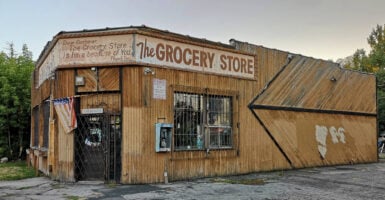
Defunct Grocery Chains That Used to Be Everywhere
Through long stretches of the 1900s, corner markets settled quietly into daily American living. More than spots to pick up meals, they shaped familiar patterns – week by week, household by household, block by block.
Some brands spread so wide their storefronts seemed fixed in place, like trees rooted too deep to move. Spotting identical emblems on poles across states gave a quiet sense: these shops weren’t going anywhere.
What felt solid didn’t last. Running a grocery store means surviving on small profits, changing customer wants, because growth never stops being urgent.
When how people bought food shifted – while rivals pushed harder – familiar names slowed down without noticing. The fall wasn’t sudden, just certain.
One shop closed, then another, each neighborhood losing its familiar aisles bit by bit. Names once seen on every block now linger only in memories, quietly erased over time.
Take a step back, notice the quiet exits of stores everyone assumed would always be around – gone not with noise but slow retreat.
A&P

For decades, A&P stood as one of the most powerful names in American retail. At its peak, the chain operated thousands of stores and played a central role in shaping the modern supermarket.
Its standardized layouts, emphasis on private-label goods, and focus on efficiency made grocery shopping faster and more predictable for millions of households.
Over time, those strengths hardened into limitations. While competitors invested in larger footprints, fresher designs, and broader product ranges, A&P struggled to modernize its aging stores.
Operational costs climbed, customer experience lagged, and loyalty slowly eroded. By the time leadership attempted meaningful change, the market had already moved on.
The closure of A&P’s final stores marked the end of a brand that once defined grocery retail itself.
Alpha Beta

Alpha Beta was a staple of West Coast grocery shopping, particularly in California suburbs where it became part of daily life. The chain built its reputation on straightforward pricing and a no-nonsense approach that resonated with families looking for reliability rather than flair.
Its presence was so widespread that many shoppers assumed it was untouchable.
Industry consolidation proved otherwise. Ownership changes gradually stripped Alpha Beta of its distinct identity.
Rebranding efforts replaced familiar signage, and longtime customers struggled to recognize the stores they once trusted. As competition intensified, the chain lost ground to better-capitalized rivals.
Eventually, Alpha Beta disappeared entirely, leaving behind a name that still sparks recognition among those who grew up shopping its aisles.
Pathmark

In the Northeast, Pathmark was once synonymous with big stores and competitive prices. Its locations catered to densely populated areas where value and volume mattered.
For many neighborhoods, Pathmark was not just convenient but essential, serving as a primary grocery destination for years.
Still, large footprints came with large expenses. Rising labor and operating costs put pressure on already-thin margins.
Efforts to reposition the brand and refresh stores failed to gain traction against national competitors expanding aggressively in the same markets. Financial troubles mounted, and store closures followed.
When Pathmark finally vanished, the loss was felt most acutely in communities that had relied on it for everyday necessities.
Dominick’s

Dominick’s held a special place in Chicago’s retail landscape. More than a grocery chain, it was a local institution with deep ties to the region.
The stores reflected neighborhood preferences, carried trusted private labels, and cultivated a sense of familiarity that national chains struggled to replicate.
That local strength weakened as ownership changed. Decision-making shifted away from Chicago, and stores began to lose the personal touch that once set them apart.
Competition intensified, costs rose, and closures accelerated. When the last Dominick’s store shut down, it marked not just the end of a chain, but the disappearance of a distinctly regional retail experience.
Grand Union

Grand Union’s reach once spanned multiple states, offering a wide range of store formats to suit different markets. This flexibility helped it expand rapidly and establish a strong presence across both urban and rural areas.
For many shoppers, Grand Union was simply the most accessible option.
Over time, that varied approach became a liability. Inconsistent store experiences made it difficult to build a unified brand identity.
Meanwhile, competitors refined their models and scaled efficiently. As pricing pressure increased and modernization lagged, Grand Union steadily retreated from the markets it once dominated.
Its decline unfolded gradually, until the brand quietly faded from most regions.
Food Town

Food Town thrived by leaning into community connection. Many of its stores operated with a local feel, emphasizing familiarity over flash.
Shoppers appreciated seeing the same faces and layouts week after week, which helped build trust and loyalty.
Even so, community appeal could not offset structural disadvantages. Larger chains negotiated better supplier terms and invested heavily in updated stores.
Food Town struggled to match those resources, and many locations were eventually sold or closed. The brand’s disappearance illustrates how scale increasingly determined survival in the grocery business.
Safeway’s Regional Offshoots

While the Safeway name still exists today, many of its regional offshoots and variations have vanished. These stores once operated under different banners depending on location, each with its own identity and customer base.
Over time, consolidation streamlined branding and eliminated many of these regional names.
For shoppers, this meant the loss of familiar store identities that felt tailored to local tastes. What remained was a more uniform experience, efficient but less personal.
The disappearance of these regional banners reflects a broader shift toward national consistency over local character.
What Drove Their Decline

The collapse of these grocery chains was rarely the result of a single failure. Instead, it stemmed from a combination of rising costs, aging infrastructure, and slow adaptation.
Grocery retail operates on razor-thin margins, leaving little room for hesitation or miscalculation.
Consumer behavior also changed dramatically. Shoppers gravitated toward larger stores with wider selections, aggressive pricing, and one-stop convenience.
Loyalty weakened as comparison shopping became easier. Even beloved brands found that nostalgia could not compete with lower prices or better experiences offered elsewhere.
The Broader Retail Shift

As these chains disappeared, the grocery landscape consolidated around fewer, larger players. This shift brought efficiency and scale, but it also reduced variety.
Neighborhood-specific stores gave way to standardized formats designed to work anywhere.
The loss of regional chains reshaped communities in subtle ways. Grocery stores once served as informal gathering points, anchoring shopping centers and daily routines.
Their absence left physical gaps and cultural ones, altering how neighborhoods functioned.
Why It Still Resonates Today

Change slips through the cracks while people look away. Not one of these stores closed fast.
One location faded then another till none remained. Looking back makes disappearance seem quick though it took years.
What shoppers want shifts without announcement just like rival businesses grow quiet and large. Daily routines bend around forces barely noticed.
A few big supermarkets look like they’ll always be around, yet time has shown such things can change. Their ghost lingers inside today’s store designs, ways of marking prices, even how people move through aisles – built slowly from years of trial.
Even when names disappeared from storefronts, echoes stayed hidden in routine choices made at checkout lines across homes. What’s gone still shows up between cereal boxes and discount tags without saying a word.
More from Go2Tutors!

- The Romanov Crown Jewels and Their Tragic Fate
- 13 Historical Mysteries That Science Still Can’t Solve
- Famous Hoaxes That Fooled the World for Years
- 15 Child Stars with Tragic Adult Lives
- 16 Famous Jewelry Pieces in History
Like Go2Tutors’s content? Follow us on MSN.