Extraordinary Vehicles Designed by Famous Artists
When high art meets horsepower, things get interesting. For decades, renowned artists have taken cars and turned them into rolling canvases, transforming vehicles from mere transportation into legitimate works of art.
Some raced at Le Mans, others sat in museums, and a few became cultural icons worth millions. Here’s a look at some of the most fascinating collaborations between the art world and the automotive industry.
Alexander Calder’s BMW 3.0 CSL

The whole art car movement kicked off in 1975 when French racing driver Hervé Poulain had an idea. He approached American sculptor Alexander Calder with a proposition: paint a race car.
Calder, already famous for his mobiles and large-scale sculptures, took a BMW 3.0 CSL and covered it in bold primary colors and sweeping shapes. The car debuted at the Louvre before heading to Le Mans, where Poulain drove it in the 24-hour race.
Seven hours in, a damaged driveshaft ended the run. But the response was phenomenal.
Calder died later that year, making this one of his final works. His grandson later commissioned an “artist’s proof” version in 2021, fulfilling Calder’s wish to create his own drivable example.
Andy Warhol’s BMW M1

Warhol painted his BMW M1 in 1979, and the story behind its creation is almost as famous as the car itself. While other artists spent weeks or months on their designs, Warhol finished in about 28 minutes.
He applied paint with his fingers, rollers, and brushes in a frenetic burst of energy. The result was a vibrant explosion of color that captured his pop art sensibility perfectly.
Today, experts estimate this single car is worth over 30 million euros. The M1 raced at Le Mans and later became one of the most recognizable art cars ever created.
Warhol didn’t drive, but he loved cars and had previously worked on a commission for Mercedes-Benz.
Roy Lichtenstein’s landscape in motion

In 1977, Lichtenstein brought his signature Ben Day dots to a BMW 320i Turbo. The comic-book style artist created what appears to be a landscape rushing past on the car’s flanks.
When the vehicle moved, the optical illusion became even more pronounced. Drivers Hervé Poulain and Marcel Mignot took the car to Le Mans, where it finished ninth overall and first in its class.
The design stayed true to Lichtenstein’s artistic language while embracing the kinetic nature of racing. The black outlines and dots transformed the BMW into a moving pop art statement that blurred the line between high art and motorsport.
Sonia Delaunay’s early experiments

Long before BMW started its Art Car program, French artist Sonia Delaunay was painting vehicles in the 1920s. She decorated a Bugatti Type 35 in 1924 and a Citroën B12 in 1925, matching the patterns to her textile designs and clothing.
These early experiments are considered some of the first true art cars. Delaunay, co-founder of the Orphism art movement, used bold geometric shapes and vibrant colors across the vehicle bodies.
She often photographed models wearing her fashion designs alongside the painted cars, creating total artistic environments. Her work predated the modern art car movement by half a century and showed how cars could serve as three-dimensional canvases for abstract art.
Janis Joplin’s psychedelic Porsche

In 1968, rock legend Janis Joplin bought a used 1964 Porsche 356C Cabriolet for $3,500 from a Beverly Hills dealer. The car came in a dull Dolphin Grey, which didn’t suit her at all.
She handed it over to her roadie, Dave Richards, gave him $500, and told him to make something special. Richards covered the car in what he called “The History of the Universe.”
Psychedelic imagery everywhere – band members, butterflies, mushrooms, the Eye of God, and California landscapes sprawled across every surface. Joplin drove it daily around San Francisco, and fans would leave notes under the windshield wipers.
When the car was stolen, the thief immediately tried to repaint it, realizing too late he’d grabbed the most recognizable vehicle in town. The Porsche sold at auction in 2015 for $1.76 million, a record for any 356 model.
Frank Stella’s geometric precision
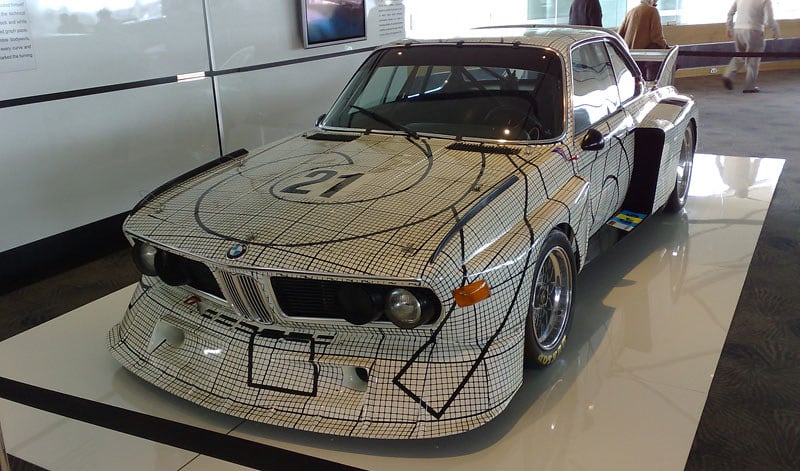
Just a year after Calder, Frank Stella designed the second BMW Art Car in 1976. The American artist took a completely different approach, covering a BMW 3.0 CSL in black and white graph paper patterns.
Stella drew inspiration from the car’s technical structure, creating a grid that followed every curve and indentation of the bodywork. The design marked a shift toward three-dimensionality in the series.
With 750 horsepower, the stark monochrome racer stood out dramatically against the more colorful competitors at Le Mans. BMW’s legendary paint master, Walter Maurer, applied both Calder’s and Stella’s designs to the metal, which is a fun bit of continuity.
David Hockney’s cubist BMW
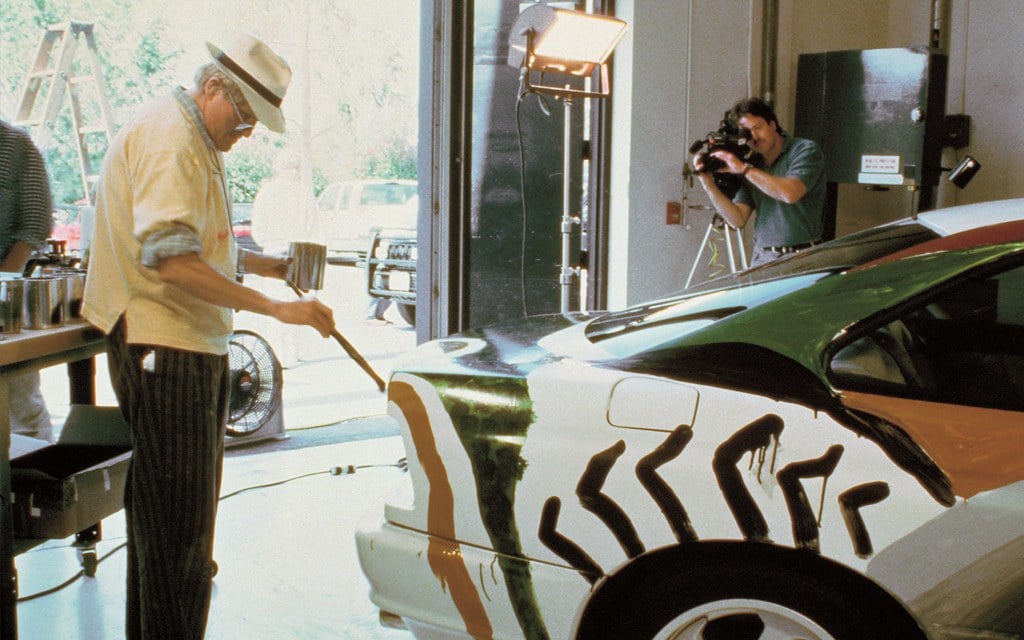
British pop artist David Hockney approached his 1995 BMW 850 CSi with a unique perspective. He wanted viewers to see both the outside and inside of the car simultaneously, creating a multi-viewpoint design inspired by cubism.
Bright colors and bold lines made the vehicle look like a Hockney painting come to life.
The artist, known for his California pool paintings and vibrant landscapes, brought that same energy to the luxury coupe. His approach differed from earlier Art Cars by focusing less on speed and racing heritage and more on spatial relationships and perception.
Jenny Holzer’s message at speed

Conceptual artist Jenny Holzer transformed a BMW V12 LMR in 1999, covering it with text from her famous Truisms series. The most prominent message, “PROTECT ME FROM WHAT I WANT,” appeared on the bonnet in reflective chrome letters.
The irony wasn’t lost on anyone – placing a critique of capitalist desire on a 580-horsepower racing car capable of 340 kilometers per hour. Holzer used phosphorescent paint that glowed BMW blue at night after absorbing daylight.
The car competed in qualifying for the 24 Hours of Le Mans but didn’t make the race. Still, another BMW V12 LMR won that year, driven by Joachim Winkelhock, Pierluigi Martini, and Yannick Dalmas.
Jeff Koons’ limited edition dream car

In 2019, Jeff Koons didn’t just paint a BMW – he created a limited production run. Only 99 examples of THE 8 X JEFF KOONS, based on the BMW M850i xDrive Gran Coupé, were produced.
Each exterior paint job required over 200 hours of manual labor, with color samples often applied under magnifying glasses. Koons spent months at BMW’s Dingolfing plant, discussing design options with engineers and workers.
The artist even designed the dust jacket of the driver’s manual. Each car came with a certificate signed by both Koons and BMW CEO Oliver Zipse, along with the vehicle’s individual identification number.
One signed example was auctioned at Christie’s in New York.
Esther Mahlangu’s African patterns

South African artist Esther Mahlangu made history in 1991 as the first woman to create a BMW Art Car, painting a 525i with bold geometric patterns from her Ndebele heritage. The traditional African designs brought a completely different aesthetic to the collection.
Mahlangu returned to BMW in 2024 with the i5 Flow Nostokana, a high-tech creation featuring electronic panels that display animated versions of her patterns. At over 90 years old, she bridged traditional art and cutting-edge technology.
Her work introduced global audiences to Ndebele artistic traditions while proving that art cars didn’t need to come exclusively from Western artists.
Robert Rauschenberg’s photographic collage
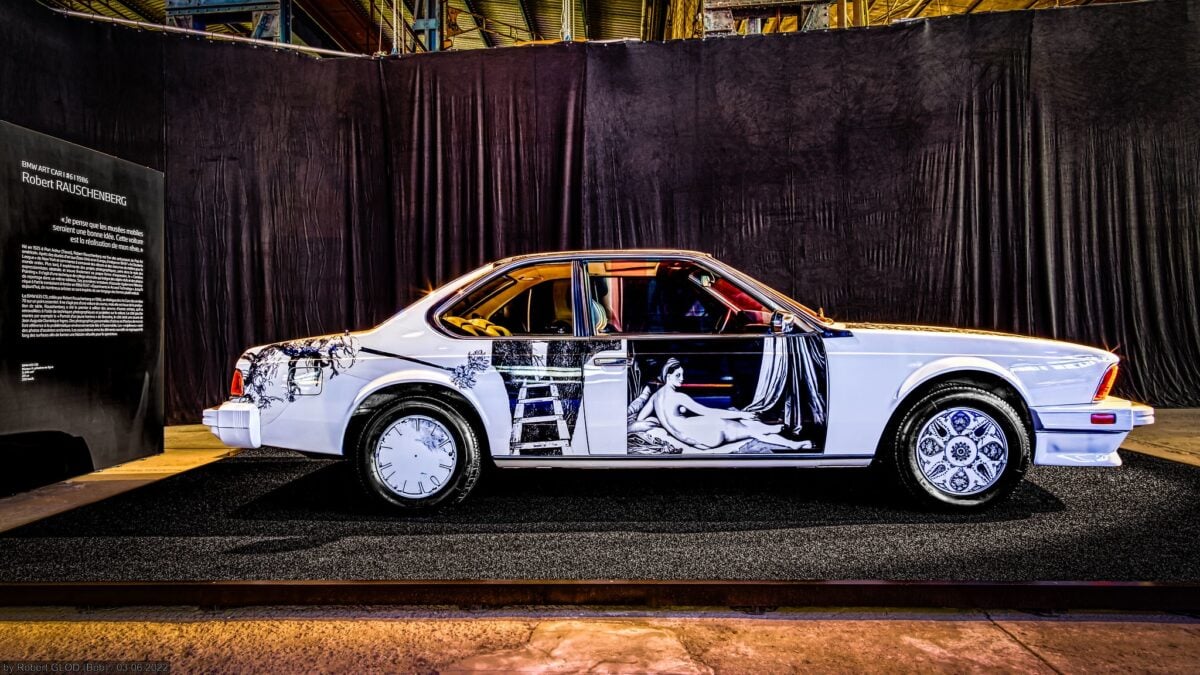
American artist Robert Rauschenberg took a BMW 635 CSi in 1986 and turned it into a rolling photographic collage. Known for his combine paintings that mixed found objects with traditional painting, Rauschenberg applied images and marks across the vehicle’s surface.
The design reflected his interest in connecting art with everyday life and popular culture. Unlike some of the more graphic designs in the collection, Rauschenberg’s approach felt layered and contemplative, requiring viewers to look closely at the details.
The car represented a shift toward more conceptual approaches in the Art Car series.
Cao Fei’s augmented reality BMW

Chinese contemporary artist Cao Fei took the Art Car concept into the digital age in 2017. Her BMW M6 GTLM appeared relatively plain in person. A black race car with minimal decoration.
The real artwork existed in augmented reality – through a special app, viewers could see digital elements swirling around the vehicle, merging physical and virtual worlds. Cao’s approach questioned what art cars could be in an increasingly digital era.
The project reflected her broader interest in how technology reshapes human experience and identity. After this car, BMW paused the Art Car program for several years before returning in 2024.
Julie Mehretu’s contemporary masterpiece
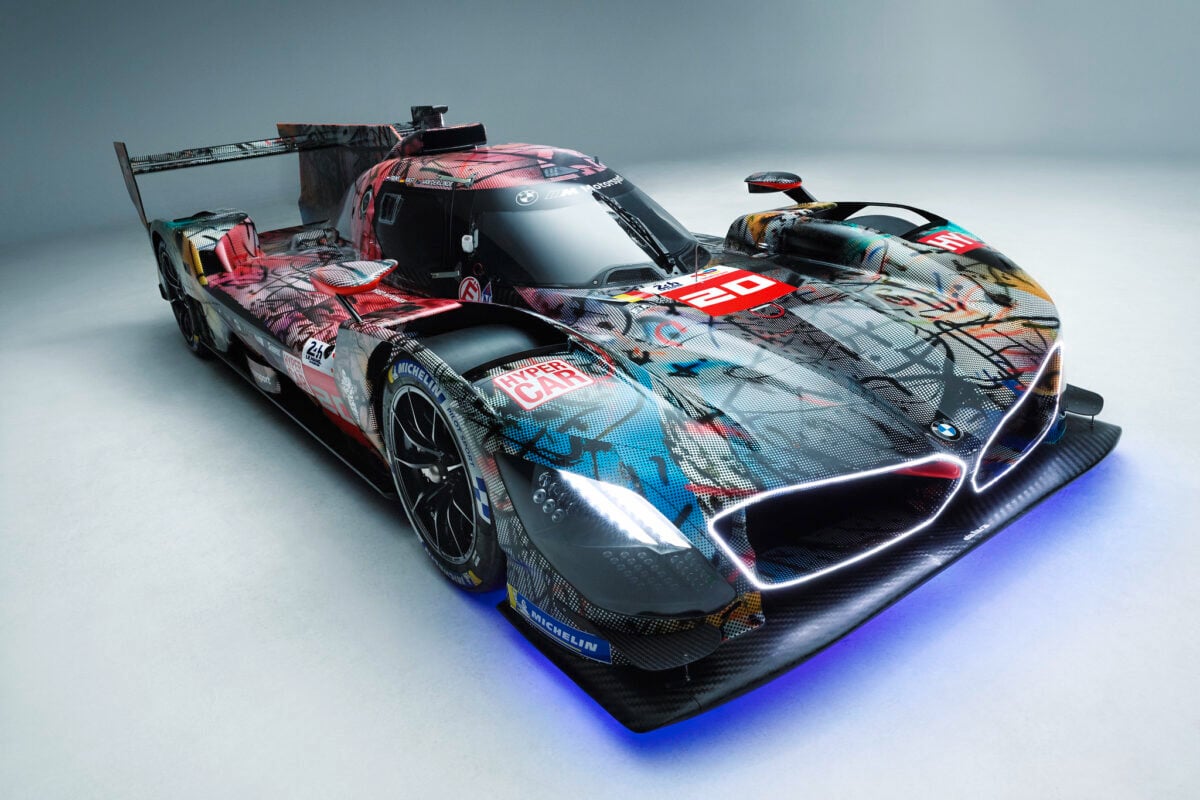
Ethiopian-American artist Julie Mehretu created the 20th BMW Art Car in 2024, bringing the collection full circle back to Le Mans. She based her design on her painting “Everywhen,” transferring neon colors, dotted grids, and gestural markings onto a BMW M Hybrid V8.
Mehretu imagined the car driving through her painting as if through a portal, with the artwork wrapping around the three-dimensional form. The design required elaborate car wrapping to meet racing regulations.
She worked closely with the German team Race Spirit, the same group that realized Jeff Koons’ Art Car design. The car debuted at an exhibition in Paris before racing at Le Mans with the starting number 20, exactly 49 years after Calder’s original.
A.R. Penck’s cryptic symbols

German artist A.R. Penck designed a BMW Z1 in 1991, covering the roadster with abstract figures and symbols inspired by cave paintings. The Z1 itself was already remarkable – a radical design with vertically-sliding retractable side doors that remain a milestone in BMW history.
Penck’s contribution came four years after the car premiered. He never provided any explanation for what his symbols meant, leaving interpretation entirely to viewers.
The mystery became part of the artwork’s appeal. Born Ralf Winkler in Dresden, Penck created a primitive visual language that contrasted sharply with the Z1’s high-tech engineering.
When art appreciation meets the open road
These collaborations changed how people think about cars and art. BMW keeps the original Art Cars in its museum, lending them out for special exhibitions worldwide. Some have appeared at the Louvre, the Whitney Museum, and the Guggenheim.
The vehicles proved that art doesn’t need to hang on walls or sit on pedestals – sometimes the best place for creativity is racing down a track at 200 miles per hour or cruising through city streets, turning heads at every stoplight. Artists found freedom in working with existing forms, stamping their visions onto machines built for performance.
And somehow, covering a precision-engineered vehicle in paint or patterns or cryptic symbols made both the art and the car more interesting.
More from Go2Tutors!

- The Romanov Crown Jewels and Their Tragic Fate
- 13 Historical Mysteries That Science Still Can’t Solve
- Famous Hoaxes That Fooled the World for Years
- 15 Child Stars with Tragic Adult Lives
- 16 Famous Jewelry Pieces in History
Like Go2Tutors’s content? Follow us on MSN.