Iconic Vehicles Born from US Military History
Military necessity creates vehicles that need to work in conditions that would destroy civilian transportation. When engineers design for combat, survival, and extreme environments, they sometimes create machines that transcend their original purpose.
These vehicles leave the battlefield and become part of everyday life, carrying with them stories of war, innovation, and adaptation that shape how Americans think about transportation.
The Jeep: From Willys to Wrangler

The Jeep started as a scramble to meet Army requirements in 1940. The military needed a light reconnaissance vehicle that could go anywhere, carry supplies, and survive abuse.
Willys-Overland won the contract and delivered a vehicle so capable that it became synonymous with American ingenuity during World War II. After the war, Willys recognized civilian potential and launched the CJ (Civilian Jeep) series.
Farmers used them to work their land. Hunters drove them into the remote wilderness. Families took them camping.
The design barely changed because it didn’t need to—the military had already solved most problems that civilian drivers would encounter. When Chrysler bought the Jeep brand, they maintained the basic formula while adding comfort features.
The Wrangler inherited the flat fenders, removable doors, and go-anywhere attitude that made the original Jeep legendary. Today’s Wranglers cost ten times what a CJ did, but buyers pay for a direct connection to that World War II workhorse.
The Hummer: Excess Meets Asphalt

The High Mobility Multipurpose Wheeled Vehicle, mercifully shortened to HUMVEE, replaced the Jeep as the military’s primary light vehicle in 1985. AM General built it wider, heavier, and more capable than anything that came before.
The HUMVEE could ford water, climb steep grades, and carry weapons that would crush a Jeep. Arnold Schwarzenegger saw HUMVEEs during a movie shoot and convinced AM General to build a civilian version.
The H1 Hummer hit showrooms in 1992, bringing military capability to suburban driveways. It was absurdly wide, had terrible fuel economy, and cost as much as a luxury sedan. People bought them anyway.
General Motors eventually took over and created the H2 and H3, which were really just Chevy trucks wearing Hummer costumes. The brand died during the 2008 financial crisis when gas prices spiked and buyers realized they didn’t actually need a vehicle designed for Iraqi deserts to drive to Costco.
The original HUMVEE still serves in various militaries worldwide, unbothered by its civilian offspring’s failure.
The Dodge Power Wagon: The Original Workhorse

Dodge built three-quarter-ton trucks for the military during World War II, creating the WC series that handled everything the Army threw at it. These trucks hauled supplies, towed artillery, and kept moving when roads disappeared.
After the war ended, Dodge saw potential in selling this capability to civilians who needed serious work vehicles. The Power Wagon launched in 1946 as essentially a military truck with a civilian bed.
It came with a Power Take-Off system, a winch, and four-wheel drive when most trucks still used two-wheel drive. Farmers, loggers, and construction companies bought them because nothing else could handle the same work.
Dodge kept making Power Wagons until 1968, then revived the name in 2005 for heavy-duty Ram trucks. Modern Power Wagons bear little resemblance to the originals beyond the name and the idea that some jobs require trucks built to military standards.
The C-47 Skytrain: Dakota’s Second Life

The military version of the Douglas DC-3 became the C-47 Skytrain during World War II. The Army Air Forces used it to haul cargo, drop paratroopers, and transport wounded soldiers.
More than 10,000 C-47s flew during the war, making it one of the most produced aircraft in history. After the war, the military sold surplus C-47s cheaply. Airlines bought them, converted them back to civilian configuration, and used them to launch post-war commercial aviation expansion.
Small airlines and cargo operators flew DC-3s and C-47s for decades because they were reliable, simple to maintain, and could land on rough airstrips. Some C-47s and DC-3s still fly today, more than 80 years after the first one rolled off the production line.
You can find them hauling cargo in remote areas, offering vintage flight experiences, or sitting in museums as examples of aircraft design that worked so well it never needed replacing.
The M35 Deuce and a Half: The Truck That Worked

The M35 cargo truck earned its nickname “deuce and a half” from its two-and-a-half-ton cargo capacity. The Army introduced it in 1950 and kept ordering them for decades.
These trucks could drive through mud, ford streams, and keep running with minimal maintenance. Soldiers learned to drive them, mechanics learned to fix them, and they became background fixtures in any military operation.
Surplus M35s flooded the civilian market as the military upgraded to newer vehicles. Farmers converted them into dump trucks.
Construction companies used them on job sites. Preppers bought them as ultimate survival vehicles.
Some people just wanted a truck that could plow through anything winter threw at it. The M35 design was so basic that almost anyone could work on it.
Parts remained available because so many were built. The truck didn’t ride smoothly, didn’t go fast, and drank fuel, but it accomplished what it was designed to do without complaint.
The M151 MUTT: The Jeep’s Problematic Successor

The military replaced the Jeep with the M151 Utility Tactical Truck in 1960. Engineers designed it with independent suspension for better off-road handling.
On paper, it outperformed the Jeep in every measurable way. In practice, the M151 had a dangerous habit of rolling over during sharp turns, killing soldiers and prompting modifications that never completely solved the problem.
The military eventually retired the M151 and prohibited civilian sales by cutting every vehicle in half before disposal. This ensured no one could drive them on public roads, though some people welded them back together or bought complete examples before the ban took effect.
The M151 serves as a reminder that replacing something that works often creates problems that didn’t exist before.
The M715 Kaiser Jeep: The Oddball Truck

Kaiser built the M715 for the military in the 1960s using Jeep Gladiator components. The truck featured a distinctive pointed nose and came with either a cargo bed or an ambulance body.
It used a Tornado straight-six engine and four-wheel drive, making it more capable than contemporary civilian trucks but less refined. The military only used M715s for about a decade before replacing them with commercial trucks.
Surplus M715s found buyers who appreciated their quirky styling and go-anywhere ability. The pointed grille made them instantly recognizable, and collectors now restore them as representatives of an era when military vehicles looked distinctly military.
The GMC CCKW: Jimmy’s War Effort

GMC built more than 560,000 CCKW trucks during World War II, earning them the nickname “Jimmy.” These 2.5-ton cargo trucks hauled supplies across Europe and the Pacific, often driving through conditions that would stop modern vehicles.
The simple design meant field repairs could keep them running even when parts ran short. After the war, surplus CCKWs became workhorses in industries that needed trucks more capable than what civilian manufacturers offered.
Construction companies, loggers, and oil field operators bought them. Some were converted into fire trucks, snow plows, or mobile workshops.
The CCKW proved that military durability translated well to civilian work when the job demanded toughness over comfort.
The M37 Dodge: The Power Wagon’s Military Twin

Dodge developed the M37 in the 1950s as a military truck based on Power Wagon components. The military bought tens of thousands for use in Korea and beyond.
The M37 shared the Power Wagon’s rugged drivetrain but came with military-specific features like blackout lights and pintle hitches. When the military sold off M37s, buyers discovered they were essentially Power Wagons with different bodies.
This made parts easy to find and repairs straightforward. M37s became popular with vintage military vehicle collectors because they could actually use them for work rather than just displaying them at shows.
The M38 and M38A1: Korean War Jeeps

The military continued buying Jeeps after World War II, ordering the M38 and M38A1 models during the 1950s. These Jeeps incorporated lessons from wartime use while maintaining the basic design that worked.
The M38A1 introduced the distinctive round fender design that would influence civilian CJ-5 and later Wrangler models. Surplus M38s reached civilian hands and became popular with hunters, farmers, and off-road enthusiasts.
They were simple enough that anyone could maintain them but capable enough to go places that would challenge modern SUVs. Original examples now command high prices from collectors who want authentic military Jeeps.
The M274 Mule: The Mechanical Pack Animal
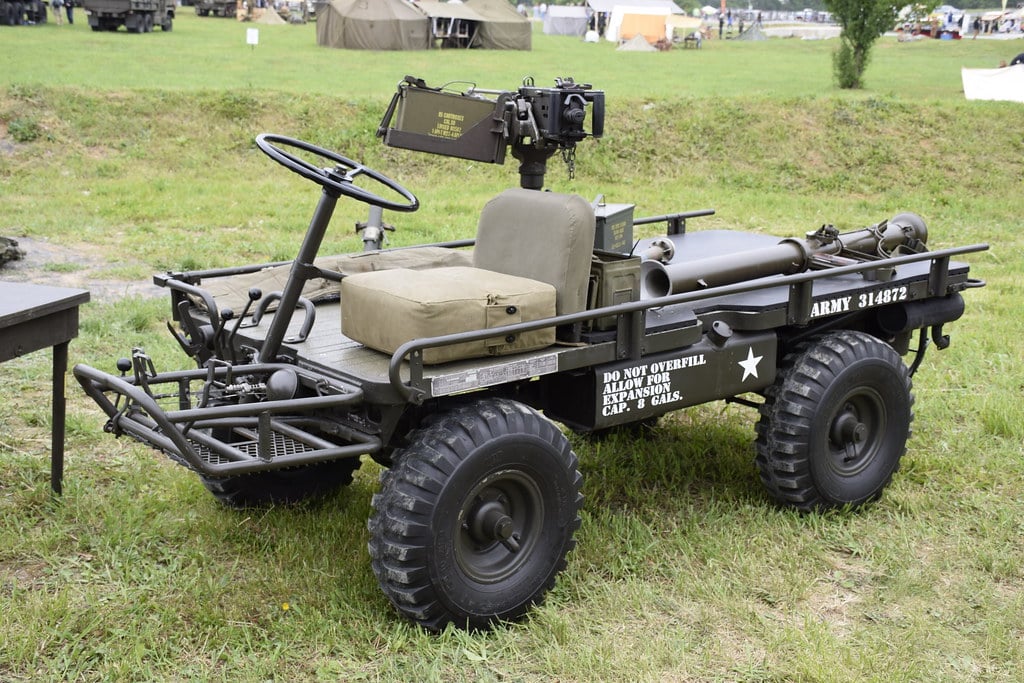
The military developed the M274 Mechanical Mule as a platform that could carry supplies across terrain where even Jeeps couldn’t go. The small four-wheel vehicle had no body, just a flat platform with a seat.
It could be driven normally or operated remotely, and paratroopers could drop it from aircraft. Civilians occasionally bought surplus Mules for use on ranches or in areas where full-size vehicles couldn’t fit.
The Mule’s tiny size and simple controls made it almost like a powered wheelbarrow. They weren’t particularly fast or comfortable, but they solved specific problems in niche applications.
The M416 and M101 Trailers: The Forgotten Haulers

Military trailers don’t get the attention that trucks and Jeeps receive, but the M416 quarter-ton and M101 three-quarter-ton trailers served just as long. These small trailers matched military vehicles in capability, featuring off-road suspension, military lighting, and construction that could take abuse.
The military produced them in enormous numbers because every vehicle needed something to tow. Surplus military trailers found eager civilian buyers who needed cheap, durable hauling capacity.
Off-road enthusiasts especially valued them because they could follow Jeeps and trucks through rough terrain without breaking. Many got modified with new boxes, camping setups, or tool storage while keeping the original chassis and wheels.
You still see M416s and M101s behind civilian vehicles, usually so modified that their military origins aren’t immediately obvious.
The Gamma Goat: Too Weird to Last

The M561 Gama Goat represented an attempt to create a vehicle that could go literally anywhere. It featured six-wheel drive and an articulated design that allowed the front and rear sections to move independently.
The Goat could swim, climb obstacles, and traverse terrain that stopped conventional vehicles. It also broke down constantly, was handled terribly on roads, and generally frustrated everyone who operated it.
The military retired the Gama Goat after relatively short service. A few reached civilian hands, mostly as curiosities for collectors who appreciate weird vehicles.
The Goat stands as proof that sometimes trying to do everything means doing nothing particularly well.
When War Machines Come Home

History rides along whenever these machines move from battlefields to backroads. Touching the steering wheel of a granddad’s old M38 means feeling what Korean War drivers gripped under fire.
Hauling bales behind an M35 tractor? That chassis once carried gear through warzone roads. Change the body, paint, purpose – still, roots stay visible beneath the surface.
Look at the way folks handle these machines. Restoration to factory condition happens far more with army rigs than regular old cars.
Instead of custom paint jobs, you find exact matches to military shades. Details like insignias appear just as they did back then.
More than rides, they’re working artifacts on wheels. Built for battle, these machines handle anything daily life brings – no trouble at all.
Toughness like that is why plenty still operate years later, working hard while holding echoes of the wars they knew.
More from Go2Tutors!

- The Romanov Crown Jewels and Their Tragic Fate
- 13 Historical Mysteries That Science Still Can’t Solve
- Famous Hoaxes That Fooled the World for Years
- 15 Child Stars with Tragic Adult Lives
- 16 Famous Jewelry Pieces in History
Like Go2Tutors’s content? Follow us on MSN.