Paintings with Hidden Symbols and Secret Messages
Staring at a well-known artwork for too long makes questions rise. The picture on the wall, snapped by countless visitors, carries quiet details unseen at first glance.
For hundreds of years, painters slipped meanings into their scenes without announcement. Hidden strokes sometimes challenged authority.
At times, they carried humor meant only for the artist. Certain clues stay unexplained, debated by experts even now.
Long before frames hung just for beauty, artists slipped secret signs into their pieces. Back then, canvases did not simply sit on walls they whispered legends, carried prayers, even passed forbidden thoughts without words.
Suddenly noticing those quiet clues changes how you walk through galleries. What seems like an ordinary glance becomes a hunt for what lies beneath.
The Brain Inside the Sistine Chapel

Michelangelo painted the ceiling of the Sistine Chapel between 1508 and 1512. The most famous section shows God reaching out to give life to Adam.
But look at the shape surrounding God and the angels. The billowing reddish-brown cloak forms the exact outline of a human brain.
Researchers have identified specific anatomical features within this shape, including what appears to be the pituitary gland and the vertebral artery. Some art historians believe Michelangelo was making a statement about divine knowledge—God literally giving Adam intelligence.
Others think the artist, known for his anatomical studies, was quietly protesting the Catholic Church’s opposition to science. Either way, the message remained hidden in plain sight for nearly 500 years.
An Angel’s Rude Gesture

Michelangelo wasn’t finished with his hidden commentary on the Sistine Chapel ceiling. Pope Julius II, who commissioned the work, was deeply unpopular.
The artist painted the prophet Zechariah to resemble the pope, creating a subtle portrait of his difficult patron.
Behind Zechariah, one of the angels makes an old insult gesture called “the fig”—essentially giving the prophet (and by extension, the pope) the Renaissance equivalent of an obscene hand sign. For those who noticed, it was a quiet act of defiance preserved on a church ceiling for eternity.
Jan van Eyck’s Mirror Trick

The Arnolfini Portrait from 1434 appears to show a wealthy couple standing in their home. But van Eyck left several surprises in the composition.
On the wall behind the figures, he painted in Latin: “Jan van Eyck was here, 1434.” The artist signed his work like graffiti.
More fascinating is the convex mirror on the wall. Look closely and you can see two additional figures reflected in the glass—people standing where the viewer would be.
Many believe one of these figures is van Eyck himself, inserting his own presence into the scene. The mirror becomes a portal, showing us what exists beyond the frame of the painting.
The Skull You Almost Miss

Hans Holbein the Younger painted The Ambassadors in 1533, a double portrait of two French diplomats surrounded by scientific instruments, books, and symbols of their learning. At the bottom of the painting, a strange diagonal smear disrupts the composition.
Walk to the far right side of the painting and look again. The smear transforms into a perfect human skull.
This technique, called anamorphosis, requires viewers to change their perspective to see what’s hidden. The skull serves as a memento mori—a reminder that death comes for everyone, no matter how wealthy or educated.
A partially hidden crucifix in the upper left corner offers the promise of something beyond mortality. The painting was likely designed to hang near a doorway.
People walking past would suddenly see the skull appear as they moved, a jarring reminder amid all the symbols of earthly achievement.
Bosch’s Garden of Nightmares

Hieronymus Bosch painted The Garden of Earthly Delights around 1500. The triptych is packed so densely with symbols that scholars have spent centuries trying to decode it.
The central panel shows countless figures engaged in strange activities—nibbling giant strawberries, emerging from flower petals, riding animals in circles around a pond.
Nearly every element carried specific meaning to viewers in Bosch’s time. The garden setting itself signified temptation.
Fish represented a crude symbol in Netherlandish culture. Musical instruments suggested sinful pleasures.
The oversized fruits people consume throughout the painting referenced forbidden desires. The right panel shows a hellscape where humans are tortured by the same instruments that brought them pleasure.
Art historians still debate whether Bosch intended the work as a moral warning or something else entirely. Some scholars in the twentieth century argued that the painter belonged to a heretical sect that viewed earthly pleasure as a return to innocence.
The truth remains uncertain, but the painting continues to reveal new details with each viewing.
Van Gogh’s Hidden Supper
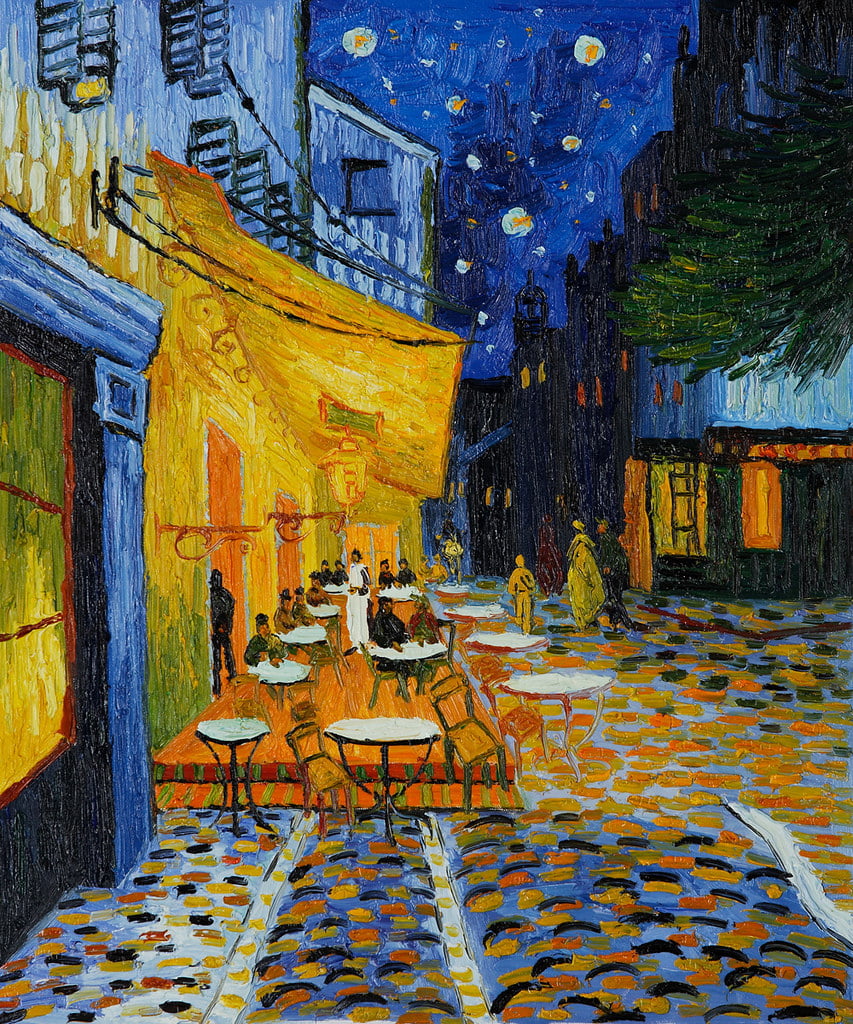
Vincent van Gogh painted Café Terrace at Night in 1888, capturing an outdoor cafe in Arles, France, under a starry sky. For over a century, people only saw beautiful night scenes.
Then researchers noticed something curious. Count the figures seated at the cafe tables: twelve people surround a central figure with long hair.
A shadowy person exits through a doorway. Cross shapes appear throughout the composition, including one formed by a window frame directly above the central figure, creating the appearance of a halo.
Van Gogh came from a deeply religious family—his father was a minister—and had once hoped to become a preacher himself. In a letter written around the time of this painting, he expressed “a tremendous need for, shall I say the word—for religion.”
Many now believe the painting contains a hidden reference to The Last Supper, with the cafe becoming a modern setting for the biblical scene.
Letters in the Mona Lisa’s Eyes

Leonardo da Vinci’s most famous painting has inspired centuries of speculation. In 2010, Italian researcher Silvano Vinceti claimed to have found microscopic letters and numbers hidden in the Mona Lisa’s eyes using high-resolution imaging.
According to Vinceti, the right eye contains the letters “LV”—presumably Leonardo’s initials. The left eye shows markings that could be letters or numbers, though they’re harder to decipher.
The number “72” appears in the arch of the bridge in the background. Some believe these numbers relate to mystical traditions Leonardo studied.
Others remain skeptical, pointing out that a 500-year-old painting might show cracks and marks that only resemble intentional symbols. Whether the letters are real or imagined, they reflect something true about this painting.
People have always sensed that Leonardo hid something in it, something beyond the famous smile.
A Hidden Portrait in the Wine

Caravaggio’s painting Bacchus from around 1596 shows the Roman god of wine holding a glass toward the viewer. For four hundred years, people admired the work without noticing what technology would eventually reveal.
In 2009, researchers used reflectography—a technique that sees beneath layers of paint—and discovered a tiny figure hidden inside the wine carafe. The image shows a man sitting upright, his arm pointing toward the canvas.
Many experts believe this is Caravaggio painting a secret self-portrait, trapped inside the wine like a message in a bottle.
Clara Peeters and Her Tiny Reflections

Dutch painter Clara Peeters specialized in still life paintings in the early seventeenth century. Her work Still Life with Cheeses, Almonds and Pretzels from around 1615 shows a beautifully arranged table of food.
But look at the knife blade. Reflected in the polished metal, you can see a tiny self-portrait of the artist.
Peeters painted herself into her own work, not prominently, but secretly—visible only to those who look closely enough. In a time when female artists faced significant barriers to recognition, this hidden signature served as a quiet claim of authorship.
Botticelli’s Botanical Encyclopedia

Sandro Botticelli’s Primavera, painted in the late 1470s or early 1480s, depicts mythological figures in a garden setting. The painting contains over 500 individual plants representing more than 200 distinct species.
All of which would have grown around Florence in springtime during the fifteenth century. This wasn’t careless decoration.
Botticelli painstakingly researched and depicted each plant with botanical accuracy. Scholars believe the work contains allegorical meanings tied to specific flowers and plants, though the full significance remains debated.
The orange grove setting, the flowers beneath the feet of the figures, and the wreaths they wear all communicate something to viewers who know the language of Renaissance botany.
Music Hidden in The Last Supper

Leonardo da Vinci’s The Last Supper has generated countless theories about hidden codes. In 2007, Italian musician Giovanni Maria Pala proposed one of the most unusual: the painting contains musical notes.
Pala noticed that the bread rolls on the table, combined with the positions of the apostles’ hands, create a pattern that corresponds to musical notation. Reading from right to left (the direction Leonardo often wrote), these elements produce a forty-second composition.
Some scholars call the theory plausible, noting that Leonardo was himself a skilled musician. Others dismiss it as coincidence.
But the idea that Leonardo might have hidden a requiem in his most famous religious painting captures something about his reputation for layered meanings.
Rembrandt’s Changing Faces

Rembrandt painted Danaë in 1636, depicting the mythological princess who would become the mother of Perseus. But the woman in the painting has an unusual expression—expectant, vulnerable, almost conversational.
That differs from the passive poses typical of the subject. X-ray analysis revealed that Rembrandt originally painted a different face.
The first version resembled his wife Saskia. After her death, he appears to have reworked the features to resemble his later companion, Geertje Dircx.
The painting became a palimpsest of his emotional life, with one lover painted over another.
The Persistence of Mystery

Hidden meanings show up when creators speak beyond what others allow. Though hired by the Church, one painter questioned power using body details.
Even when women received little recognition, an artist marked her name on canvas. Grief shaped another man’s hand, holding his beloved close within each scene.
Patience opens doors that quick glances slam shut. Hidden meanings live just outside plain sight, waiting for someone willing to stare a little longer.
Paintings in textbooks or behind glass hold quiet clues most walk past without noticing. What feels familiar today might whisper something fresh tomorrow.
A single glance rarely catches everything worth seeing. Each person brings different eyes, revealing pieces left unseen before.
More from Go2Tutors!

- The Romanov Crown Jewels and Their Tragic Fate
- 13 Historical Mysteries That Science Still Can’t Solve
- Famous Hoaxes That Fooled the World for Years
- 15 Child Stars with Tragic Adult Lives
- 16 Famous Jewelry Pieces in History
Like Go2Tutors’s content? Follow us on MSN.