The Most Expensive Watches Ever Made
There’s something strange about paying tens of millions of dollars for an object that tells time. Your phone does it for free.
A gas station clock does it for a few bucks. And yet, some of the wealthiest people on earth have handed over staggering sums — sometimes nine figures — for a single watch. Why?
The answers are messier than you’d expect. Some of these watches are feats of mechanical genius, crammed with more moving parts than a small factory.
Others are basically jewelry with a clock tucked in as an afterthought. A few carry histories so dramatic they belong in novels, not watch catalogs.
And some are simply the rarest objects on the planet — made in quantities of one, or five, or ten — and that scarcity alone drives the price into the stratosphere. Here are the watches that have pushed the boundaries of what people are willing to pay.
The $55 Million Diamond Bracelet That Happens to Be a Watch
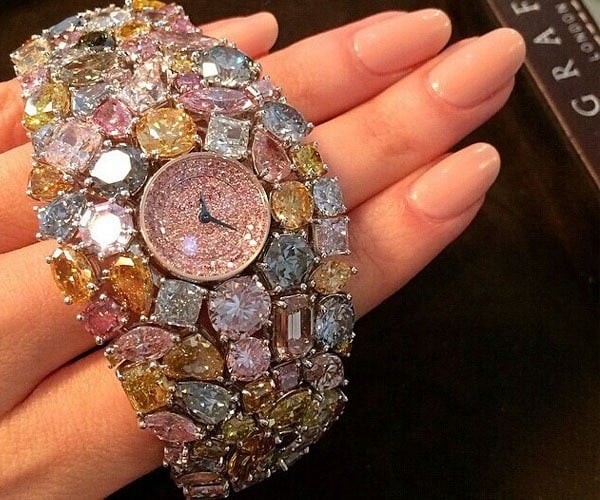
The Graff Diamonds Hallucination holds the title of the most expensive watch ever created, with a price tag of $55 million. But calling it a watch feels generous.
The actual timekeeping dial is tiny — a small quartz face framed by pink diamonds, easily missed if you’re looking at the rest of the piece. And the rest of the piece is extraordinary.
A platinum bracelet covered entirely in 110 carats of rare colored diamonds: vivid yellows, intense pinks, blues, greens, oranges. Half the stones weigh two or three carats each, and sourcing them took over two years.
A team of 30 specialists — designers, gemologists, and master craftsmen — spent another two and a half years assembling the thing. It debuted at Baselworld in 2014 and sparked an immediate argument in the watch world.
Some called it a masterpiece. Others pointed out that a quartz movement inside a $55 million piece of jewelry bordered on absurdist comedy.
To this day, no confirmed buyer has stepped forward, which raises a fair question about whether “most expensive watch ever made” and “most expensive watch ever sold” are actually the same thing.
The Yellow Diamond Fever Dream

Jacob & Co. took a different approach to the diamond watch with the Billionaire Timeless Treasure, priced at $20 million. Where the Graff Hallucination leans into colored stones for pure spectacle, Jacob & Co. committed entirely to yellow diamonds — and the commitment bordered on obsessive.
Yellow diamonds occur at a rate of roughly one in every 10,000 white diamonds. Jacob & Co. spent three and a half years hunting the globe for 425 stones that matched in color and quality.
They started with 880 carats of rough diamonds and ended up with 216.89 carats after cutting. Each stone was Asscher-cut — a demanding process that wastes a significant portion of the raw material.
The skeleton tourbillon movement underneath is genuinely impressive engineering, but the watch exists primarily as a statement: wealth, turned into a wearable object.
The Auction King

If you’re talking about real money actually changing hands, the Patek Philippe Grandmaster Chime Ref. 6300A-010 holds the record. It sold for $31.19 million at a Christie’s auction in Geneva in November 2019, making it the most expensive watch ever sold at auction.
The watch packs 20 complications into its case, including a Grande Sonnerie, a petite Sonnerie, a minute repeater, and an alarm. It features a patented double-face case that flips instantly using a reversing mechanism — so both sides are functional dials.
Patek Philippe originally launched the Grandmaster Chime line in 2014 to celebrate its 175th anniversary, but this particular example stands apart from the rest of the collection for one reason: it’s the only Grandmaster Chime ever made in stainless steel. That single material choice, combined with the watch’s technical depth, is what sent collectors into a frenzy at auction.
The Pocket Watch That Broke Records

Before wristwatches dominated, pocket watches were the pinnacle of horological ambition. The Patek Philippe Henry Graves Supercomplication is a perfect example of that era’s obsession with mechanical complexity.
American banker Henry Graves Jr. commissioned the watch in 1927, reportedly after a bet with another collector over who could own the most complicated timepiece. Patek Philippe spent eight years building it.
The finished watch contains 24 complications and 1,366 individual parts, packed into an 18-karat gold case. For decades it held the title of the most complicated watch in the world.
When it went to auction in Geneva in 2014, it sold for $23.98 million — a record for any pocket watch ever.
The Watch Paul Newman Wore

The Rolex “Paul Newman” Daytona Ref. 6239 is the only non-Patek Philippe watch in the top tier of auction records, and its story is as much about romance as it is about rarity. Newman’s wife, Joanne Woodward, gave it to him as a gift, and had the caseback engraved with a simple message: “Drive Carefully Me.”
Newman wore the watch casually for years, and it became associated with his image as a racing driver and film star. When it went to auction at Phillips in New York in October 2017, bidding went on for over 11 minutes before the hammer fell at $17.75 million.
It remains the most expensive Rolex ever sold publicly, and it likely will for a long time.
A Watch Finished 34 Years After a Queen Was Executed
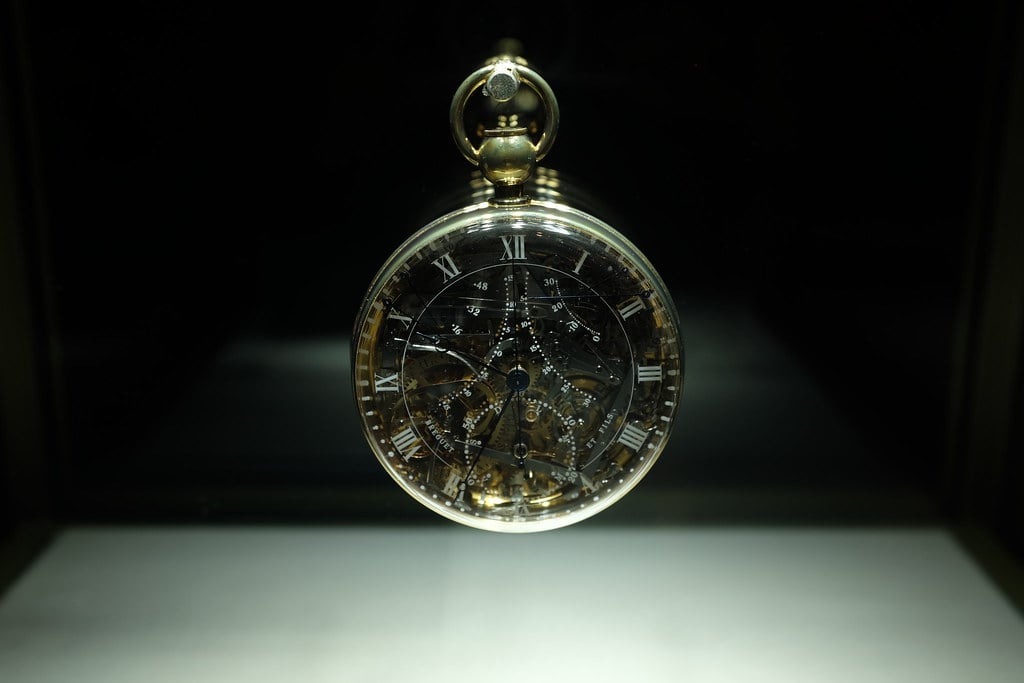
Few objects in the history of horology carry a story as strange as the Breguet No. 160, known simply as the “Marie Antoinette.” The watch was commissioned in 1783 — reportedly by a secret admirer of the French Queen — with an extraordinary brief: include every known complication, use the finest materials available, and set no deadline or budget.
Abraham-Louis Breguet began work on it that same year. Then the French Revolution happened.
Marie Antoinette was executed in 1793. Breguet himself died in 1823.
His son finished the watch in 1827 — 44 years after work began. The completed piece features a perpetual calendar, minute repeater, equation of time, a thermometer, and sapphires used throughout the mechanism to reduce friction.
It sat quietly in private collections for generations before being stolen from a museum in Jerusalem in 1983 as part of a massive heist. The thief hid the watches across three countries.
The Marie Antoinette wasn’t recovered until 2007, when authorities tracked down the stolen pieces years after the thief’s death. Today it sits in the L.A. Mayer Institute for Islamic Art, valued at roughly $30 million.
The Most Complicated Watch on Earth

In 2015, Vacheron Constantin unveiled the Reference 57260 and made a bold claim: this is the most complicated pocket watch ever made. Nobody seriously disputed it.
The watch contains 57 complications — nearly double the 33 that the previous record holder, the Patek Philippe Calibre 89, had carried since 1989. Three master watchmakers spent eight years building it.
The movement alone contains 2,601 parts. The entire watch weighs close to a kilogram and measures 98 millimeters across.
It displays the Gregorian calendar, the Judaic calendar, and a lunar calendar simultaneously. It includes a triple-axis tourbillon, a double retrograde split-second chronograph, and a Westminster chime.
Ten of its functions had never been built into a watch before. The price remains confidential, but credible estimates put it well above $10 million — possibly close to $20 million.
Then in 2024, the same anonymous collector commissioned a follow-up: the Berkley Grand Complication, with 63 complications and the first-ever Chinese perpetual calendar in a mechanical watch.
A $52,000 Watch That Sold for $6.5 Million

The Patek Philippe Nautilus Ref. 5711/1A-018 with a Tiffany Blue dial might be the best case study in how scarcity and desire can detach a watch’s price from any rational measure of its components. The watch retailed for about $52,000.
It sold at auction for $6.5 million — roughly 125 times its list price. Patek Philippe made only 170 of them, produced exclusively to celebrate 170 years of partnership with Tiffany & Co.
The dial carries both the Patek Philippe and Tiffany & Co. logos. One example was consigned to Phillips in New York for a charity auction in December 2021, with all proceeds going to The Nature Conservancy.
Bidding started at $20,000 and took less than 15 minutes to reach the final price. Celebrities like Jay-Z and Leonardo DiCaprio received allocations of the watch through Tiffany boutiques.
The sale demonstrated, more clearly than almost any other event in recent watch history, that the market for luxury timepieces runs on something deeper than craftsmanship.
The Ring Watch Worth $40 Million
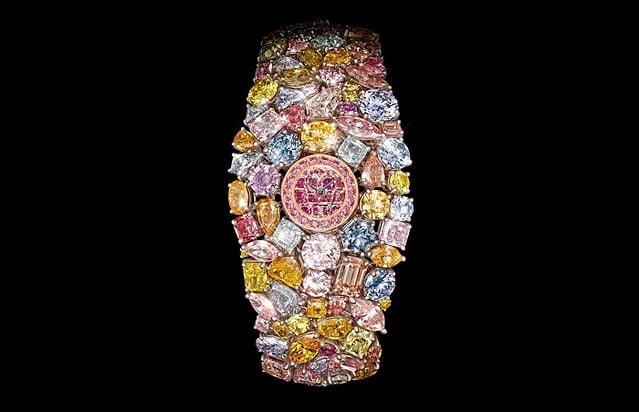
Graff Diamonds followed up the Hallucination with the Fascination in 2015, priced at $40 million. It shares the Hallucination’s DNA — platinum, rare diamonds, extravagant gem-setting — but adds a twist that borders on theatrical.
The watch features a 38-carat pear-shaped diamond that detaches from the piece entirely and can be worn as a ring. The remaining body of the watch is set with an additional 152.96 carats of white diamonds.
It’s a design that blurs the line between jewelry and timepiece even more aggressively than its predecessor, and it positions Graff firmly in the space where horology meets high jewelry. Whether you find it beautiful or ridiculous probably says more about you than it does about the watch.
Steel in Wartime: The $11 Million Patek
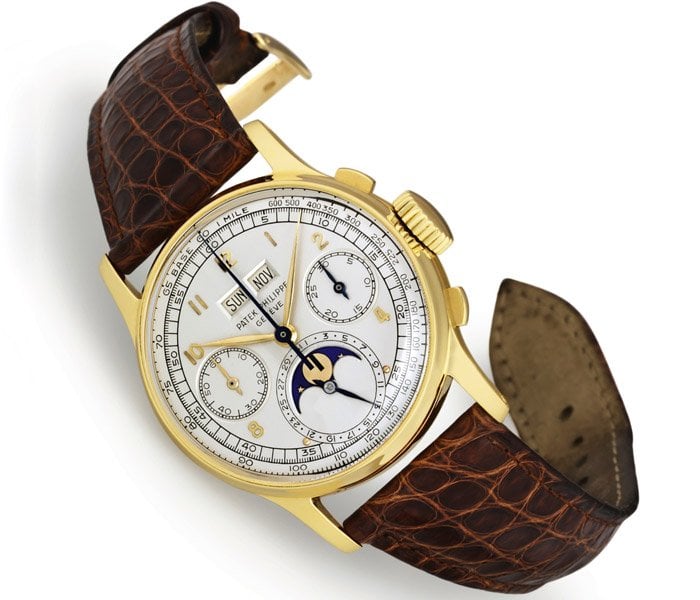
The Patek Philippe Ref. 1518 in stainless steel is valuable for a reason that has nothing to do with diamonds or celebrity. It was made in 1943, during World War II, at a time when stainless steel was being directed to the war effort.
Patek Philippe produced only four Ref. 1518 watches in steel during this period — and the Ref. 1518 was already significant, being the first wristwatch to combine a perpetual calendar with a chronograph.
When one of these four steel examples went to auction at Phillips in Geneva in 2016, it set a world record at the time for the most expensive wristwatch ever sold, fetching $11.1 million. The scarcity here isn’t manufactured by a marketing team.
It’s a genuine product of history and circumstance, and collectors feel that difference.
The Marvel Collab That Fetched Millions

Audemars Piguet has always pushed the boundaries of what a luxury watch can look like, and the Royal Oak Concept Tourbillon Spider-Man edition proved just how far that impulse can go. Made in partnership with Marvel, the watch features Spider-Man imagery worked into its design — a departure from the brand’s typically austere aesthetic.
A special version sold at auction in 2023 for $6.2 million, becoming the most expensive Audemars Piguet ever sold publicly. The sale surprised many in the traditional watch community, who expected the collaboration to be seen as a novelty rather than a serious collector piece.
It turned out that the combination of brand prestige, limited production, and genuine visual spectacle appealed to a wider audience than expected.
A Skull Worth Almost $7 Million

Richard Mille watches are built differently from almost everything else in fine watchmaking. The brand uses aerospace-grade materials — titanium, carbon fiber composites, polymers — and designs cases that look more like engineering prototypes than traditional watch cases.
The RM 52-01 Skull Tourbillon “Vanitas Vanitatum” takes this further with a hand-sculpted skull on the dial, rendered in three dimensions. The watch sold at auction in 2020 for $6.9 million, setting a record for the brand.
Richard Mille pieces are already famously expensive at retail — some models run into the hundreds of thousands — but the RM 52-01 demonstrated that the brand’s most dramatic designs could also command serious secondary market prices. It sits in an interesting space: technically ambitious, visually confrontational, and deeply polarizing among collectors.
The Egyptian Prince’s Timepiece
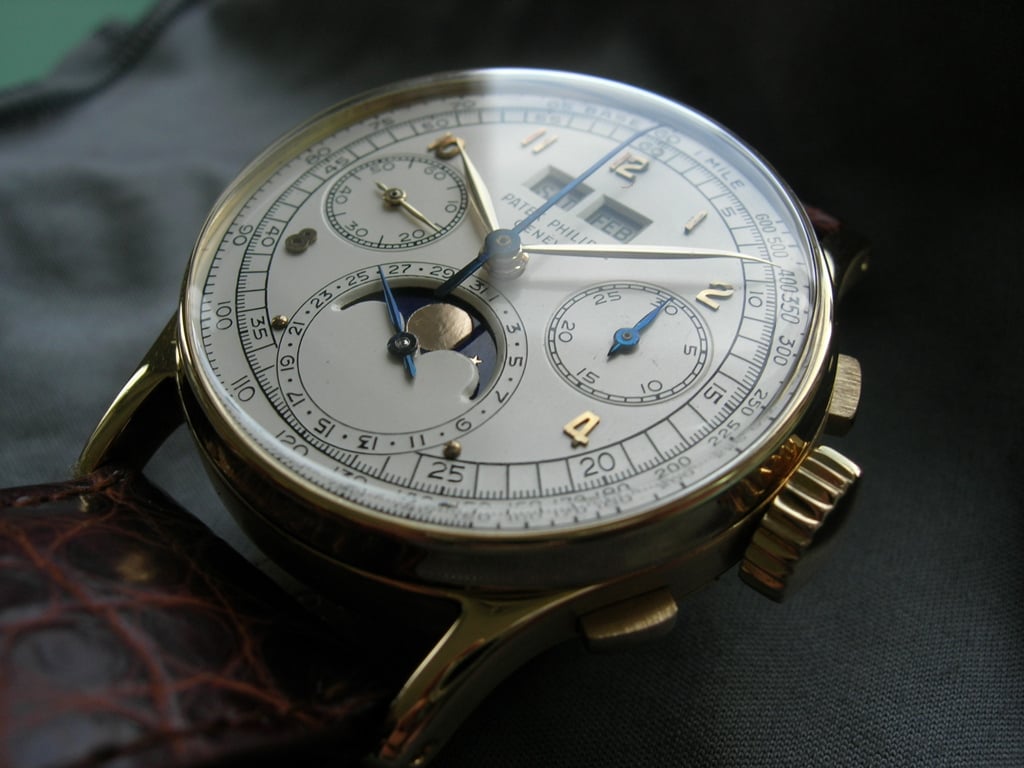
Among the most storied vintage watches in existence is the Patek Philippe Ref. 1518 in pink gold, known as the “Prince Mohammed Tewfik A. Toussoun.” The watch was acquired in 1951 by an Egyptian prince who was a direct descendant of Muhammad Ali, the founder of modern Egypt.
All original certificates and documentation survived with the piece. When it went to auction at Sotheby’s in 2021, it sold for $9.57 million.
The combination of an already rare reference, exceptional condition, royal provenance, and complete documentation made it one of the most desirable vintage watches on the market. It’s a reminder that in the world of high-end horology, history and story carry real financial weight.
What You’re Actually Paying For

A few of these timepieces cost far more than their materials suggest. Weeks of careful work go into each one, yet labor alone does not push values skyward.
Precious metals like gold add cost, though never enough to reach tens of millions. The presence of diamond, even uncommon stones, fails to justify extreme figures.
Value here rises beyond weight or craftsmanship. What drives prices so high lies elsewhere entirely.
It isn’t just about function. Hidden beneath sits rarity, legacy, handwork renown – tied together by how people who collect agree on worth.
Timekeeping? A basic quartz does the job fine. Yet look closer.
There lives a past filled with monarchs, heists, battlefields, artisans bent over tiny tools in Swiss workshops. That weight of narrative – passed down, built up – becomes why one person hands over thirty-one million dollars.
Meaning shapes price more than precision ever could.
Time Not Counted in Hours

A watch here might just remind you how little attention we pay to seconds passing. Not because it ticks louder but because what hides beneath the glass feels alive – imagine minuscule wheels spinning together like they’ve rehearsed for centuries.
One piece stands apart simply by surviving wars; others were never made again. Then there’s the pull of owning a shape or weight so unique you sense it before seeing it.
Fascination doesn’t demand understanding, especially with these watches. Spend moments near one – study its details, listen to its past whispers – then it becomes clear why some wearers treat timepieces like heirlooms.
Not merely tools for reading hours, they become companions worn close.
More from Go2Tutors!

- The Romanov Crown Jewels and Their Tragic Fate
- 13 Historical Mysteries That Science Still Can’t Solve
- Famous Hoaxes That Fooled the World for Years
- 15 Child Stars with Tragic Adult Lives
- 16 Famous Jewelry Pieces in History
Like Go2Tutors’s content? Follow us on MSN.