Unusual Roadside Attractions That Became Legends
American roads hold weird surprises. While some began as pranks or marketing tricks, a few came from wild passion or creative dreams.
Still, each one caught eyes and just stuck around. What started out as odd little ideas turned into spots pulling in crowds every single year.
These places stand for a one-of-a-kind American spirit – go ahead, make something totally ridiculous and see folks travel hours just to check it out.
The World’s Largest Sphere of Twine

Cawker City, Kansas holds a massive sphere of sisal twine that weighs over 20,000 pounds. Frank Stoeber started it in 1953, wrapping twine in his spare time.
After his death, the town took over. Every August, residents add more twine during a festival.
The circumference now exceeds 40 feet. Minnesota claims its own champion twine sphere in Darwin, created by Francis Johnson between 1950 and 1979.
He worked alone, refusing help, and the finished product weighed nearly nine tons. The rivalry between these two towns over which has the “biggest” continues today, depending on how you measure.
Cadillac Ranch

Ten Cadillacs stand buried nose-first in the ground outside Amarillo, Texas. Artist Chip Lord and the Ant Farm collective installed them in 1974, angling the cars at 60 degrees.
Visitors spray paint the cars freely, creating layers of graffiti that change constantly. The installation originally stood in a different location but had to move when suburban sprawl encroached.
Stanley Marsh 3, the eccentric millionaire who funded the project, relocated the cars in 1997. The site remains accessible 24 hours a day, and the paint never stops accumulating.
Lucy the Elephant

A six-story elephant made of wood and tin stands in Margate City, New Jersey. James Lafferty built Lucy in 1881 as a real estate promotion, and she’s one of the oldest surviving roadside attractions in America.
Visitors climb spiral staircases inside her legs to reach rooms in her body. Lucy served various purposes over the years—tavern, hotel, private residence.
By the 1960s, she was falling apart. A preservation group saved her from demolition, and she’s now a National Historic Landmark.
You can tour her interior and climb up to the howdah on her back for views of the coastline.
The Mystery Spot

Santa Cruz, California hosts a tilted shack where gravity supposedly doesn’t work properly. Visitors experience visual phenomena that seem to defy physics—people appear to change height when switching positions, and it feels impossible to stand up straight.
The attraction opened in 1939 after owner George Prather claimed to discover a circular area where strange forces were at work. Scientists explain the effects as optical illusions created by tilted architecture and clever design.
But the Mystery Spot doesn’t break the spell by admitting this. Guided tours lean into the weirdness, and visitors leave both skeptical and delighted by the experience.
South of the Border

Pedro’s South of the Border sprawls across Interstate 95 near the North Carolina-South Carolina state line. The complex features a 200-foot sombrero tower, restaurants, gift shops, fireworks stores, and motels, all decorated with Mexican-themed kitsch.
Alan Schafer opened a small beer stand here in 1949 and expanded it over decades into this impossible-to-miss destination. Hundreds of billboards announce South of the Border for miles in both directions, featuring terrible puns and the mascot Pedro.
The place looks dated now, stuck in a 1970s aesthetic. But that’s part of the appeal.
It represents a specific era of American road culture that’s largely disappeared.
Salvation Mountain

Leonard Knight spent three decades covering a hillside near Niland, California with adobe clay, straw, and thousands of gallons of paint. His creation shouts messages about God’s love in bright primary colors.
Knight started work in 1984 and continued until health problems forced him to stop in 2011. He died in 2014.
The mountain sits in the Colorado Desert on public land. After Knight’s death, volunteers have maintained the site.
The paint fades quickly in the harsh climate, requiring constant touch-ups. Salvation Mountain represents outsider art at its most ambitious—one man’s vision executed through decades of solitary labor.
The House on the Rock
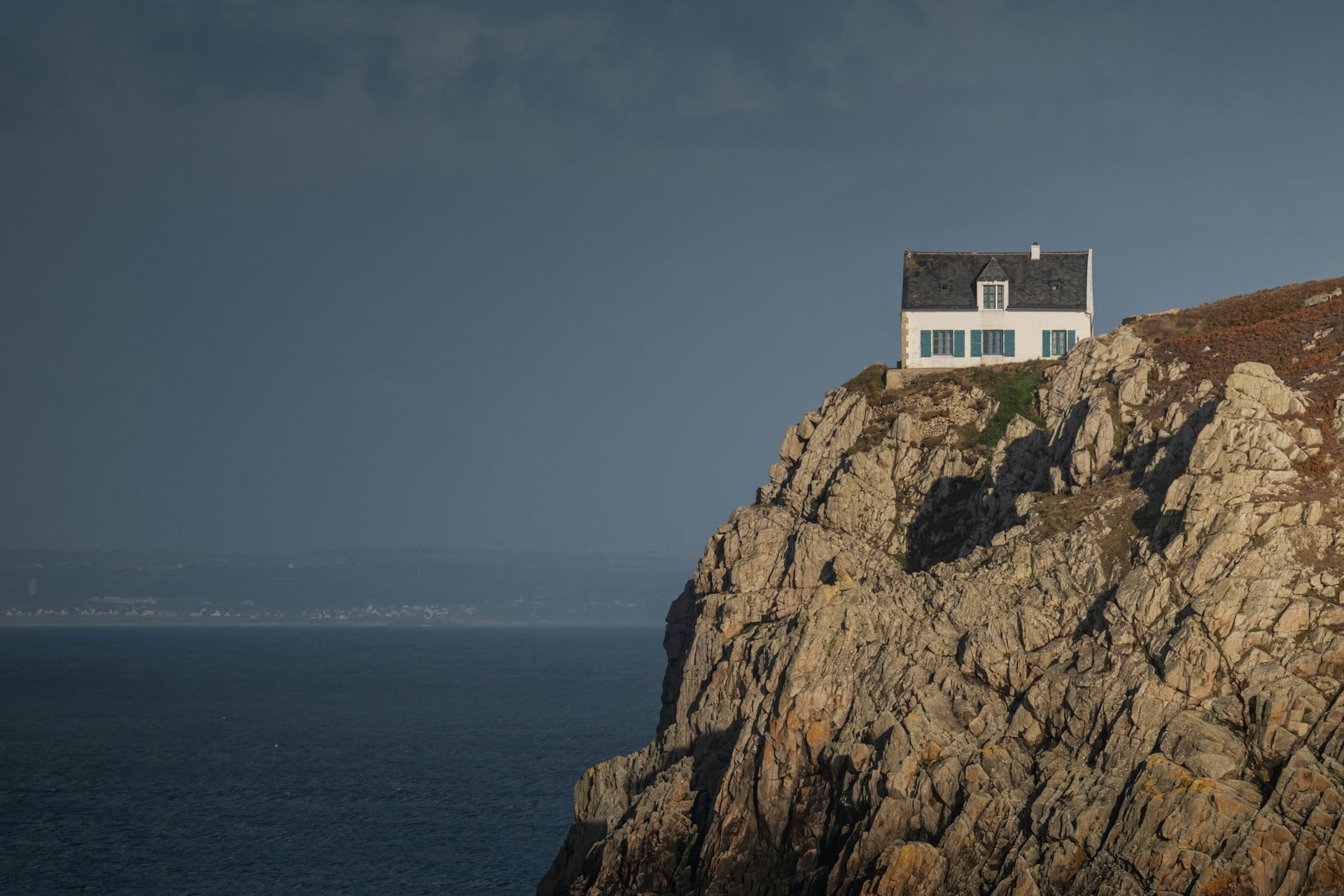
Alex Jordan built this Wisconsin attraction starting in the 1940s, constructing a house on top of a rock chimney 450 feet above the valley floor. But the house was just the beginning.
Jordan kept adding rooms, collections, and themed spaces over the decades. The complex now includes the Infinity Room, which cantilevers out from the house with windows on all sides, the Streets of Yesterday with recreated shops, and the world’s largest carousel.
The collections inside range from impressive to bewildering—antique music machines, dollhouses, weapons, nautical artifacts, and automated orchestras. Jordan died in 1989, but his creation continues to puzzle and fascinate visitors who spend hours wandering through the labyrinthine spaces.
Coral Castle

Edward Leedskalnin carved 1,100 tons of coral rock into a sculpture garden in Homestead, Florida. Working alone at night between 1923 and 1951, he cut and moved massive stones using homemade tools.
He claimed to understand the secrets of the Egyptian pyramids, and he never fully explained his methods. The stones fit together without mortar.
Some weigh several tons, yet Leedskalnin moved them by himself. He created furniture, including rocking chairs and tables, entirely from coral rock.
After his death, people promoted theories about antigravity devices and magnetic energy. More likely, Leedskalnin used clever engineering with block and tackle systems, but the mystery persists.
Foamhenge

Mark Cline created a full-scale replica of Stonehenge using Styrofoam in Natural Bridge, Virginia. He built it in 2004, originally as part of a sculpture park.
The lightweight stones look surprisingly convincing from a distance. Cline painted them to resemble weathered sarsen stones.
The installation pokes fun at America’s fascination with ancient monuments while being genuinely impressive in its execution. Foamhenge moved to a new location in Centreville, Virginia in 2017.
It sits on a hilltop where visitors can walk among the foam megaliths and contemplate the absurdity of recreating Neolithic architecture from modern materials.
The Thing

Off Interstate 10 in Arizona, yellow billboards ask “WHAT IS THE THING?” for hundreds of miles. The attraction sits in a desert gas station complex.
You pay admission, walk through a covered pathway, and find yourself in a building containing various odd artifacts and dioramas. The Thing itself remains deliberately anticlimactic.
Visitors who’ve seen it still debate what it actually is—a mummified body, a fake, something else entirely. The attraction works because the marketing creates expectations that the reality undercuts.
People stop specifically because they need to know, and afterward, they can’t decide if they got their money’s worth.
Prada Marfa

Artists Elmgreen and Dragset installed a freestanding Prada store in the desert outside Marfa, Texas in 2005. The building contains actual Prada shoes and handbags from the fall/winter 2005 collection, displayed in illuminated windows.
The door doesn’t open. It’s a permanent sculpture, not a functioning store.
Vandals have broken in multiple times, and the harsh climate requires ongoing maintenance. The installation comments on consumerism and luxury brands, but it’s also become exactly what it satirizes—a destination people visit to take photos.
The irony of driving into the desert to see a fake store that’s now a real tourist attraction isn’t lost on anyone.
The Giant Uniroyal Tire
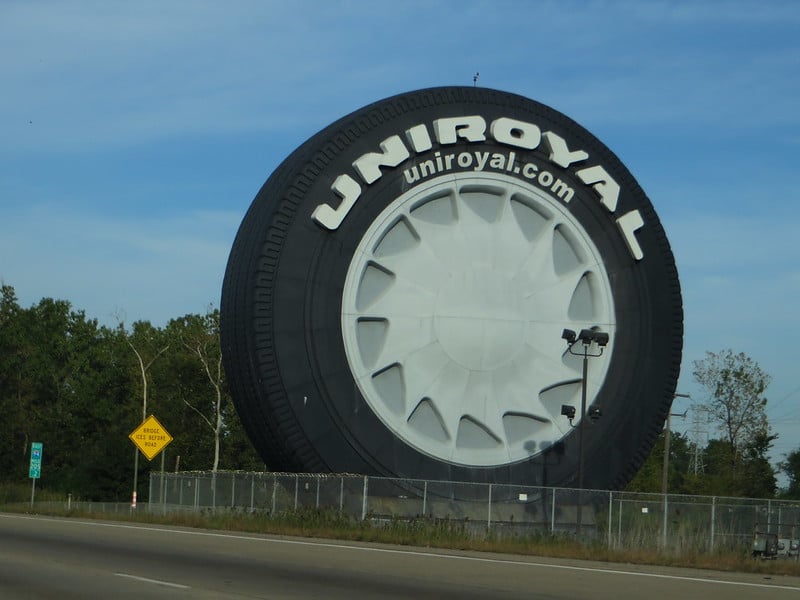
A massive tire stands along Interstate 94 near Detroit, Michigan. Detroit Uniroyal Tire created it as a Ferris wheel for the 1964 New York World’s Fair, where it carried two million riders.
After the fair, the company moved the 80-foot tire to Allen Park, Michigan, converting it into a static advertisement visible from the highway. The tire weathered for decades as Detroit’s automotive industry declined around it.
It became an icon of the region’s industrial heritage. In 1998, Uniroyal added a fiberglass tree, changing the display seasonally with lights during holidays.
The tire endures as a reminder of Detroit’s glory days and the strange afterlives objects can have.
Wall Drug
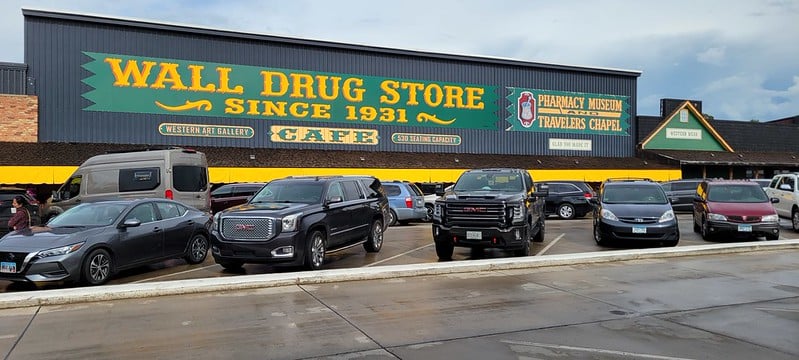
A drugstore in Wall, South Dakota transformed into a sprawling tourist complex through brilliant marketing. In 1931, during the Depression, Ted and Dorothy Hustead bought the struggling pharmacy.
Dorothy suggested offering free ice water to travelers. They put up signs along the highway, and it worked.
Visitors poured in. The Husteads expanded relentlessly, adding restaurants, Western-themed shops, and attractions.
Wall Drug signs now appear around the world, from Antarctica to war zones, placed by travelers and soldiers. The complex covers an entire city block.
What started as a simple drugstore is now firmly embedded in American road trip mythology.
The Roads That Led Here

These places have more than oddity in common. Yet they stand unapologetic.
No one asked for a giant round of yarn this heavy – or vehicles stuck underground – but folks made ’em either way. Still, that defiance, sticking to a silly idea no matter what, clicks with people tired of seeing the same highway food and roadside signs.
The web didn’t wipe out roadside oddities. In fact, platforms like Instagram actually revived them.
Folks now travel miles just to see things that feel real – yes, even if they’re totally tacky. That oversized rubber tire or the fake Stonehenge made of foam?
They mean something – not ’cause they’re perfect, but ’cause someone built ‘em, fixed ‘em up, kept power running through cold nights. These spots claim space, shout individuality, and prove road trips can still surprise you.
The real issue isn’t if these spots deserve a visit. It’s more about if you’ll go off route just to see for yourself.
More from Go2Tutors!

- The Romanov Crown Jewels and Their Tragic Fate
- 13 Historical Mysteries That Science Still Can’t Solve
- Famous Hoaxes That Fooled the World for Years
- 15 Child Stars with Tragic Adult Lives
- 16 Famous Jewelry Pieces in History
Like Go2Tutors’s content? Follow us on MSN.



