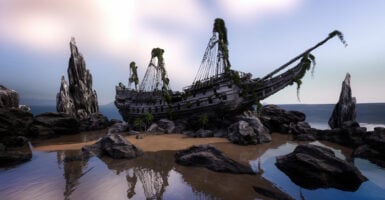
Weather Events That Saved Cities
Some of history’s most dramatic turning points came not from brilliant generals or superior armies, but from the sky itself. Storms have scattered invasion fleets.
Fog has concealed desperate retreats. Rain has mired artillery in mud at exactly the wrong moment.
These weather events didn’t just change battles. They changed the fate of nations.
The Divine Wind That Stopped the Mongol Empire

In the 13th century, Kublai Khan ruled the largest empire the world had ever seen. His grandfather Genghis Khan had conquered most of Asia, and now Kublai had his sights set on Japan.
The island nation seemed an easy target. What happened instead became legend.
In 1274, a Mongol fleet of 500 to 900 ships carrying 30,000 to 40,000 soldiers descended on Japan. They captured the outlying islands and pushed inland from Hakata Bay.
The samurai defenders fought fiercely but were outnumbered and outmatched. Then, as the Mongol forces withdrew to their ships for the night, a typhoon struck.
Around 13,000 soldiers did not return, and roughly a third of the fleet sank. The invasion collapsed.
The Mongols returned seven years later with an even larger force. This second armada in 1281 was staggering in scale: roughly 4,400 ships and as many as 140,000 men.
It was one of the largest naval invasion forces in history until the D-Day landings of 1944. Once again, after weeks of fighting and as the Mongols prepared their final assault, a massive typhoon struck on August 15.
The destruction was catastrophic. At least half the soldiers perished, and all but a few hundred ships were destroyed.
The Japanese called these storms kamikaze, meaning “divine wind.” They believed the gods had intervened to protect their nation.
Modern geological research has found evidence of these storms in lake sediments near the invasion sites. The typhoons that stopped the Mongol Empire were real, and they likely saved Japan from conquest.
The Storm That Saved Washington

On August 24, 1814, British troops marched into Washington, D.C., and set the young nation’s capital ablaze. The White House, the Capitol, and the Treasury all went up in flames.
President Madison had fled. The Library of Congress burned to ashes.
The American experiment seemed to be ending in smoke. The fires burned through the night and continued into the scorching August morning.
Temperatures hovered around 100 degrees. Then, around 2 PM on August 25, the sky darkened.
A severe thunderstorm rolled into the city, and with it came something even more terrifying: a tornado. British soldier George Robert Gleig described winds so powerful that roofs were torn off buildings and whirled into the air like sheets of paper.
Two cannons were lifted and thrown several yards, killing soldiers in their path. The downpour that accompanied the storm was so intense that Gleig compared it to a waterfall.
The torrential rain extinguished the fires that threatened to destroy what remained of the city. The storm killed more British soldiers than American guns had during the battle.
When a British officer asked a local woman if such weather was common, she reportedly replied that it was divine intervention to drive out their enemies. The officer suggested it might instead be heaven helping the British destroy the city.
Either way, the chaos allowed the British to cover their retreat that night. Their occupation of Washington had lasted just 26 hours.
Tornadoes are rare in Washington, D.C. Fewer than a dozen have been recorded since 1814, and some historians debate whether the 1814 storm was a true tornado or a severe thunderstorm with tornado-like winds.
Whatever its exact nature, the violent weather arrived at exactly the moment the capital needed salvation.
The Fog That Saved the Revolution

The Battle of Long Island in August 1776 should have ended the American Revolution. George Washington’s Continental Army had been routed.
Trapped on Brooklyn Heights with the East River at their backs, 9,000 American soldiers faced a British force of over 20,000. General William Howe began digging trenches for a siege, preparing to crush the rebellion once and for all.
Washington knew his army would be destroyed or captured if they stayed. He ordered a nighttime evacuation across the East River to Manhattan.
It was a desperate gamble. The British fleet controlled the surrounding waters.
Any movement of troops at dawn would be spotted immediately and cut to pieces. Working through darkness and rain, oarsmen ferried soldiers across the river in small boats.
But the operation moved too slowly. As the sun rose on August 30, thousands of troops remained on the Brooklyn shore.
Washington himself had not yet crossed. Discovery seemed inevitable.
Then fog rolled in. A dense blanket of mist settled over the river and both encampments.
One soldier recalled that he could barely see a man six yards away. Under this cover, the remaining troops slipped away.
Washington boarded the last boat as British patrols finally realized something was wrong. By 7 AM, all 9,000 soldiers had reached Manhattan without a single casualty.
The Continental Army survived to fight another day. Without that fog, the revolution might have died in Brooklyn Heights.
England’s Protestant Wind

When the Spanish Armada sailed from Lisbon in May 1588, it was the largest naval force Europe had ever assembled. King Philip II of Spain had gathered 130 ships, 8,000 sailors, and nearly 20,000 soldiers to invade Protestant England and restore Catholic rule.
The “Invincible Armada” seemed unstoppable. The English fleet, faster and more maneuverable, harassed the Spanish through the English Channel but could not break their defensive crescent formation.
On August 8, the English sent fire ships into the Spanish fleet anchored off Calais, forcing them to scatter. The next morning, the Battle of Gravelines saw English cannons devastate the disorganized Armada.
But the decisive blow came from the weather. With their formation broken and supplies running low, the Spanish had no choice but to flee north, around Scotland and Ireland, to reach home.
The late sixteenth century featured unusually severe North Atlantic storms, and the retreating Armada sailed directly into them. Gales drove ships onto the rocky coasts of Scotland and Ireland.
Vessels broke apart in the mountainous seas. About 5,000 sailors and soldiers died from drowning, starvation, and exposure.
Some survivors who made it to shore were killed by locals or by English soldiers. Of the roughly 130 ships that had left Spain, only about 60 to 67 returned.
As many as 15,000 men perished during the campaign, most of them from storms and disease rather than English guns. The English struck commemorative medals reading “God blew, and they were scattered.”
They called it the “Protestant Wind.” For England, it was nothing short of salvation.
The Rain Before Waterloo

On the night of June 17, 1815, a torrential storm soaked the fields around Waterloo, Belgium. Napoleon Bonaparte, returned from exile and commanding the French army, planned to crush the Duke of Wellington’s forces the next morning.
The storm would change everything. Napoleon relied heavily on his artillery.
His cannons had won victories across Europe, smashing enemy formations before his infantry and cavalry finished the job. But the rain-soaked ground at Waterloo presented a serious problem.
Artillery shot was designed to bounce along the ground, scything through ranks of soldiers. In mud, it simply buried itself harmlessly in the earth.
Napoleon’s artillery commanders insisted he delay the attack until the ground dried enough for the guns to maneuver and the shot to ricochet properly. The Emperor, unaware that the Prussian army was already marching to reinforce Wellington, agreed to wait until around 11 AM.
Those lost hours proved fatal. The Prussians arrived in the late afternoon, catching the French army between two forces.
Napoleon’s final assault by the Imperial Guard failed. By nightfall, the French were in full retreat.
The man who had dominated Europe for a decade was finished. Modern analysis suggests the rain may have been caused by the eruption of Mount Tambora in Indonesia two months earlier.
Volcanic ash disrupted weather patterns across the globe. If so, a volcano thousands of miles away helped end Napoleon’s empire.
The Calm Seas of Dunkirk

In late May 1940, the British Expeditionary Force was trapped. German forces had swept through France, pushing 400,000 Allied soldiers against the English Channel at Dunkirk.
The British government hoped to rescue perhaps 45,000 men before the Germans crushed the remaining forces. The situation seemed hopeless.
What followed was called a miracle. Between May 26 and June 4, the English Channel remained largely calm for the nine days of Operation Dynamo.
This was critical because the beaches at Dunkirk slope gradually into the sea. Large naval vessels could not approach within a mile of the shore.
Soldiers had to be ferried out to waiting ships in small boats: fishing vessels, pleasure yachts, lifeboats, and civilian craft of all kinds. Rough seas would have capsized these little ships.
Heavy waves would have made the slow process of loading exhausted soldiers impossible. Though conditions varied day to day, the Channel stayed calm enough during most of the operation.
Over 338,000 Allied soldiers were rescued, far exceeding the initial expectation of 45,000. The weather cooperated in another way as well.
Thick clouds on several days limited the effectiveness of German air attacks. The Luftwaffe struggled to locate and strike the evacuation fleet.
On days when the skies cleared, like June 1, the bombing was devastating. But bad weather on other days, particularly May 30, gave the rescue operation crucial protection.
Winston Churchill called the evacuation a “miracle of deliverance.” He cautioned that wars are not won by evacuations.
But without the calm seas and protective clouds, Britain would have lost its trained army, and the war might have taken a very different course.
The Weather Window That Made D-Day Possible

By June 1944, the largest invasion force in history waited in southern England. Over 160,000 Allied troops, 6,500 ships, and thousands of aircraft prepared to storm the beaches of Normandy.
General Dwight Eisenhower had set June 5 as D-Day. Everything depended on the weather.
The invasion required a full moon for paratroopers and pilots to see their targets. It required a low tide at dawn to expose German beach obstacles.
It required clear skies for air support and calm seas for the landing craft. Only a few days each month met these conditions.
If the June 5-7 window was missed, the next opportunity would not come for two weeks. On June 3, weather observations from western Ireland showed a storm approaching.
American meteorologists believed it would pass harmlessly. British forecasters disagreed.
Group Captain James Stagg, the chief meteorological officer, convinced Eisenhower to postpone the invasion by one day. June 5 brought terrible weather: gale-force winds, heavy rain, high seas.
An invasion that day would have been a disaster. But Stagg had spotted something in the data.
A brief break in the weather would occur on June 6. It would not be perfect, but it would be enough.
Eisenhower gave the order to go. The Germans, meanwhile, believed their own forecasters who predicted bad weather would continue for two weeks.
German commanders left their posts. Soldiers received passes.
Field Marshal Rommel returned to Germany for his wife’s birthday. The invasion caught the Germans by surprise.
Weeks later, Stagg noted that if the invasion had been delayed until the next suitable tides in mid-June, the troops would have encountered the worst Channel weather in forty years. Eisenhower wrote across Stagg’s memo: “I thank the Gods of War we went when we did.”
The Typhoons of Tactical Surprise

Weather has repeatedly determined who knew what and when during crucial military moments. The German attack that began the Battle of the Bulge in December 1944 succeeded in part because bad weather grounded Allied reconnaissance aircraft.
For days, German forces advanced without being spotted from above. Then the weather cleared.
Allied aircraft returned to the skies, identified German positions, and helped stop the offensive. The battle became a turning point, but the initial surprise came from clouds and fog that blinded Allied eyes.
Similar stories appear throughout military history. The attack on Pearl Harbor on December 7, 1941, came under clear Hawaiian skies that Japanese pilots needed for accurate bombing.
The Tet Offensive in Vietnam in 1968 coincided with the monsoon season, which limited American air power. Weather does not just affect the ability to fight.
It affects the ability to see.
Moscow’s Frozen Defenders

The Russian winter has destroyed multiple invasion armies. Charles XII of Sweden lost two-thirds of his troops to cold and starvation during the Great Northern War of 1708-1709.
It was one of the coldest winters in recorded European history. Napoleon suffered even worse losses in 1812 when his Grande Armée of 610,000 men invaded Russia.
Fewer than 100,000 returned. The pattern repeated in World War II.
German forces drove deep into Soviet territory in 1941, reaching the outskirts of Moscow by December. Then winter struck with full force.
German tanks and vehicles froze. Soldiers lacked proper winter clothing.
The advance stalled, and the Soviets counterattacked. Moscow did not fall.
The brutal Russian winter bought time for the Soviet Union to rebuild its forces and eventually push the Germans back. The city’s survival shaped the entire Eastern Front.
The Storm Windows of History

Not every weather event saves the right side or changes history for the better. The hurricanes that struck the Caribbean in 1780 killed over 20,000 people and devastated colonial economies.
The dust storms of the 1930s drove millions from their homes across the American Great Plains. Weather is indifferent to human hopes.
But the pattern persists. At critical moments, storms and fog and rain and clear skies have appeared at exactly the right time to alter the balance of power.
The city that should have fallen survived. The army that should have been destroyed escaped.
The invasion that should have succeeded failed. Maybe it is a coincidence.
Maybe the laws of probability guarantee that weather will occasionally intervene at crucial moments. Or maybe there is something more at work: the accumulated effect of terrain and timing and the chaotic nature of atmospheric systems.
Living at Weather’s Mercy

Modern forecasting has reduced some of these uncertainties. Satellites track storms across oceans.
Computer models predict weather days in advance. Military planners can schedule operations around atmospheric conditions with far greater precision than General Eisenhower ever could.
But the weather still surprises. Hurricanes change course unexpectedly.
Sudden fog grounds aircraft. Unseasonable storms disrupt the best-laid plans.
For all the technological advances, armies and navies and cities remain vulnerable to forces they cannot control. The lesson of these weather events is humility.
The greatest powers in the world have seen their ambitions thwarted by rain and wind and fog. Empires have risen and fallen based on atmospheric conditions that no human could command.
When the Sky Decides

The kamikaze winds that stopped the Mongols. The tornado that drove the British from Washington.
The fog that saved Washington’s army. The storms that scattered the Spanish Armada.
The rain that delayed Napoleon. The calm seas of Dunkirk.
The weather window of D-Day. These are not just military curiosities.
They are reminders that history is not written solely by human hands. The weather does not care about strategy or politics or who deserves to win.
It simply happens. And sometimes, when it happens at exactly the right moment, it changes everything.
Every city you know today exists in part because of weather events that allowed it to survive. Somewhere in its history, a storm came or did not come, and that made all the difference.
The sky has saved more cities than any army ever built.
More from Go2Tutors!

- The Romanov Crown Jewels and Their Tragic Fate
- 13 Historical Mysteries That Science Still Can’t Solve
- Famous Hoaxes That Fooled the World for Years
- 15 Child Stars with Tragic Adult Lives
- 16 Famous Jewelry Pieces in History
Like Go2Tutors’s content? Follow us on MSN.