Evolution of the Luxury Travel Trunk Design
Before suitcases with wheels became the norm, before carry-on regulations dictated what you could bring aboard, there was the trunk. Not just any trunk, though.
We’re talking about those magnificent pieces of craftsmanship that wealthy travelers hauled across continents, each one a statement of status as much as a vessel for belongings. The story of how these containers evolved tells us as much about changing transportation as it does about shifting ideas of luxury itself.
Here’s how these pieces transformed from basic wooden boxes into some of the most coveted artifacts of travel history:
Medieval Beginnings

Travel trunks existed long before anyone called them luxury goods. During the Medieval Period, when journeys meant weeks or months on rutted roads, people needed something sturdy enough to survive the trip.
These early versions were straightforward wooden chests, usually oak, reinforced with iron hardware and topped with rounded lids. The curved top wasn’t a design flourish.
Water needed somewhere to run off when your luggage spent days strapped to the outside of a carriage, exposed to whatever weather decided to show up. Craftsmen carved intricate designs into the wood and added forged ironwork, though function always won out over form.
Heavy, ungainly things. But they did the job.
The Flat-Top Revolution

Everything changed in 1858 when a young Parisian trunk maker named Louis Vuitton introduced something radical. His flat-topped trunk, covered in grey Trianon canvas, solved a problem nobody realized was so annoying until someone fixed it.
Rounded tops meant trunks couldn’t stack. Try loading a ship or train car with hundreds of pieces of curved luggage and you’ll understand why porters probably curse every day at work.
Vuitton’s design was lightweight, waterproof, and stackable. The innovation seems obvious now, but at the time, people thought he was mad to abandon the water-shedding curve.
His water-tight construction made the flat top possible, and suddenly everyone wanted one. The French nobility took notice first, then the rest of Europe’s traveling class followed.
Canvas and Leather Take Over
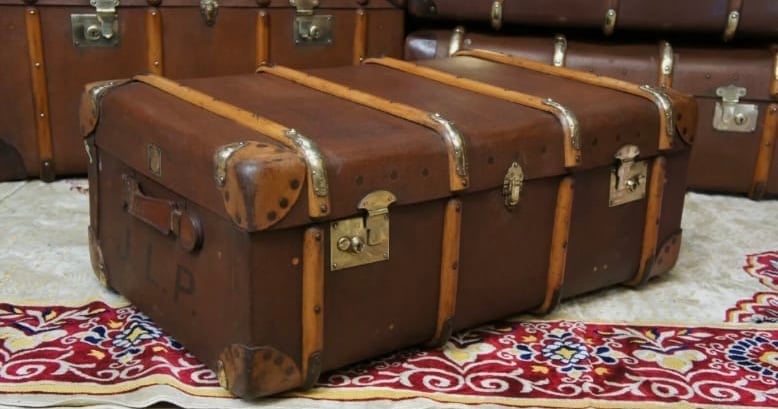
Early trunks wore their wooden bones on the outside, maybe wrapped in studded hide if you had money. As trunk making became an industry rather than a craft, materials got more sophisticated.
Canvas emerged as the covering of choice because you could treat it to resist water and stains. Leather trim added durability at the corners and edges where trunks took the most abuse during loading and unloading.
By the 1870s, makers were experimenting with embossed tin, patterned papers, and various canvas treatments. Some trunks featured elaborate designs pressed into metal panels.
Others kept things simple with plain materials and minimal hardware. The spectrum ran from utilitarian to ostentatious, depending on what the owner wanted to project.
Brass hardware became standard on better pieces, not just for looks but because it resisted rust better than iron.
The Monogram Makes Its Mark

George Vuitton had a problem. His father’s trunks were so popular that competitors started copying them, right down to the grey canvas.
In 1896, Georges introduced the interlocking LV monogram pattern that’s still everywhere today. The design combined his father’s initials with graphic flowers and quatrefoils borrowed from Oriental design trends of the Victorian era.
Other makers had used simple stripes or checks, but the Vuitton monogram was something else entirely. Ornate enough to look expensive, distinctive enough that copies were obvious fakes.
The pattern turned the trunk’s exterior into a billboard advertising exactly who made it and, by extension, how much the owner could afford to spend. Goyard had their chevron pattern.
Louis Vuitton had the monogram. Both became calling cards for their respective houses.
Steamer Trunks and Ship Regulations

When steamship companies started imposing luggage regulations in the late 1870s, trunk makers had to adapt. The new rules were specific about dimensions—anything stored in your cabin couldn’t exceed 14 inches in height.
Thus the steamer trunk was born, a low-profile design that fit under berths on ships. These flat-tops were covered in canvas or leather, featured brass hardware, and opened to reveal carefully organized compartments.
Hat boxes, document holders, shirt compartments, sometimes even secret storage areas. A well-designed steamer trunk was like a portable dresser, everything in its place and easy to access.
The wealthy traveled with multiple pieces. One trunk for the cabin, several more for the cargo hold.
Baggage handlers developed strong opinions about which manufacturers built trunks that survived the journey.
Wardrobe Trunks Arrive

Standing a wardrobe trunk on its end and opening it was like revealing a closet. One side had drawers, the other side had space for hanging clothes.
The better models included mirrors, makeup compartments, shoe storage, removable briefcases, and even privacy curtains. These weren’t meant to be portable in any real sense.
Wardrobe trunks were massive, heavy, designed for extended stays where ship or train travel meant you’d have help with your luggage. Companies like Hartmann, Oshkosh, and Wheary in Wisconsin dominated the American market for these elaborate pieces.
The 1910s through the 1940s were the golden age for wardrobe trunks. Patents piled up as makers competed to cram more functionality into each design.
Some resembled phone booths when opened. More patents were issued for wardrobe trunk innovations than for any other trunk style, which tells you how competitive the market got.
Saratoga Style

Named after the wealthy vacation spot in New York, Saratoga trunks represented the peak of luxury trunk design before the 1880s. These were the pieces wealthy travelers commissioned to show off.
Large, dome-topped, covered in leather or decorative canvas, and absolutely loaded with fancy hardware and trim. The interiors featured complex compartment systems, multiple trays, and specialized storage for different items.
If you were traveling to Saratoga Springs for the season, you arrived with a Saratoga trunk because anything less suggested you couldn’t afford to be there. The name became somewhat generic over time, with makers applying it to various large, elaborate trunk designs.
Still, the original Saratogas were status symbols first and luggage second.
Hardware and Construction Details

Trunk hardware evolved from simple iron fittings to elaborate brass assemblies. Locks became more sophisticated, with manufacturers like Corbin developing systems that were genuinely difficult to pick.
Leather straps and handles had to be thick enough to support the trunk’s weight when loaded. Corner protectors, edge guards, and reinforcement plates kept the structure from falling apart after years of rough handling.
Inside, paper linings often bore the manufacturer’s label and sometimes pencil marks from the craftsmen who built the piece. Makers used everything from pine to poplar for the wooden frame, then covered it with their chosen exterior material.
The construction process was labor-intensive. One trunk could require hundreds of brass rivets, each individually set. Leather pieces needed cutting, dyeing, tooling, and stitching.
The better makers employed specialists for each step, essentially assembly lines for luxury goods.
Jenny Lind and Barrel-Top Designs

Some trunk styles barely lasted a generation before falling out of fashion. The Jenny Lind trunk, named after the Swedish singer who toured America in the 1850s, had a distinctive hourglass shape when viewed from the side.
Leather covering, iron or brass bands, and large brass studs for decoration. Makers all over America copied the design after seeing her London-made trunks.
Barrel-top trunks, also called camelback trunks, featured horizontal slats instead of vertical ones, giving them a distinctive rounded appearance. Popular from the late 1870s through the mid-1880s.
Then they largely disappeared as flat-tops took over. The barrel construction made them harder to stack, which was exactly the problem Vuitton had solved. Fashion moved on.
Railroad and Automobile Influence

Trains made trunk travel mainstream, but automobiles changed what people wanted from their luggage. Suddenly storage space was at a premium.
Cars didn’t have cargo holds like ships or dedicated baggage cars like trains. Trunks needed to fit in smaller spaces, which meant downsizing.
French carmaker Bugatti commissioned Goyard to create custom trunks that fit precisely into the Bugatti Type 46, with the chassis number displayed on each case. The trunks were shaped to match the car’s curves.
Other luxury automakers followed suit, offering bespoke luggage as part of the package. Even so, the writing was on the wall.
Massive wardrobe trunks made less sense when you were driving yourself somewhere instead of having porters handle everything.
The Airplane Problem

Commercial air travel basically killed the traditional trunk industry. Weight restrictions and space limitations meant those elaborate wardrobe pieces and heavy steamer trunks were impractical.
Airlines charged by weight. Passengers had to carry their own bags more often. The 1940s saw trunk manufacturers pivoting to lighter suitcases made from new materials.
Canvas replaced leather. Metal frames replaced wood.
Wheels appeared. After World War II, leather was heavily taxed in Britain as a luxury material, pushing makers toward more affordable options.
The golden age ended not with a dramatic finale but with a slow fade as practicality won out over style. By the 1960s, vintage trunks were already becoming collectibles rather than functional luggage.
The shift happened faster than anyone expected.
Modern Bespoke Revival

Luxury trunk making never quite died. Louis Vuitton still operates their Asnières workshop, creating custom pieces using techniques from the 19th century.
Goyard maintains its strict no-e-commerce policy, requiring clients to visit boutiques to commission work. Smaller operations like Method Studio in the UK and Royal Trunk in Italy have carved out niches making contemporary trunks for brands and wealthy individuals.
These modern versions blend traditional materials with current needs. A Bentley Mulliner trunk might feature the automaker’s signature diamond quilting pattern engraved into steel doors, wrapped in bull leather with custom hardware.
Method Studio has created trunks housing industrial machinery, presentation equipment, and rare whisky collections. The trunks serve as both functional storage and elaborate marketing tools.
Prices for new bespoke pieces start around $10,000 and climb quickly depending on complexity. Vintage Louis Vuitton trunks in good condition regularly sell for $20,000 to $50,000, sometimes more for rare models.
Hardware Innovation and Specialization

As trunk design matured, makers developed increasingly specialized internal configurations. Hat trunks from the 1860s-1890s were square boxes designed to hold up to six hats or bonnets without crushing them.
Wall trunks, made for theatrical performers and others living in tight quarters, opened from the side and could sit flush against a wall. The lid became a side panel, requiring no extra floor space.
Monitor-top trunks from the late 1870s through the 1910s had rounded front and rear corners forming a lying-down D shape. Early versions featured labor-intensive curved hardwood slats.
Patent dates stamped on locks and latches help collectors date unmarked pieces, though not all hardware carried dates if the pieces were too small. Cross-slat trunk designs, where slats ran from front to back instead of side to side, were patented in 1880 and became extremely popular.
So popular, in fact, that the design was called the “New Design” at the time.
From Storage to Statement

What made a trunk luxurious changed over time. Early on, luxury meant durability and quality construction.
By the Victorian era, luxury meant elaborate compartments and expensive materials. The Edwardian period added personalization, with custom monograms and family crests.
Today’s luxury trunks often skip the functional aspect entirely. They’re furniture pieces, conversation starters, investments.
Collectors pay premium prices for trunks with original labels, complete interior fittings, and minimal damage. Restoration can be controversial. Some purists want every scratch and stain preserved as patina.
Others strip trunks down and refinish them completely. The market supports both approaches, though the original condition usually commands higher prices from serious collectors.
Where Craftsmanship Landed

The luxury travel trunk started as a solution to a practical problem and evolved into a canvas for showing off wealth, taste, and status. From medieval oak chests designed to survive rough roads, through Vuitton’s stackable innovation, to the elaborate wardrobe systems of the early 20th century, each design shift reflected changes in how people traveled and what they valued.
The airplane effectively ended the trunk’s reign as essential luggage, but the form survived as something else entirely. Modern makers keep the tradition alive not because anyone needs a trunk for travel, but because the craftsmanship itself became the point.
Those hours of hand-tooling leather, setting hundreds of brass rivets, carving wooden inlays represent a kind of making that’s increasingly rare. Whether displayed as furniture or still used for their original purpose, luxury trunks remain reminders of when traveling meant something different, when the journey itself deserved as much attention as the destination.
More from Go2Tutors!

- The Romanov Crown Jewels and Their Tragic Fate
- 13 Historical Mysteries That Science Still Can’t Solve
- Famous Hoaxes That Fooled the World for Years
- 15 Child Stars with Tragic Adult Lives
- 16 Famous Jewelry Pieces in History
Like Go2Tutors’s content? Follow us on MSN.