Photos of 15 Classic Toys With Secret Design Twists
Classic toys appear to be simple. A brightly colored cube, a plastic brick, or a common board game token may appear to be simple enough to understand in a matter of seconds.
However, behind many of these popular toys is a surprising level of engineering and design. The problem for toy makers was always the same: how to make something fun, long-lasting, and replayable indefinitely.
And so, a range of toy designs was created that featured subtle but brilliant design ideas. Let’s take a closer look at fifteen classic toys whose design ideas helped make them iconic.
Rubik’s Cube

The Rubik’s Cube looks like a simple color puzzle, yet its internal mechanism is far more sophisticated than it appears. Invented in 1974 by Hungarian architect Ernő Rubik, the cube contains a hidden pivot system that allows rows to rotate smoothly without the entire structure falling apart.
The real design twist lies in the central core. Instead of individual cubes holding everything together, a concealed cross-shaped structure anchors the pieces while allowing them to move independently.
LEGO Bricks

LEGO bricks appear to be ordinary plastic blocks with studs on top. The secret to their success lies underneath, where hollow tubes create a precise clutch system that locks bricks together firmly while still allowing them to be pulled apart.
This design, patented in the 1950s, created the perfect balance between grip and flexibility. Children can build tall structures without them collapsing, yet the pieces remain easy to separate.
Barbie

Barbie dolls have evolved in countless ways since their introduction in 1959, yet the original design contained a subtle twist. The doll’s proportions were deliberately exaggerated so clothing would drape properly at a small scale.
Designers discovered that realistic proportions made tiny fabric garments look stiff and awkward. By adjusting the body shape slightly, they ensured that dresses and outfits moved naturally.
Etch A Sketch

Etch A Sketch introduced a magical drawing experience when it debuted in 1960. Turning the two knobs moves a stylus inside the screen, scraping aluminum powder from the glass to create lines.
The clever part is how the device erases drawings. Instead of wiping a surface, shaking the toy redistributes the powder evenly across the screen.
Hot Wheels Cars

Hot Wheels cars are famous for their speed on toy tracks. The secret behind that performance lies in their carefully engineered axles and low-friction wheels.
When the cars first appeared in 1968, designers experimented with thinner axles and smoother wheel surfaces than many competing toy vehicles used. The result was a car that could race dramatically faster on plastic tracks, transforming simple playsets into thrilling miniature racetracks.
Slinky
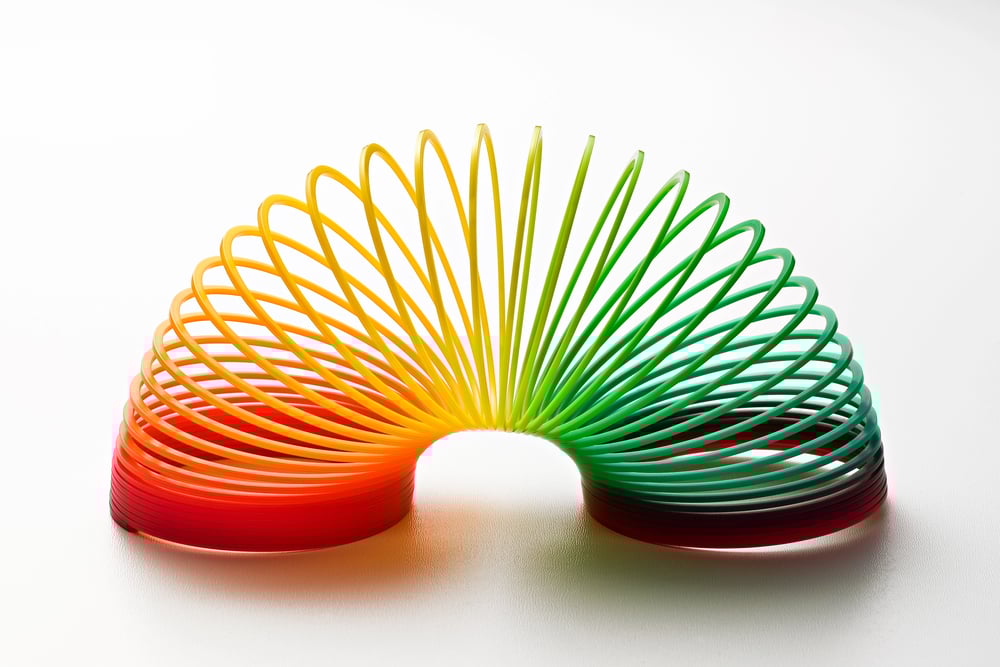
The Slinky looks like a simple metal spring, yet its behavior relies on carefully balanced physics. Created in the 1940s, the toy uses gravity and tension to create its signature motion when placed on stairs.
The coils are spaced and weighted just right so the spring stretches forward while the rear portion follows. This controlled transfer of motion produces the distinctive walking movement that has fascinated generations of children.
Mr. Potato Head

Mr. Potato Head introduced a playful idea when it first appeared in the early 1950s. The toy allows children to rearrange facial features on a potato-shaped body.
The design twist lies in the interchangeable pieces. Each part uses small connectors that fit securely while remaining easy to swap.
Play-Doh

Play-Doh’s bright colors and soft texture have delighted children since the 1950s. The compound itself was originally developed as a cleaning material for wallpaper before someone noticed its potential as a modeling substance.
The formula uses ingredients that maintain softness while resisting quick drying. That balance allows children to shape, flatten, and reshape creations repeatedly without the material becoming brittle.
View-Master

The View-Master introduced a unique way to experience images long before digital displays. The device uses circular reels filled with pairs of small photographs that create a three-dimensional illusion when viewed through the lenses.
The design works by showing slightly different images to each eye, mimicking how human vision perceives depth. This simple optical trick produces a convincing sense of distance and dimension inside a small handheld toy.
Nerf Blasters

Nerf toys became famous for launching soft foam projectiles safely across rooms and backyards. The internal mechanisms rely on springs or air pressure to propel the foam pieces forward.
The key design twist lies in the foam itself. The material is light enough to travel through the air while remaining soft enough to reduce the risk of injury.
Teddy Bears

Teddy bears might seem like the simplest toys imaginable, yet their construction involves subtle design choices. Early toy makers discovered that jointed arms and legs made the plush animals far more expressive.
The joints allow the bear to sit, wave, or hug in ways that fixed limbs cannot. This flexibility helped transform teddy bears from decorative items into companions that children could interact with during imaginative play.
Yo-Yo

The yo-yo is one of the oldest toys still widely played today. At first glance it appears to be little more than two discs connected by an axle with a string attached.
The clever detail is the ‘sleep’ function. When the string unwinds completely, the spinning motion keeps the toy rotating at the end of the string before returning to the hand.
Monopoly

Monopoly became one of the most famous board games in the world after its commercial release in the 1930s. The design twist lies in how the game gradually concentrates wealth among players.
As properties are purchased and rents increase, the board becomes more challenging for those with fewer resources. This escalating dynamic creates tension and strategic decision-making throughout the game.
Transformers

Transformers toys introduced a clever mechanical idea in the 1980s. Each figure can shift from a vehicle or device into a robot through a series of folding parts.
Designers carefully arranged hinges and panels so pieces could serve two purposes. Wheels might become shoulders, while vehicle panels form limbs.
Super Soaker

The Super Soaker changed water play when it appeared in the early 1990s. Unlike earlier water toys that relied on simple squeeze action, the Super Soaker used a pressurized air chamber.
Pumping the toy forces air into a sealed space, building pressure that pushes water out in a powerful stream when the trigger is pulled. This design allowed the toy to shoot water much farther than earlier designs.
Why Clever Toy Design Still Matters

Classic toys remain popular because their design ideas are surprisingly timeless. A good toy design strikes a balance between creativity, durability, and challenge, which is often achieved by applying simple mechanical design principles after thorough experimentation.
In the modern world, where there is so much digital entertainment, these designs continue to capture the imagination of children. The surprises within these designs show how engineering can create simple objects that become iconic over time.
More from Go2Tutors!

- The Romanov Crown Jewels and Their Tragic Fate
- 13 Historical Mysteries That Science Still Can’t Solve
- Famous Hoaxes That Fooled the World for Years
- 15 Child Stars with Tragic Adult Lives
- 16 Famous Jewelry Pieces in History
Like Go2Tutors’s content? Follow us on MSN.