The Greatest Buried Treasure Never Recovered
There’s something irresistible about buried treasure. Maybe it’s the Indiana Jones factor, or maybe we’re all just drawn to the idea that massive wealth could be sitting under our feet right now, waiting.
Whatever the reason, humans have spent centuries—and fortunes—searching for lost riches that may or may not actually exist. The thing is, some of these treasures are definitely real.
We have documentation, eyewitness accounts, historical records. Others? They’re probably folklore mixed with wishful thinking and a healthy dose of scam artistry.
Here’s a look at some of the most famous ones that nobody’s managed to dig up yet.
The Oak Island Money Pit

This one’s in Nova Scotia, and people have been obsessing over it since 1795. The story goes that a teenager named Daniel McGinnis found a depression in the ground and started digging, convinced he’d found pirate treasure.
What he actually found was a nightmare of booby traps, flooding tunnels, and mystery after mystery that has now consumed over 200 years of searching. The pit itself seems almost engineered to frustrate treasure hunters.
Every time someone digs down (and we’re talking depths of over 100 feet now), seawater floods in through elaborate channels. Various expeditions have reported finding wooden platforms, coconut fiber, bits of parchment, and other tantalizing hints.
The History Channel made a whole series about it, which should tell you something about either the treasure’s legitimacy or our collective willingness to watch people dig pits for entertainment. Theories about what’s down there range from Captain Kidd’s treasure to Marie Antoinette’s jewels to the Holy Grail to absolutely nothing.
At this point, more money has been spent searching for the treasure than any treasure could possibly be worth (unless it’s the Ark of the Covenant down there, which, let’s be honest, it’s not).
Forrest Fenn’s Treasure

Forrest Fenn was an art dealer and author who claimed he hid a bronze chest filled with gold, jewels, and artifacts worth over a million dollars somewhere in the Rocky Mountains. He published a poem in 2010 with clues to its location, and thousands of people spent the next decade searching for it. Some died trying.
In 2020, someone allegedly found it. Fenn confirmed the discovery but was maddeningly vague about the details—where it was, who found it, what exactly was in it.
Then Fenn died a few months later, and the finder remained anonymous for a while before eventually revealing himself as a medical student from Michigan. The whole thing feels slightly anticlimactic and suspicious in equal measure, but apparently it’s been verified.
So technically this one doesn’t belong on this list anymore, but it’s too culturally significant to leave out.
The Amber Room

Now this is genuinely one of the greatest art heists in history. The Amber Room was an entire chamber decorated with amber panels backed with gold leaf and mirrors, originally constructed in Prussia in the early 1700s and later given to Peter the Great of Russia.
It was installed in the Catherine Palace near St. Petersburg and became known as the “Eighth Wonder of the World.” Then the Nazis invaded during World War II.
They disassembled the entire room—six tons of amber—and shipped it to Königsberg Castle in what’s now Kaliningrad, Russia. The room was displayed there until 1944, when Allied bombing forced its evacuation. And then… nothing.
It disappeared completely. The theories are endless.
It was destroyed in the bombing. It’s hidden in a bunker somewhere. It was loaded onto a ship that sank.
It’s buried in an underground tunnel system. Multiple people have claimed to know where it is, expeditions have searched based on deathbed confessions, but nobody’s found it.
Russia built a reconstruction in 2003, which is beautiful but not the same thing at all.
Treasure of Lima

This one’s got everything: Spanish conquistadors, a corrupt sea captain, murder, and a deserted island in the Pacific. In 1820, Lima, Peru was on the verge of revolution, and the Spanish government needed to evacuate massive wealth—gold, silver, jewels, religious artifacts, all of it.
They loaded it onto a ship called the Mary Dear (some sources say Dear Mary, because apparently historical records couldn’t be bothered with consistency). The captain, William Thompson, was supposed to transport this fortune to Mexico.
Instead, he and his crew murdered the Spanish guards and soldiers, threw the bodies overboard, and sailed to Cocos Island off Costa Rica to bury everything. The plan was to hide out, let things cool down, then come back for the loot.
They got caught. The crew was executed, but Thompson and his first mate saved themselves by offering to lead the Spanish to the treasure.
They took them to Cocos Island, then escaped into the jungle and were never seen again. Since then, over 300 expeditions have searched the island.
Nobody’s found the treasure, though plenty of people have gone bankrupt or insane trying (which is kind of on-brand for treasure hunting).
Flor de la Mar
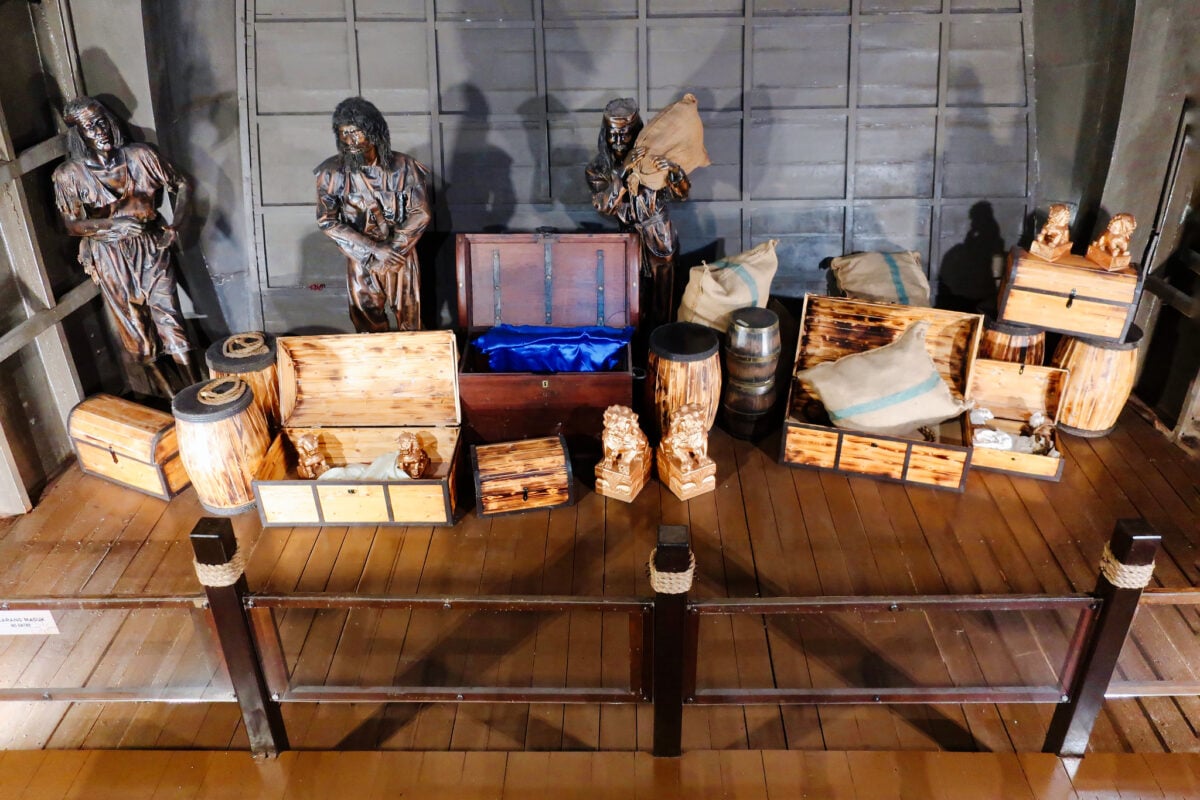
The Flor de la Mar was a Portuguese carrack that sank in 1511 during a storm in the Strait of Malacca. On board was an absolutely staggering amount of treasure that the Portuguese had just looted from the conquered Sultanate of Malacca—gold, diamonds, rubies, the personal treasure of the Sultan himself.
This is one of those treasures where the value is almost impossible to estimate because we’re talking about priceless historical artifacts, not just bullion. Some estimates put it at over $9 billion in today’s money, which seems both absurd and potentially conservative.
The problem is that nobody knows exactly where the ship went down. The Strait of Malacca is busy, murky, and has strong currents.
The wreck could be buried under meters of sediment by now. Indonesia and Malaysia both claim jurisdiction over wherever it is (once it’s found).
Multiple expeditions have searched, including ones with sonar equipment and underwater robots, but the Flor de la Mar remains lost.
Captain Kidd’s Treasure

William Kidd is one of history’s most famous pirates, except he probably wasn’t actually much of a pirate. He was a privateer (basically a legal pirate working for the government) who got accused of piracy, tried, and executed in London in 1701.
Before his arrest, he supposedly buried a massive treasure somewhere. The only problem is that Kidd buried treasure exactly once, on Gardiners Island off Long Island, and authorities recovered it before his trial.
It wasn’t that impressive. But legends don’t care about facts, so now Kidd’s “real” treasure is supposedly buried everywhere from Oak Island to the Caribbean to upstate New York to Vietnam (yes, really). The myth is more valuable than any actual treasure at this point. It’s the template for every pirate treasure story that came after.
Yamashita’s Gold

General Tomoyuki Yamashita was a Japanese commander during World War II, and according to legend, he hid massive amounts of treasure looted from across Southeast Asia in caves and tunnels in the Philippines before the Japanese surrender. Some estimates put the value at hundreds of billions of dollars.
Here’s the thing: there’s no credible historical evidence that this treasure exists. And yet, people keep looking. Ferdinand Marcos, the Philippine dictator, claimed to have found some of it in the 1970s, which is convenient because he needed an explanation for his sudden wealth that wasn’t “I’m stealing from my own country.”
His story involved hiring a locksmith who supposedly used psychic powers to locate the treasure, which should tell you everything. But the legend persists, and treasure hunters continue to dig up the Philippine countryside, occasionally getting trapped in cave-ins or arrested for illegal excavation.
It’s probably nothing, but what if it’s something?
Confederate Gold

At the end of the American Civil War, the Confederate treasury disappeared. We’re talking about potentially millions of dollars in gold, silver, and other valuables that were being evacuated from Richmond, Virginia as the Confederacy collapsed in 1865.
Some of it was definitely spent on payments and supplies during the retreat. Some were probably stolen by Confederate officials. But a persistent legend claims that a substantial portion was buried somewhere, with various locations proposed: somewhere in Georgia, or Virginia, or even as far as Texas.
Jefferson Davis was captured with some gold on him, which only fueled speculation about the rest. The problem with Confederate treasure stories is that the Confederacy was broken by 1865.
Most of their wealth was in now-worthless Confederate currency. The actual gold and silver reserves were substantial but not the Fort Knox-level hauls that legends describe.
Still, treasure hunters dig up Civil War sites constantly, convinced they’re about to strike it rich. Mostly they find rusty Minié orbs and depression.
The Lost Dutchman’s Gold Mine

This is less buried treasure and more a lost gold mine, but it’s too famous to exclude. Somewhere in the Superstition Mountains of Arizona, there’s supposedly a fantastically rich gold mine that a German immigrant (not Dutch—”Dutchman” is a corruption of “Deutsch”) named Jacob Waltz discovered in the 1870s.
On his deathbed in 1891, Waltz allegedly gave directions to the mine, though those directions were typically vague nineteenth-century nonsense like “from the nose of the rock, go three canyons to the west.” People have died searching for this mine.
A lot of people. The Superstition Mountains are hot, remote, and dangerous, full of abandoned mineshafts and sheer cliffs.
The area has such a sinister reputation that some treasure hunters won’t go there, convinced it’s cursed. Does the mine exist? Maybe. Arizona had plenty of gold, and German immigrants definitely prospected there.
But Jacob Waltz’s mine, if it existed, was probably just a decent claim that legend has transformed into El Dorado. Or it’s out there, waiting, full of gold, and I’m an idiot for being skeptical.
Treasure of the Knights Templar

The Knights Templar were a medieval Catholic military order that became incredibly wealthy and powerful before being abruptly suppressed in 1307. King Philip IV of France arrested hundreds of Templars, seized their assets, and eventually had the leadership burned at the stake for heresy (probably because he owed them money and this was cheaper than paying it back).
But according to legend, the Templars knew the arrests were coming and smuggled their massive treasure out of Paris. Where it went is anyone’s guess: Scotland, Portugal, America (centuries before Columbus), or buried beneath Rosslyn Chapel, depending on which conspiracy theory you prefer.
The Templar treasure is probably the most mythologized on this list. It’s been connected to the Holy Grail, the Ark of the Covenant, ancient religious texts, and basically every historical mystery you can think of.
The reality is that whatever wealth the Templars had was likely seized by various European monarchs or distributed among the order’s holdings across Europe. But that’s boring, so people prefer the version with secret tunnels and mystical artifacts.
Blackbeard’s Treasure

Edward Teach, better known as Blackbeard, was a legitimately terrifying pirate who operated off the American coast in the early 1700s. He died in a violent battle with the Royal Navy in 1718, and legends immediately sprang up about his buried treasure.
Here’s the thing: pirates didn’t really bury treasure. They spent it.
The whole point of piracy was to get rich and enjoy it, not to create elaborate savings accounts in the sand. Blackbeard was active for less than two years, and while he captured valuable ships, he also had a crew to pay and expenses to cover.
That said, Blackbeard supposedly told people he’d buried treasure “where none but Satan and I can find it,” which is excellent marketing for a treasure that probably doesn’t exist. People have searched all along the Carolina coast, and while they’ve found shipwrecks (including possibly Blackbeard’s flagship, the Queen Anne’s Revenge), they haven’t found treasure hoards.
The San Miguel

The San Miguel was part of the 1715 Spanish Treasure Fleet that was destroyed by a hurricane off the coast of Florida. The fleet was carrying massive amounts of gold, silver, and emeralds from the New World back to Spain, and most of it sank when eleven ships went down in the storm.
Treasure hunters have recovered millions of dollars worth of artifacts from the 1715 fleet over the years, but the San Miguel itself has never been found. It’s believed to have sunk further out to sea than the other vessels, and it was supposedly carrying a particularly valuable cargo.
Modern salvage companies continue to search for it, armed with magnetometers and ROVs and diving equipment that would make Jacques Cousteau weep with envy. The wreck is out there somewhere, gradually being buried under sand and deteriorating in the salt water, and whoever finds it will be extremely wealthy.
It’s one of the more plausible treasures on this list, which is why people keep looking.
Nazi Gold Trains

As World War II ended and the Soviet Army advanced into Poland, the Nazis allegedly loaded up trains with looted gold, art, and valuables and hid them in tunnels and abandoned mines around the city of Wałbrzych. The most famous story involves a train that entered a tunnel in 1945 and was never seen emerging.
In 2015, two guys claimed they’d found the train using ground-penetrating radar, sparking an international media frenzy. The Polish government got involved, treasure hunters descended on the area, and everyone was convinced this was it—finally, the Nazi gold.
Then they excavated the site and found absolutely nothing. The radar had shown natural geological formations, not trains.
But the legend won’t die. People are still searching, still analyzing wartime documents, still convinced that somewhere under Poland is a fortune in Nazi plunder. It makes for great television and terrible investment decisions.
What We’re Really Searching For

The truth is, most buried treasure is either found, spent, never existed in the first place, or isn’t nearly as valuable as the legends claim. And yet we keep looking, keep dreaming, keep digging pits in increasingly improbable locations.
Maybe that’s the real treasure—not the gold or jewels themselves, but the permission to believe in something extraordinary, to imagine that the world still has secrets worth discovering. Or maybe we’re all just suckers for a good story and the fantasy that we could be the one to finally solve the mystery that’s stumped everyone else.
Either way, people will keep searching, and the treasures will keep remaining lost, which is probably exactly how it should be. A found treasure is just money, but a lost treasure is an infinite possibility.
More from Go2Tutors!

- The Romanov Crown Jewels and Their Tragic Fate
- 13 Historical Mysteries That Science Still Can’t Solve
- Famous Hoaxes That Fooled the World for Years
- 15 Child Stars with Tragic Adult Lives
- 16 Famous Jewelry Pieces in History
Like Go2Tutors’s content? Follow us on MSN.